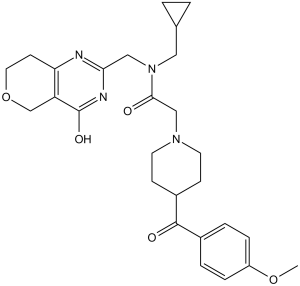
NVP-TNKS656 (also called TNKS-656; NVP-TNKS-656; TNKS 656; NVP-TNKS 656) is a selective, and orally bioactive tankyrase inhibitor with potential antitumor activity. It blocks tankyrase/TNKS2 with an IC50 of 6 nM, and shows > 300-fold selectivity against PARP1 and PARP2.
Physicochemical Properties
| Molecular Formula | C27H34N4O5 | |
| Molecular Weight | 494.58 | |
| Exact Mass | 494.253 | |
| Elemental Analysis | C, 65.57; H, 6.93; N, 11.33; O, 16.17 | |
| CAS # | 1419949-20-4 | |
| Related CAS # |
|
|
| PubChem CID | 136237316 | |
| Appearance | White to light yellow solid powder | |
| LogP | 2.122 | |
| Hydrogen Bond Donor Count | 1 | |
| Hydrogen Bond Acceptor Count | 7 | |
| Rotatable Bond Count | 9 | |
| Heavy Atom Count | 36 | |
| Complexity | 911 | |
| Defined Atom Stereocenter Count | 0 | |
| SMILES | O=C(C([H])([H])N1C([H])([H])C([H])([H])C([H])(C(C2C([H])=C([H])C(=C([H])C=2[H])OC([H])([H])[H])=O)C([H])([H])C1([H])[H])N(C([H])([H])C1=NC2C([H])([H])C([H])([H])OC([H])([H])C=2C(N1[H])=O)C([H])([H])C1([H])C([H])([H])C1([H])[H] |
|
| InChi Key | DYGBNAYFDZEYBA-UHFFFAOYSA-N | |
| InChi Code | InChI=1S/C27H34N4O5/c1-35-21-6-4-19(5-7-21)26(33)20-8-11-30(12-9-20)16-25(32)31(14-18-2-3-18)15-24-28-23-10-13-36-17-22(23)27(34)29-24/h4-7,18,20H,2-3,8-17H2,1H3,(H,28,29,34) | |
| Chemical Name | N-(cyclopropylmethyl)-2-[4-(4-methoxybenzoyl)piperidin-1-yl]-N-[(4-oxo-3,5,7,8-tetrahydropyrano[4,3-d]pyrimidin-2-yl)methyl]acetamide | |
| Synonyms |
|
|
| HS Tariff Code | 2934.99.9001 | |
| Storage |
Powder-20°C 3 years 4°C 2 years In solvent -80°C 6 months -20°C 1 month |
|
| Shipping Condition | Room temperature (This product is stable at ambient temperature for a few days during ordinary shipping and time spent in Customs) |
Biological Activity
| Targets | TNKS2 ( IC50 = 6 nM ); PARP2 ( IC50 = 32 μM ) | |
| ln Vitro |
|
|
| ln Vivo |
|
|
| Enzyme Assay | Nicotinamide is detected by quantitative liquid chromatography/mass spectrometry (LC-MS), which is used to track PARP catalytic activity. 384-well Greiner flat-bottom plates are used for the autoPARsylation reactions, which are carried out at room temperature. The final reaction mixture contains 2.5% DMSO and inhibitors with concentrations ranging from 0.0001 to 18.75 μM. The enzymes PARP1, PARP2, GST-TNKS2P, and GST-TNKS1P are utilized at final concentrations of 5, 5, 5, and 2 nM, respectively. Quantitative liquid chromatography/mass spectrometry (LC-MS), which monitors PARP catalytic activity, is used to identify nicotinamide. 384-well Greiner flat-bottom plates are used for the autoPARsylation reactions, which are carried out at room temperature. The final reaction mixture contains 2.5% DMSO and inhibitors with concentrations ranging from 0.0001 to 18.75 μM. Final concentrations of 5, 5, 5, and 2 nM are used for the enzymes PARP1, PARP2, GST-TNKS2P, and GST-TNKS1P, respectively. | |
| Animal Protocol |
|
|
| References |
[1]. J Med Chem . 2013 Aug 22;56(16):6495-511. [2]. Clin Cancer Res . 2016 Feb 1;22(3):644-56. |
Solubility Data
| Solubility (In Vitro) |
|
|||
| Solubility (In Vivo) |
Solubility in Formulation 1: ≥ 2.5 mg/mL (5.05 mM) (saturation unknown) in 10% DMSO + 40% PEG300 + 5% Tween80 + 45% Saline (add these co-solvents sequentially from left to right, and one by one), clear solution. For example, if 1 mL of working solution is to be prepared, you can add 100 μL of 25.0 mg/mL clear DMSO stock solution to 400 μL PEG300 and mix evenly; then add 50 μL Tween-80 to the above solution and mix evenly; then add 450 μL normal saline to adjust the volume to 1 mL. Preparation of saline: Dissolve 0.9 g of sodium chloride in 100 mL ddH₂ O to obtain a clear solution. Solubility in Formulation 2: ≥ 2.5 mg/mL (5.05 mM) (saturation unknown) in 10% DMSO + 90% (20% SBE-β-CD in Saline) (add these co-solvents sequentially from left to right, and one by one), clear solution. For example, if 1 mL of working solution is to be prepared, you can add 100 μL of 25.0 mg/mL clear DMSO stock solution to 900 μL of 20% SBE-β-CD physiological saline solution and mix evenly. Preparation of 20% SBE-β-CD in Saline (4°C,1 week): Dissolve 2 g SBE-β-CD in 10 mL saline to obtain a clear solution. Solubility in Formulation 3: ≥ 2.5 mg/mL (5.05 mM) (saturation unknown) in 10% DMSO + 90% Corn Oil (add these co-solvents sequentially from left to right, and one by one), clear solution. For example, if 1 mL of working solution is to be prepared, you can add 100 μL of 25.0 mg/mL clear DMSO stock solution to 900 μL of corn oil and mix evenly. Solubility in Formulation 4: 5%DMSO+ 40%PEG300+ 5%Tween 80+ 50%ddH2O: 5.0mg/ml (10.11mM) (Please use freshly prepared in vivo formulations for optimal results.) |
| Preparing Stock Solutions | 1 mg | 5 mg | 10 mg | |
| 1 mM | 2.0219 mL | 10.1096 mL | 20.2192 mL | |
| 5 mM | 0.4044 mL | 2.0219 mL | 4.0438 mL | |
| 10 mM | 0.2022 mL | 1.0110 mL | 2.0219 mL |