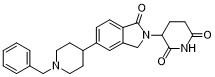
NVP-DKY709 (NVP-DKY-709; DKY-709) is a first-in-class selective cereblon (CRBN) glue degrader of IKZF2 with anticancer and may be used for cancer immunotherapy. It is a molecular glue type of degrader that spares IKZF1 and IKZF3 from degradation. X-ray crystal structure of IKZF2 zinc fingers bound to DDB1:CRBN:NVP-DKY709 explained the target selectivity of NVP-DKY709. In vitro, NVP-DKY709 modulated Treg cell and Teff cell functions. In a mouse breast cancer xenograft model, daily oral dosing with NVP-DKY709 led to degradation of IKZF2 in tumour and peripheral blood Treg cells, reducing tumour growth similarly to that achieved with the anti-PD1 antibody PDR001. Oral NVP-DKY709 effectively degraded IKZF2 in monkeys and patients and is currently being evaluated in a first-in-human phase I trial in solid tumours.
Physicochemical Properties
| Molecular Formula | C25H27N3O3 |
| Molecular Weight | 417.50 |
| Exact Mass | 417.205 |
| Elemental Analysis | C, 71.92; H, 6.52; N, 10.06; O, 11.50 |
| CAS # | 2291360-73-9 |
| PubChem CID | 137519326 |
| Appearance | White to off-white solid powder |
| LogP | 2.3 |
| Hydrogen Bond Donor Count | 1 |
| Hydrogen Bond Acceptor Count | 4 |
| Rotatable Bond Count | 4 |
| Heavy Atom Count | 31 |
| Complexity | 696 |
| Defined Atom Stereocenter Count | 0 |
| SMILES | N1C(=O)CCC(N2CC3=C(C2=O)C=CC(C2CCN(CC4=CC=CC=C4)CC2)=C3)C1=O |
| InChi Key | OMISHRJQMYQPMG-UHFFFAOYSA-N |
| InChi Code | InChI=1S/C25H27N3O3/c29-23-9-8-22(24(30)26-23)28-16-20-14-19(6-7-21(20)25(28)31)18-10-12-27(13-11-18)15-17-4-2-1-3-5-17/h1-7,14,18,22H,8-13,15-16H2,(H,26,29,30) |
| Chemical Name | 3-[6-(1-benzylpiperidin-4-yl)-3-oxo-1H-isoindol-2-yl]piperidine-2,6-dione |
| Synonyms | NVP-DKY709; 2291360-73-9; DKY709; 3-(5-(1-benzylpiperidin-4-yl)-1-oxoisoindolin-2-yl)piperidine-2,6-dione; NVP-DKY709?; CHEMBL5077506; SCHEMBL20765247; |
| HS Tariff Code | 2934.99.9001 |
| Storage |
Powder-20°C 3 years 4°C 2 years In solvent -80°C 6 months -20°C 1 month |
| Shipping Condition | Room temperature (This product is stable at ambient temperature for a few days during ordinary shipping and time spent in Customs) |
Biological Activity
| Targets | IZKF2 (DC50 = 4 nM ) |
| ln Vitro | NVP-DKY709 is a first-in-class and selective cereblon (CRBN) glue degrader of IKZF2, which spares IKZF1 and IKZF3 from degradation. Solving the X-ray crystal structure of IKZF2 zinc fingers bound to DDB1:CRBN:NVP-DKY709 explained the target selectivity of NVP-DKY709. In vitro, NVP-DKY709 modulated Treg cell and Teff cell functions [1]. |
| ln Vivo | In a mouse breast cancer xenograft model, daily oral dosing with NVP-DKY709 led to degradation of IKZF2 in tumour and peripheral blood Treg cells, reducing tumour growth similarly to that achieved with the anti-PD1 antibody PDR001. Oral NVP-DKY709 effectively degraded IKZF2 in monkeys and patients and is currently being evaluated in a first-in-human phase I trial in solid tumours [1]. |
| ADME/Pharmacokinetics | Orally available (F > 35%) |
| References | [1]. Developing an IKZF2 glue degrader. Nat Rev Drug Discov. 2023 Apr;22(4):271. |
| Additional Infomation | Tumours can evade immune system attack through the recruitment of immune-suppressive FOXP3+ regulatory T (Treg) cells, which can limit the activation and expansion of tumour-specific effector T (Teff) cells. Recently, the Ikaros transcription factor family member IKZF2 (Helios) — which plays a crucial role in maintaining the function and stability of Treg cells — has emerged as an attractive target for enhancing the antitumour immune response. However, targeting zinc finger transcription factors such as IKZF2 is challenging, as they are mostly unstructured and lack ligandable sites. |
Solubility Data
| Solubility (In Vitro) | DMSO : ~16.67 mg/mL (~39.93 mM) |
| Solubility (In Vivo) |
Solubility in Formulation 1: ≥ 1 mg/mL (2.40 mM) (saturation unknown) in 10% DMSO + 40% PEG300 + 5% Tween80 + 45% Saline (add these co-solvents sequentially from left to right, and one by one), clear solution. For example, if 1 mL of working solution is to be prepared, you can add 100 μL of 10.0 mg/mL clear DMSO stock solution to 400 μL of PEG300 and mix evenly; then add 50 μL of Tween-80 to the above solution and mix evenly; then add 450 μL of normal saline to adjust the volume to 1 mL. Preparation of saline: Dissolve 0.9 g of sodium chloride in 100 mL ddH₂ O to obtain a clear solution. Solubility in Formulation 2: ≥ 1 mg/mL (2.40 mM) (saturation unknown) in 10% DMSO + 90% (20% SBE-β-CD in Saline) (add these co-solvents sequentially from left to right, and one by one), clear solution. For example, if 1 mL of working solution is to be prepared, you can add 100 μL of 10.0 mg/mL clear DMSO stock solution to 900 μL of 20% SBE-β-CD physiological saline solution and mix evenly. Preparation of 20% SBE-β-CD in Saline (4°C,1 week): Dissolve 2 g SBE-β-CD in 10 mL saline to obtain a clear solution. Solubility in Formulation 3: ≥ 1 mg/mL (2.40 mM) (saturation unknown) in 10% DMSO + 90% Corn Oil (add these co-solvents sequentially from left to right, and one by one), clear solution. For example, if 1 mL of working solution is to be prepared, you can add 100 μL of 10.0 mg/mL clear DMSO stock solution to 900 μL of corn oil and mix evenly. (Please use freshly prepared in vivo formulations for optimal results.) |
| Preparing Stock Solutions | 1 mg | 5 mg | 10 mg | |
| 1 mM | 2.3952 mL | 11.9760 mL | 23.9521 mL | |
| 5 mM | 0.4790 mL | 2.3952 mL | 4.7904 mL | |
| 10 mM | 0.2395 mL | 1.1976 mL | 2.3952 mL |