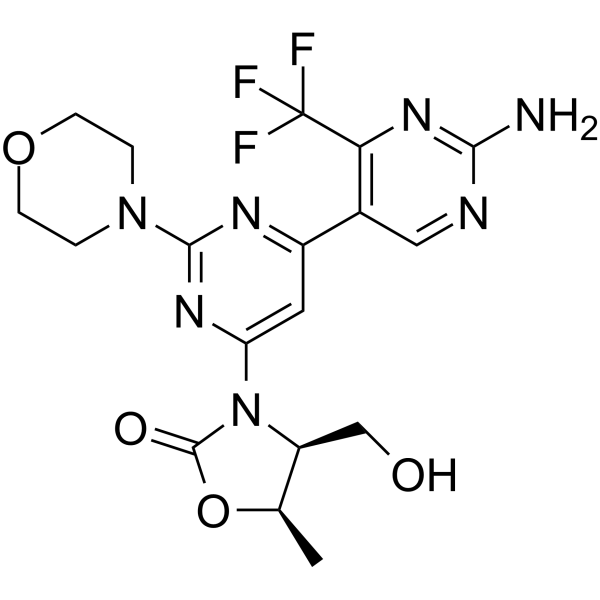
Physicochemical Properties
| Molecular Formula | C18H20F3N7O4 |
| Molecular Weight | 455.39 |
| Exact Mass | 455.152 |
| CAS # | 1453082-52-4 |
| PubChem CID | 71682837 |
| Appearance | Typically exists as solid at room temperature |
| LogP | 0.5 |
| Hydrogen Bond Donor Count | 2 |
| Hydrogen Bond Acceptor Count | 13 |
| Rotatable Bond Count | 4 |
| Heavy Atom Count | 32 |
| Complexity | 669 |
| Defined Atom Stereocenter Count | 2 |
| SMILES | C[C@@H]1[C@@H](N(C(=O)O1)C2=NC(=NC(=C2)C3=CN=C(N=C3C(F)(F)F)N)N4CCOCC4)CO |
| InChi Key | IEYOHYVYEJVEJJ-SKDRFNHKSA-N |
| InChi Code | InChI=1S/C18H20F3N7O4/c1-9-12(8-29)28(17(30)32-9)13-6-11(24-16(25-13)27-2-4-31-5-3-27)10-7-23-15(22)26-14(10)18(19,20)21/h6-7,9,12,29H,2-5,8H2,1H3,(H2,22,23,26)/t9-,12+/m1/s1 |
| Chemical Name | (4S,5R)-3-[6-[2-amino-4-(trifluoromethyl)pyrimidin-5-yl]-2-morpholin-4-ylpyrimidin-4-yl]-4-(hydroxymethyl)-5-methyl-1,3-oxazolidin-2-one |
| HS Tariff Code | 2934.99.9001 |
| Storage |
Powder-20°C 3 years 4°C 2 years In solvent -80°C 6 months -20°C 1 month |
| Shipping Condition | Room temperature (This product is stable at ambient temperature for a few days during ordinary shipping and time spent in Customs) |
Biological Activity
| ln Vitro | Compound 40, NVP-CLR457, exhibits mTOR activity at an IC50 of 2474 ± 722 nM and inhibits phosphorylation of RPS6 at an IC50 of 1633 ± 54 nM [1]. The DDR response remains unaffected by NVP-CLR457 at concentrations of 1 and 5 μM [1]. The rate at which microtubule polymerization occurs is unaffected by NVP-CLR457 [1]. |
| ln Vivo | Dose-dependent inhibition of tumor growth was observed in NVP-CLR457 (Compound 40)-bearing athymic nude mice with xenografted Rat1-myr-p110α tumors (3–20 mg/kg, po, daily for 8 days) [1]. Throughout the course of the study, NVP-CLR457 (mice given xenografts of human primary breast tumors, 40 mg/kg orally, daily for 15 days) inhibited the growth of the tumors [1]. The oral exposure and bioavailability of NVP-CLR457 (male Sprague-Dawley rats, 1.0 mg/kg IV; 3.0 mg/kg PO; once) are high [1]. NVP-CLR457's pharmacokinetic characteristics in male Sprague-Dawley rats [1]. Compound 40 CL (mL/min/kg) 22 ± 6 Vss (L/kg) 4.4 ± 0.2 t1/2 (h) 3.3 ± 0.2 AUC iv (nM*h) 1770 ± 443 Oral F (%) 97 ± 20 HDM FA (%) 37 NVP-CLR457 (female OF1 mice 3 mg/kg (IV) and 10 mg/kg (PO), male beagles 0.1 mg/kg (IV), 0.3 mg/kg (PO) once) displays low clearance, moderate distribution volume, and rapid absorption, leading to a moderate to long half-life and high oral bioavailability [1]. NVP-CLR457 pharmacokinetic parameters in male Beagle dogs and female OF1 mice [1]. PPB (%) 76 71 CL (mL/min/kg) 10 3 ± 0 Vss (L/kg) 2 1.5 ± 0.2 t1/2 (h) 2 11 ± 3 AUC iv (nM*h) 3580 11213 ± 1169 AUC po (nM*h) 1738 11034 ± 1531 Oral F (%) 49 98 ± 14 Cmax (nM) 422 1121 ± 128 Tmax (h) 0.5 1.3 ± 0.6 NVP-CLR457 (0.3-100 mg/kg, PO, once) causes a disproportionate increase in exposure (AUC and Cmax values] [1]. NVP-CLR457 pharmacokinetic parameters in male beagle dogs and Sprague-Dawley rats [1]. Dog Dose (mg/kg) Species Rat Dog 3 30 100 0.3 3 AUC (nM*h) 1709 ± 362 913 ± 251 784 ± 342 12,970 ± 1828 11,213 ± 1169 Cmax (nM) 213 ± 61 41 ± 6 22 ± 4 1121 ± 128 309 ± 40 Tmax (h) 0.5-2 4–24 24 1-2 2-24 |
| Cell Assay |
Western Blot Analysis Cell Types: U87MG cells [1] Tested Concentrations: 0, 1.4, 16, 63, 250, 1000 nM Incubation Duration: 24 hrs (hours) Experimental Results: Readout of inhibition of class I PI3K activity in a dose-dependent manner, S473P-Akt The IC50 and IC90 values for inhibition were 100 and 507 nM, respectively, and there was no significant change in the readout of mTOR activity. |
| Animal Protocol |
Animal/Disease Models: Sprague Dawley rat (male) [1] Doses: 1 mg/kg (iv), 3 mg/kg (Oral) Route of Administration: intravenous (iv) (iv)or po (po (oral gavage)) once (pharmacokinetic/PK/PK analysis) Experimental Results: Demonstrated high levels of oral exposure and bioavailability. Animal/Disease Models: female OF1 mice, male beagle dogs [1] Doses: mice 3 mg/kg (IV) and 10 mg/kg (PO), dogs 0.1 mg/kg (IV), 0.3 mg/kg (PO ) Route of Administration: intravenous (iv) (iv)or po (po (oral gavage)) once (pharmacokinetic/PK/PK analysis) Experimental Results: Displayed low clearance, moderate volume of distribution, and rapid absorption, resulting in a moderate to long half-life and high oral bioavailability. Animal/Disease Models: Male Sprague Dawley rat, male Beagle dog [1] Doses: 0.3, 3, 30, 100 mg/kg Route of Administration: po (po (oral gavage)) once (pharmacokinetic/PK/PK analysis) Experimental Results: Result in exposure (AUC and Cmax) do not increase proportionally) and longer Tmax values when it is formulated as a suspension of crystalline materials. Animal/Disease Models: Female athymic nude mice (carrying xenografted Rat1-myr-p110α tumors) [1] Doses: 3, 10 and 2 |
| References |
[1]. Identification of NVP-CLR457 as an Orally Bioavailable Non-CNS-Penetrant pan-Class IA Phosphoinositol-3-Kinase Inhibitor. J Med Chem. 2022 May 2. |
Solubility Data
| Solubility (In Vitro) | May dissolve in DMSO (in most cases), if not, try other solvents such as H2O, Ethanol, or DMF with a minute amount of products to avoid loss of samples |
| Solubility (In Vivo) |
Note: Listed below are some common formulations that may be used to formulate products with low water solubility (e.g. < 1 mg/mL), you may test these formulations using a minute amount of products to avoid loss of samples. Injection Formulations (e.g. IP/IV/IM/SC) Injection Formulation 1: DMSO : Tween 80: Saline = 10 : 5 : 85 (i.e. 100 μL DMSO stock solution → 50 μL Tween 80 → 850 μL Saline) *Preparation of saline: Dissolve 0.9 g of sodium chloride in 100 mL ddH ₂ O to obtain a clear solution. Injection Formulation 2: DMSO : PEG300 :Tween 80 : Saline = 10 : 40 : 5 : 45 (i.e. 100 μL DMSO → 400 μLPEG300 → 50 μL Tween 80 → 450 μL Saline) Injection Formulation 3: DMSO : Corn oil = 10 : 90 (i.e. 100 μL DMSO → 900 μL Corn oil) Example: Take the Injection Formulation 3 (DMSO : Corn oil = 10 : 90) as an example, if 1 mL of 2.5 mg/mL working solution is to be prepared, you can take 100 μL 25 mg/mL DMSO stock solution and add to 900 μL corn oil, mix well to obtain a clear or suspension solution (2.5 mg/mL, ready for use in animals). Injection Formulation 4: DMSO : 20% SBE-β-CD in saline = 10 : 90 [i.e. 100 μL DMSO → 900 μL (20% SBE-β-CD in saline)] *Preparation of 20% SBE-β-CD in Saline (4°C,1 week): Dissolve 2 g SBE-β-CD in 10 mL saline to obtain a clear solution. Injection Formulation 5: 2-Hydroxypropyl-β-cyclodextrin : Saline = 50 : 50 (i.e. 500 μL 2-Hydroxypropyl-β-cyclodextrin → 500 μL Saline) Injection Formulation 6: DMSO : PEG300 : castor oil : Saline = 5 : 10 : 20 : 65 (i.e. 50 μL DMSO → 100 μLPEG300 → 200 μL castor oil → 650 μL Saline) Injection Formulation 7: Ethanol : Cremophor : Saline = 10: 10 : 80 (i.e. 100 μL Ethanol → 100 μL Cremophor → 800 μL Saline) Injection Formulation 8: Dissolve in Cremophor/Ethanol (50 : 50), then diluted by Saline Injection Formulation 9: EtOH : Corn oil = 10 : 90 (i.e. 100 μL EtOH → 900 μL Corn oil) Injection Formulation 10: EtOH : PEG300:Tween 80 : Saline = 10 : 40 : 5 : 45 (i.e. 100 μL EtOH → 400 μLPEG300 → 50 μL Tween 80 → 450 μL Saline) Oral Formulations Oral Formulation 1: Suspend in 0.5% CMC Na (carboxymethylcellulose sodium) Oral Formulation 2: Suspend in 0.5% Carboxymethyl cellulose Example: Take the Oral Formulation 1 (Suspend in 0.5% CMC Na) as an example, if 100 mL of 2.5 mg/mL working solution is to be prepared, you can first prepare 0.5% CMC Na solution by measuring 0.5 g CMC Na and dissolve it in 100 mL ddH2O to obtain a clear solution; then add 250 mg of the product to 100 mL 0.5% CMC Na solution, to make the suspension solution (2.5 mg/mL, ready for use in animals). Oral Formulation 3: Dissolved in PEG400 Oral Formulation 4: Suspend in 0.2% Carboxymethyl cellulose Oral Formulation 5: Dissolve in 0.25% Tween 80 and 0.5% Carboxymethyl cellulose Oral Formulation 6: Mixing with food powders Note: Please be aware that the above formulations are for reference only. InvivoChem strongly recommends customers to read literature methods/protocols carefully before determining which formulation you should use for in vivo studies, as different compounds have different solubility properties and have to be formulated differently. (Please use freshly prepared in vivo formulations for optimal results.) |
| Preparing Stock Solutions | 1 mg | 5 mg | 10 mg | |
| 1 mM | 2.1959 mL | 10.9796 mL | 21.9592 mL | |
| 5 mM | 0.4392 mL | 2.1959 mL | 4.3918 mL | |
| 10 mM | 0.2196 mL | 1.0980 mL | 2.1959 mL |