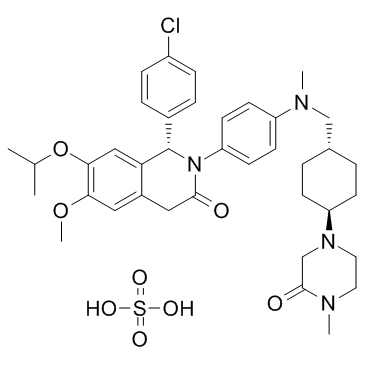
NVP-CGM097 sulfate ( also known as CGM097; NVP-CGM-097; NVPCGM097), the sulfate salt of NVP-CGM097 or CGM-097, is a novel, orally bioavailable and selective inhibitor of MDM2 (human homolog of double minute 2)-p53 interaction with antitumor activity. With an IC50 of 1.7±0. nM, it blocks inhibits MDM2-p53.
Physicochemical Properties
| Molecular Formula | C38H49CLN4O8S |
| Molecular Weight | 757.335668325424 |
| Exact Mass | 756.296 |
| Elemental Analysis | C, 60.27; H, 6.52; Cl, 4.68; N, 7.40; O, 16.90; S, 4.23 |
| CAS # | 1313367-56-4 |
| Related CAS # | NVP-CGM097;1313363-54-0;NVP-CGM097 (stereoisomer);2070009-54-8 |
| PubChem CID | 53262550 |
| Appearance | Light yellow to yellow solid powder |
| Hydrogen Bond Donor Count | 2 |
| Hydrogen Bond Acceptor Count | 10 |
| Rotatable Bond Count | 9 |
| Heavy Atom Count | 52 |
| Complexity | 1120 |
| Defined Atom Stereocenter Count | 1 |
| SMILES | CC(C)OC1=C(C=C2CC(=O)N([C@H](C2=C1)C3=CC=C(C=C3)Cl)C4=CC=C(C=C4)N(C)CC5CCC(CC5)N6CCN(C(=O)C6)C)OC.OS(=O)(=O)O |
| InChi Key | YFLKIFVIZIALIA-GHVGLMRRSA-N |
| InChi Code | InChI=1S/C38H47ClN4O4.H2O4S/c1-25(2)47-35-22-33-28(20-34(35)46-5)21-36(44)43(38(33)27-8-10-29(39)11-9-27)32-16-14-30(15-17-32)41(4)23-26-6-12-31(13-7-26)42-19-18-40(3)37(45)24-42;1-5(2,3)4/h8-11,14-17,20,22,25-26,31,38H,6-7,12-13,18-19,21,23-24H2,1-5H3;(H2,1,2,3,4)/t26?,31?,38-;/m0./s1 |
| Chemical Name | (1S)-1-(4-chlorophenyl)-6-methoxy-2-[4-[methyl-[[4-(4-methyl-3-oxopiperazin-1-yl)cyclohexyl]methyl]amino]phenyl]-7-propan-2-yloxy-1,4-dihydroisoquinolin-3-one;sulfuric acid |
| Synonyms | NVP-CGM097 sulfate; NVP CGM097 sulfate |
| HS Tariff Code | 2934.99.9001 |
| Storage |
Powder-20°C 3 years 4°C 2 years In solvent -80°C 6 months -20°C 1 month Note: Please store this product in a sealed and protected environment, avoid exposure to moisture. |
| Shipping Condition | Room temperature (This product is stable at ambient temperature for a few days during ordinary shipping and time spent in Customs) |
Biological Activity
| Targets | hMDM2 (IC50 = 1.7±0.1 nM) |
| ln Vitro | NVP-CGM097 sulfate binds to human MDM2 with an IC50 of 1.7 nM and demonstrates strong selectivity for MDM4 (IC50=2000 nM). NVP-CGM097 sulfate is roughly four times more powerful than Nutlin-3a (IC50=8 nM). In addition, NVP-CGM097 sulfate showed no significant action on Bcl-2:Bak, Bcl-2:Bad, Mcl-1:Bak, Mcl-1:NOXA, XIAP:BIR3 and c-IAP:BIR3 protein-protein responses. CGM097 sulfate effectively reduced the growth of cells expressing wild-type p53 while sparing p53-null cells with a 35-58-fold differential. NVP-CGM097 sulfate may dramatically relocate wild-type p53 into the nucleus, with an IC50 of 0.224 μM, indicating that it can suppress NVP-CGM097 sulfate significantly reduces the proliferation of cells expressing wild-type p53, at a 35-58-fold rate. Differential retention of p53 null cells. NVP-CGM097 sulfate inhibits HCT116 (p53WT/WT) with an IC50 of 454±136nM[1]. |
| ln Vivo | In the SJSA-1 human tumor model, NVP-CGM097 sulfate reactivates the p53 dye adjacent to MDM2 and suppresses the response between p53 and MDM2, as indicated by higher p21 mRNA levels, a measure of p53 activity according to pharmacodynamic (PD) indications. It was discovered that when NVP-CGM097 sulfate levels were raised to 30 mg/kg in the tumor-bearing state, p21 mRNA levels rose as well. The biphasic PD response lasts for a maximum of twenty-four hours. Comparable patterns were observed in the mRNA levels of other p53 target genes, including MDM2 and PUMA, which were assessed in concurrent samples. NVP-CGM097 sulfate administration on a daily basis dramatically and dose-dependently enhanced SJSA-1 tumor development. 20 mg/kg is a dose that can help stabilize the condition, and the antibiotic's AUC0–24 is 163 μM.h. The total blood clearance (CL) of NVP-CGM097 following intravenous injection is 5 mL/min/kg for mice, 7 mL/min/kg for rats, 3 mL/min/kg for dogs, and 4 mL/min/kg for monkeys. Dogs have a longer apparent terminal half-life (t1/2) than birds (20 hours), whereas rats and monkeys have a longer t1/2 (6–12 hours). NVP-CGM097 was well absorbed upon prototyping, with Tmax occurring in the range of 1 to 4.5 for all studied species [1]. |
| Cell Assay | Two pairs of cell lines are used to assess NVP-CGM097 p53-dependent antiproliferative effects: (1) an isogenic pair of HCT116 cell lines either expressing wild-type p53 or knocked-out for the p53 gene and (2) a nonisogenic pair of osteosarcoma cell lines either endogenously expressing wild-type p53 and amplified for MDM2 (SJSA-1 cells) or null for p53 (SAOS-2 cells)[1]. |
| References |
[1]. Discovery of a Dihydroisoquinolinone Derivative (NVP-CGM097): A Highly Potent and Selective MDM2 Inhibitor Undergoing Phase 1 Clinical Trials in p53wt Tumors. J Med Chem. 2015 Aug 27;58(16):6348-58. |
Solubility Data
| Solubility (In Vitro) |
DMSO: ~100 mg/mL (132.0 mM) H2O: ~100 mg/mL (132.0 mM) |
| Solubility (In Vivo) |
Solubility in Formulation 1: ≥ 2.5 mg/mL (3.30 mM) (saturation unknown) in 10% DMSO + 40% PEG300 + 5% Tween80 + 45% Saline (add these co-solvents sequentially from left to right, and one by one), clear solution. For example, if 1 mL of working solution is to be prepared, you can add 100 μL of 25.0 mg/mL clear DMSO stock solution to 400 μL PEG300 and mix evenly; then add 50 μL Tween-80 to the above solution and mix evenly; then add 450 μL normal saline to adjust the volume to 1 mL. Preparation of saline: Dissolve 0.9 g of sodium chloride in 100 mL ddH₂ O to obtain a clear solution. Solubility in Formulation 2: ≥ 2.5 mg/mL (3.30 mM) (saturation unknown) in 10% DMSO + 90% (20% SBE-β-CD in Saline) (add these co-solvents sequentially from left to right, and one by one), clear solution. For example, if 1 mL of working solution is to be prepared, you can add 100 μL of 25.0 mg/mL clear DMSO stock solution to 900 μL of 20% SBE-β-CD physiological saline solution and mix evenly. Preparation of 20% SBE-β-CD in Saline (4°C,1 week): Dissolve 2 g SBE-β-CD in 10 mL saline to obtain a clear solution. Solubility in Formulation 3: ≥ 2.5 mg/mL (3.30 mM) (saturation unknown) in 10% DMSO + 90% Corn Oil (add these co-solvents sequentially from left to right, and one by one), clear solution. For example, if 1 mL of working solution is to be prepared, you can add 100 μL of 25.0 mg/mL clear DMSO stock solution to 900 μL of corn oil and mix evenly. Solubility in Formulation 4: 50 mg/mL (66.02 mM) in PBS (add these co-solvents sequentially from left to right, and one by one), clear solution; with ultrasonication. (Please use freshly prepared in vivo formulations for optimal results.) |
| Preparing Stock Solutions | 1 mg | 5 mg | 10 mg | |
| 1 mM | 1.3204 mL | 6.6021 mL | 13.2041 mL | |
| 5 mM | 0.2641 mL | 1.3204 mL | 2.6408 mL | |
| 10 mM | 0.1320 mL | 0.6602 mL | 1.3204 mL |