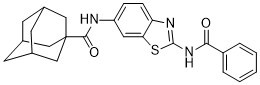
NVP-231 is a novel, potent, specific, and reversible CerK inhibitor that competitively inhibits binding of ceramide to CerK with IC50 of 12±2 nM. NVP-231 inhibits phosphorylation of ceramide and is active at low nanomolar concentrations on both purified and cellular CerK. This lowers the levels of endogenous C1P. NVP-231 increased ceramide levels and inhibited cell growth when used in conjunction with another ceramide metabolizing inhibitor, such as tamoxifen. To control ceramide metabolism, NVP-231 is thus a brand-new and promising substance that may shed light on CerK physiological function.
Physicochemical Properties
| Molecular Formula | C25H25N3O2S |
| Molecular Weight | 431.5499 |
| Exact Mass | 431.166 |
| Elemental Analysis | C, 69.58; H, 5.84; N, 9.74; O, 7.41; S, 7.43 |
| CAS # | 362003-83-6 |
| Related CAS # | 362003-83-6 |
| PubChem CID | 4096211 |
| Appearance | White to off-white solid powder |
| Density | 1.4±0.1 g/cm3 |
| Index of Refraction | 1.743 |
| LogP | 5.34 |
| Hydrogen Bond Donor Count | 2 |
| Hydrogen Bond Acceptor Count | 4 |
| Rotatable Bond Count | 4 |
| Heavy Atom Count | 31 |
| Complexity | 680 |
| Defined Atom Stereocenter Count | 0 |
| SMILES | S1C(N([H])C(C2C([H])=C([H])C([H])=C([H])C=2[H])=O)=NC2C([H])=C([H])C(=C([H])C1=2)N([H])C(C12C([H])([H])C3([H])C([H])([H])C([H])(C([H])([H])C([H])(C3([H])[H])C1([H])[H])C2([H])[H])=O |
| InChi Key | MVSSJPGNLQPWSW-UHFFFAOYSA-N |
| InChi Code | InChI=1S/C25H25N3O2S/c29-22(18-4-2-1-3-5-18)28-24-27-20-7-6-19(11-21(20)31-24)26-23(30)25-12-15-8-16(13-25)10-17(9-15)14-25/h1-7,11,15-17H,8-10,12-14H2,(H,26,30)(H,27,28,29) |
| Chemical Name | N-(2-benzamido-1,3-benzothiazol-6-yl)adamantane-1-carboxamide |
| Synonyms | NVP231; NVP 231; NVP-231 |
| HS Tariff Code | 2934.99.9001 |
| Storage |
Powder-20°C 3 years 4°C 2 years In solvent -80°C 6 months -20°C 1 month |
| Shipping Condition | Room temperature (This product is stable at ambient temperature for a few days during ordinary shipping and time spent in Customs) |
Biological Activity
| Targets | CerK (IC50 = 12 nM); apoptosis |
| ln Vitro | NVP-231 causes cancer cells to die, which lowers cell viability and DNA synthesis. Cells treated with NVP-231 exhibited M phase arrest as opposed to G2/M boundary arrest. NVP-231 treatment results in a concentration-dependent up-regulation of cyclin B1 phosphorylation at Ser133 and a decrease of CDK1 phosphorylation at Tyr15 in MCF-7 and NCI-H358 cells. NVP-231 inhibits Wee1 expression in NCI-H358 and MCF-7 cells. Cancer cells treated with NVP-231 exhibit concentration- and time-dependent down-regulation of the CDK4 protein. In synchronized cells, this effect is even more pronounced[2]. |
| Cell Assay | MCF-7 and NCI-H358 cells are plated in a 96-well black plate at a density of 1 × 10⁴ cells per well, and they are then exposed to the indicated concentrations of NVP-231 (in nM) for 48 hours. During the final 4 hours of the treatment, alamarBlueR is added, and fluorescence is measured. |
| References |
[1] Mol Pharmacol . 2008 Oct;74(4):925-32. [2] Br J Pharmacol . 2014 Dec;171(24):5829-44. |
| Additional Infomation | NVP-231 is a member of benzothiazoles. |
Solubility Data
| Solubility (In Vitro) | DMSO: ≥41 mg/mL (~95.0 mM) |
| Solubility (In Vivo) |
Solubility in Formulation 1: ≥ 2.5 mg/mL (5.79 mM) (saturation unknown) in 10% DMSO + 40% PEG300 + 5% Tween80 + 45% Saline (add these co-solvents sequentially from left to right, and one by one), clear solution. For example, if 1 mL of working solution is to be prepared, you can add 100 μL of 25.0 mg/mL clear DMSO stock solution to 400 μL PEG300 and mix evenly; then add 50 μL Tween-80 to the above solution and mix evenly; then add 450 μL normal saline to adjust the volume to 1 mL. Preparation of saline: Dissolve 0.9 g of sodium chloride in 100 mL ddH₂ O to obtain a clear solution. Solubility in Formulation 2: ≥ 2.5 mg/mL (5.79 mM) (saturation unknown) in 10% DMSO + 90% (20% SBE-β-CD in Saline) (add these co-solvents sequentially from left to right, and one by one), clear solution. For example, if 1 mL of working solution is to be prepared, you can add 100 μL of 25.0 mg/mL clear DMSO stock solution to 900 μL of 20% SBE-β-CD physiological saline solution and mix evenly. Preparation of 20% SBE-β-CD in Saline (4°C,1 week): Dissolve 2 g SBE-β-CD in 10 mL saline to obtain a clear solution. Solubility in Formulation 3: ≥ 2.5 mg/mL (5.79 mM) (saturation unknown) in 10% DMSO + 90% Corn Oil (add these co-solvents sequentially from left to right, and one by one), clear solution. For example, if 1 mL of working solution is to be prepared, you can add 100 μL of 25.0 mg/mL clear DMSO stock solution to 900 μL of corn oil and mix evenly. (Please use freshly prepared in vivo formulations for optimal results.) |
| Preparing Stock Solutions | 1 mg | 5 mg | 10 mg | |
| 1 mM | 2.3172 mL | 11.5861 mL | 23.1723 mL | |
| 5 mM | 0.4634 mL | 2.3172 mL | 4.6345 mL | |
| 10 mM | 0.2317 mL | 1.1586 mL | 2.3172 mL |