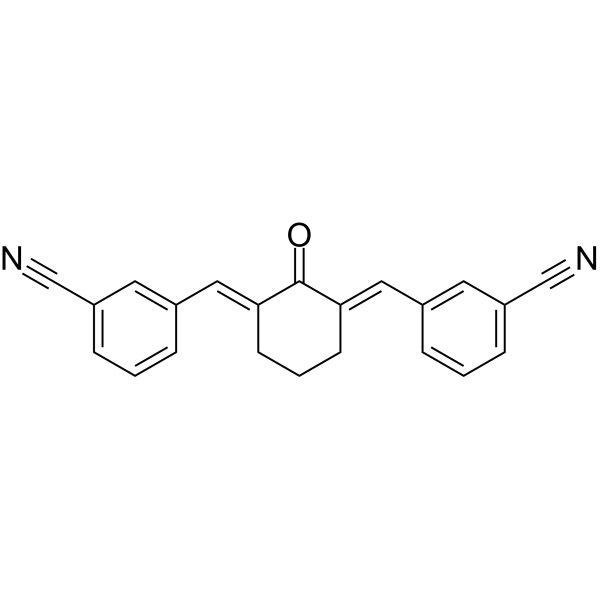
Physicochemical Properties
| Molecular Formula | C22H16N2O |
| Molecular Weight | 324.375245094299 |
| Exact Mass | 324.126 |
| CAS # | 2674753-39-8 |
| PubChem CID | 12374020 |
| Appearance | Light yellow to green yellow solid powder |
| LogP | 4.5 |
| Hydrogen Bond Donor Count | 0 |
| Hydrogen Bond Acceptor Count | 3 |
| Rotatable Bond Count | 2 |
| Heavy Atom Count | 25 |
| Complexity | 613 |
| Defined Atom Stereocenter Count | 0 |
| SMILES | C1C/C(=C\C2=CC(=CC=C2)C#N)/C(=O)/C(=C/C3=CC(=CC=C3)C#N)/C1 |
| InChi Key | LENALXRGKSPEKI-ZIOPAAQOSA-N |
| InChi Code | InChI=1S/C22H16N2O/c23-14-18-6-1-4-16(10-18)12-20-8-3-9-21(22(20)25)13-17-5-2-7-19(11-17)15-24/h1-2,4-7,10-13H,3,8-9H2/b20-12+,21-13+ |
| Chemical Name | 3-[(E)-[(3E)-3-[(3-cyanophenyl)methylidene]-2-oxocyclohexylidene]methyl]benzonitrile |
| HS Tariff Code | 2934.99.9001 |
| Storage |
Powder-20°C 3 years 4°C 2 years In solvent -80°C 6 months -20°C 1 month |
| Shipping Condition | Room temperature (This product is stable at ambient temperature for a few days during ordinary shipping and time spent in Customs) |
Biological Activity
| Targets | CBP-HAT 0.35 μM (IC50) |
| ln Vitro | In a dose-dependent way, NiCur (0.5~1 μM; U2OS cells) lowers the levels of Dox-induced p53K382ac, p53S15p, and p53[1]. H3K27ac is decreased by NiCur (1.5 μM). Cell growth is restored by NiCur (1.5 μM; U2OS cells). NiCur (intestinal epithelial cells) inhibits the activation of p53 mediated by Dox without changing the concentrations of H2A.X S139p. To redesign the chromatin landscape, NiCur has the ability to modify the gene regulatory switch. CBP HAT activity is blocked by NiCur[1]. |
| Cell Assay |
Western Blot Analysis[1] Cell Types: U2OS cells Tested Concentrations: 0.5~1 μM Incubation Duration: Experimental Results: decreased the Dox-induced p53K382ac, p53S15p, and p53 levels in a dose-dependent manner. |
| References |
[1]. Inhibitor of CBP Histone Acetyltransferase Downregulates p53 Activation and Facilitates Methylation at Lysine 27 on Histone H3. Molecules. 2018;23(8):1930. Published 2018 Aug 2. |
Solubility Data
| Solubility (In Vitro) | DMSO : 50 mg/mL (154.14 mM) |
| Solubility (In Vivo) |
Solubility in Formulation 1: ≥ 1.67 mg/mL (5.15 mM) (saturation unknown) in 10% DMSO + 40% PEG300 + 5% Tween80 + 45% Saline (add these co-solvents sequentially from left to right, and one by one), clear solution. For example, if 1 mL of working solution is to be prepared, you can add 100 μL of 16.7 mg/mL clear DMSO stock solution to 400 μL PEG300 and mix evenly; then add 50 μL Tween-80 to the above solution and mix evenly; then add 450 μL normal saline to adjust the volume to 1 mL. Preparation of saline: Dissolve 0.9 g of sodium chloride in 100 mL ddH₂ O to obtain a clear solution. Solubility in Formulation 2: 1.67 mg/mL (5.15 mM) in 10% DMSO + 90% (20% SBE-β-CD in Saline) (add these co-solvents sequentially from left to right, and one by one), suspension solution; with ultrasonication. For example, if 1 mL of working solution is to be prepared, you can add 100 μL of 16.7 mg/mL clear DMSO stock solution to 900 μL of 20% SBE-β-CD physiological saline solution and mix evenly. Preparation of 20% SBE-β-CD in Saline (4°C,1 week): Dissolve 2 g SBE-β-CD in 10 mL saline to obtain a clear solution. (Please use freshly prepared in vivo formulations for optimal results.) |
| Preparing Stock Solutions | 1 mg | 5 mg | 10 mg | |
| 1 mM | 3.0828 mL | 15.4140 mL | 30.8280 mL | |
| 5 mM | 0.6166 mL | 3.0828 mL | 6.1656 mL | |
| 10 mM | 0.3083 mL | 1.5414 mL | 3.0828 mL |