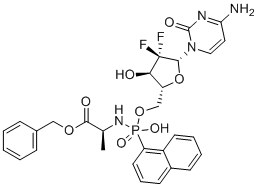
NUC-3373 is a 5-FU prodrug based on ProTide technology that is able to generate much higher concentrations of FUDR-MP in patients' cells. It is reported to be effective against COVID-19. NUC-3373 also has a more convenient administration schedule and does not produce toxic levels of metabolites such as FBAL which results in an improved safety profile. NUC-3373 is a more potent and targeted inhibitor of TS.
Physicochemical Properties
| Molecular Formula | C29H30F2N4O8P |
| Molecular Weight | 613.527432203293 |
| Exact Mass | 613.162 |
| CAS # | 1332837-31-6 |
| PubChem CID | 53373585 |
| Appearance | White to off-white solid powder |
| Density | 1.5±0.1 g/cm3 |
| Index of Refraction | 1.650 |
| LogP | 3.04 |
| Hydrogen Bond Donor Count | 3 |
| Hydrogen Bond Acceptor Count | 11 |
| Rotatable Bond Count | 12 |
| Heavy Atom Count | 43 |
| Complexity | 1100 |
| Defined Atom Stereocenter Count | 4 |
| SMILES | C[C@@H](C(=O)OCC1=CC=CC=C1)NP(=O)(OC[C@@H]2[C@H](C[C@@H](O2)N3C=C(C(=O)NC3=O)F)O)OC4=CC=CC5=CC=CC=C54 |
| InChi Key | LYMGFDGRLCYHTR-ICIRLHQFSA-N |
| InChi Code | InChI=1S/C29H30F2N4O8P/c1-18(26(37)41-16-19-8-3-2-4-9-19)34-44(39,40,23-13-7-11-20-10-5-6-12-21(20)23)42-17-22-25(36)29(30,31)27(43-22)35-15-14-24(32)33-28(35)38/h2-15,18,22,25,27,36H,16-17H2,1H3,(H2,32,33,38)(H2,34,39,40)/t18-,22+,25+,27+/m0/s1 |
| Chemical Name | L-Alanine, N-(-2'-deoxy-2',2'-difluoro-p-1-naphthalenyl-5'-cytidylyl)-, phenylmethyl ester |
| Synonyms | NUC-3373 NUC 3373 NUC3373 |
| HS Tariff Code | 2934.99.9001 |
| Storage |
Powder-20°C 3 years 4°C 2 years In solvent -80°C 6 months -20°C 1 month |
| Shipping Condition | Room temperature (This product is stable at ambient temperature for a few days during ordinary shipping and time spent in Customs) |
Biological Activity
| ln Vitro | Damage-associated molecular patterns (DAMPs) are released, cell surface calreticulin (CRT) is expressed more, and nuclear high-mobility group protein 1 (HMGB1) is lost when fosifloxuridine nafalbenamide is administered [1]. |
| ln Vivo | The HT-29 nude mouse xenograft model shows antitumor efficacy for fosifloxuridine nafalbenamide [2]. |
| References |
[1]. Abstract 1848: NUC-3373 induces ER stress and the release of damage associated molecular patterns in colorectal cancer cells. Cancer Res August 15 2020 (80) (16 Supplement) 1848. [2]. Abstract B46: NUC-3373: A novel pyrimidine nucleotide analogue that overcomes key cancer drug resistance limiting patient survival. Mol Cancer Ther December 1 2015 (14) (12 Supplement 2) B46. |
| Additional Infomation |
Fosifloxuridine nafalbenamide is under investigation in clinical trial NCT03428958 (A Safety Study of NUC-3373 in Combination With Standard Agents Used in Colorectal Cancer Treatment). Fosifloxuridine Nafalbenamide is a phosphoramidate-based prodrug of the monophosphate (MP) form of 5-fluoro-2'-deoxyuridine (FUdR; FUDR), the active metabolite of fluorouracil (5-FU), an antimetabolite fluoropyrimidine analog of the pyrimidine nucleoside, with potential antineoplastic activity. Upon administration of the nucleotide analog prodrug fosifloxuridine nafalbenamide, fosifloxuridine nafalbenamide is readily taken up by tumor cells. In the tumor cell, the phosphoramidate moiety is removed and fosifloxuridine nafalbenamide is converted to its active form FUDR-MP. In turn, FUDR-MP binds to and inhibits thymidylate synthase (TS), resulting in the depletion of thymidine triphosphate (TTP) and thus DNA synthesis. With the phosphoramidate moiety attached to FUDR-MP, fosifloxuridine nafalbenamide, compared to 5-FU, is more lipophilic and accumulates in cancer cells by passive diffusion and does not require a nucleoside transporter, thereby generating higher intracellular concentrations. In addition, compared to 5-FU, once inside the cell FUDR-MP does not need to be phosphorylated and is already in its active form. Unlike 5-FU, fosifloxuridine nafalbenamide does not get deactivated or converted into toxic metabolites by dihydropyrimidine dehydrogenase (DPD) and thymidine phosphorylase (TP), which leads to both a longer half-life and less toxicity. |
Solubility Data
| Solubility (In Vitro) | DMSO : ~100 mg/mL (~162.99 mM) |
| Solubility (In Vivo) |
Solubility in Formulation 1: ≥ 2.5 mg/mL (4.07 mM) (saturation unknown) in 10% DMSO + 40% PEG300 + 5% Tween80 + 45% Saline (add these co-solvents sequentially from left to right, and one by one), clear solution. For example, if 1 mL of working solution is to be prepared, you can add 100 μL of 25.0 mg/mL clear DMSO stock solution to 400 μL PEG300 and mix evenly; then add 50 μL Tween-80 to the above solution and mix evenly; then add 450 μL normal saline to adjust the volume to 1 mL. Preparation of saline: Dissolve 0.9 g of sodium chloride in 100 mL ddH₂ O to obtain a clear solution. Solubility in Formulation 2: ≥ 2.5 mg/mL (4.07 mM) (saturation unknown) in 10% DMSO + 90% (20% SBE-β-CD in Saline) (add these co-solvents sequentially from left to right, and one by one), clear solution. For example, if 1 mL of working solution is to be prepared, you can add 100 μL of 25.0 mg/mL clear DMSO stock solution to 900 μL of 20% SBE-β-CD physiological saline solution and mix evenly. Preparation of 20% SBE-β-CD in Saline (4°C,1 week): Dissolve 2 g SBE-β-CD in 10 mL saline to obtain a clear solution. Solubility in Formulation 3: ≥ 2.5 mg/mL (4.07 mM) (saturation unknown) in 10% DMSO + 90% Corn Oil (add these co-solvents sequentially from left to right, and one by one), clear solution. For example, if 1 mL of working solution is to be prepared, you can add 100 μL of 25.0 mg/mL clear DMSO stock solution to 900 μL of corn oil and mix evenly. (Please use freshly prepared in vivo formulations for optimal results.) |
| Preparing Stock Solutions | 1 mg | 5 mg | 10 mg | |
| 1 mM | 1.6299 mL | 8.1496 mL | 16.2991 mL | |
| 5 mM | 0.3260 mL | 1.6299 mL | 3.2598 mL | |
| 10 mM | 0.1630 mL | 0.8150 mL | 1.6299 mL |