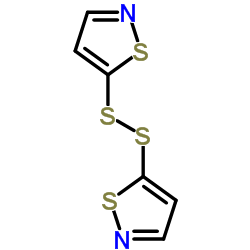
NU-9056 (NU9056) is novel, potent and selective KAT5 (Tip60) histone acetyltransferase inhibitor with anticancer effects. It inhibits KAT5 with IC50 values of < 2, 60, 36, and >100 μM for KAT5, p300, pCAF and GCN5, respectively. Also inhibits protein acetylation in prostate cancer cell lines and blocks DNA damage response. It alsp decreases proliferation of LNCaP cells; induces apoptosis via caspase activation.
Physicochemical Properties
| Molecular Formula | C6H4N2S4 |
| Molecular Weight | 232.35 |
| Exact Mass | 231.925 |
| CAS # | 1450644-28-6 |
| PubChem CID | 72201043 |
| Appearance | Yellow to brown liquid |
| Density | 1.6±0.1 g/cm3 |
| Boiling Point | 209.2±40.0 °C at 760 mmHg |
| Flash Point | 80.3±27.3 °C |
| Vapour Pressure | 0.3±0.4 mmHg at 25°C |
| Index of Refraction | 1.759 |
| LogP | 1.59 |
| Hydrogen Bond Donor Count | 0 |
| Hydrogen Bond Acceptor Count | 6 |
| Rotatable Bond Count | 3 |
| Heavy Atom Count | 12 |
| Complexity | 130 |
| Defined Atom Stereocenter Count | 0 |
| SMILES | S(C1=CC=NS1)SC1=CC=NS1 |
| InChi Key | MLRAMCAHIWHWRM-UHFFFAOYSA-N |
| InChi Code | InChI=1S/C6H4N2S4/c1-3-7-9-5(1)11-12-6-2-4-8-10-6/h1-4H |
| Chemical Name | 5-(1,2-thiazol-5-yldisulfanyl)-1,2-thiazole |
| Synonyms | NU-9056 NU 9056 NU9056 |
| HS Tariff Code | 2934.99.9001 |
| Storage |
Powder-20°C 3 years 4°C 2 years In solvent -80°C 6 months -20°C 1 month |
| Shipping Condition | Room temperature (This product is stable at ambient temperature for a few days during ordinary shipping and time spent in Customs) |
Biological Activity
| ln Vitro | In a concentration- and time-dependent manner, NU9056 (17–36 μM; 24-96 hours) activates caspase 3 and 9. The cue histones H4K16, H3K14, and H4K8, which are the targets of Tip60-mediated oralization, are less abundant after treatment with NU9056 (2.5–40 μM; 2) [1]. A treatment with NU9056 also decreased the levels of p53 and p21 proteins, drought stress front, and androgen irrigation [1]. |
| ln Vivo | Mice were injected with Nu9056 (2 μg/g), and hippocampi were harvested 1 hour later. Tip60 inhibits H2A.Z binding on the -1 nucleosome of Arc and the +1 nucleosome of Arc and Syp. In addition, Nu9056 promotes the throating of -1 nucleosomes of Fos, Tacstd2 and Gria4 as well as the +1 nucleosome of Gria4 [2]. |
| Cell Assay |
Apoptosis Analysis[1] Cell Types: LNCaP Cell Tested Concentrations: 17 µM, 24 µM, 36 µM Incubation Duration: 24 hrs (hours), 48 hrs (hours), 72 hrs (hours), 96 hrs (hours) Experimental Results: Induction of apoptosis by activating caspase 3 and caspase 9 at a certain concentration and time Dependence on death. Western Blot Analysis[1] Cell Types: LNCaP Cell Tested Concentrations: 2.5 µM, 5 µM, 10 µM, 20 µM, 40 µM Incubation Duration: 2 hrs (hours) Experimental Results: diminished levels of Tip60 target acetylated histones H4K16, H3K14 and H4K8 - mediator induced acetylation. |
| References |
[1]. Characterisation of a Tip60 specific inhibitor, NU9056, in prostate cancer. PLoS One. 2012;7(10):e45539. [2]. Blocking H2A.Z Incorporation via Tip60 Inhibition Promotes Systems Consolidation of Fear Memory in Mice. eNeuro. 2018 Nov 8;5(5):ENEURO.0378-18.2018. |
Solubility Data
| Solubility (In Vitro) | DMSO : ~125 mg/mL (~537.94 mM) |
| Solubility (In Vivo) |
Solubility in Formulation 1: ≥ 2.08 mg/mL (8.95 mM) (saturation unknown) in 10% DMSO + 90% (20% SBE-β-CD in Saline) (add these co-solvents sequentially from left to right, and one by one), clear solution. For example, if 1 mL of working solution is to be prepared, you can add 100 μL of 20.8 mg/mL clear DMSO stock solution to 900 μL of 20% SBE-β-CD physiological saline solution and mix evenly. Preparation of 20% SBE-β-CD in Saline (4°C,1 week): Dissolve 2 g SBE-β-CD in 10 mL saline to obtain a clear solution. Solubility in Formulation 2: ≥ 2.08 mg/mL (8.95 mM) (saturation unknown) in 10% DMSO + 90% Corn Oil (add these co-solvents sequentially from left to right, and one by one), clear solution. For example, if 1 mL of working solution is to be prepared, you can add 100 μL of 20.8 mg/mL clear DMSO stock solution to 900 μL of corn oil and mix evenly. Solubility in Formulation 3: ≥ 1.1 mg/mL (4.73 mM) (saturation unknown) in 10% DMSO + 40% PEG300 + 5% Tween80 + 45% Saline (add these co-solvents sequentially from left to right, and one by one), clear solution. For example, if 1 mL of working solution is to be prepared, you can add 100 μL of 11.0 mg/mL clear DMSO stock solution to 400 μL PEG300 and mix evenly; then add 50 μL Tween-80 to the above solution and mix evenly; then add 450 μL normal saline to adjust the volume to 1 mL. Preparation of saline: Dissolve 0.9 g of sodium chloride in 100 mL ddH₂ O to obtain a clear solution. (Please use freshly prepared in vivo formulations for optimal results.) |
| Preparing Stock Solutions | 1 mg | 5 mg | 10 mg | |
| 1 mM | 4.3039 mL | 21.5193 mL | 43.0385 mL | |
| 5 mM | 0.8608 mL | 4.3039 mL | 8.6077 mL | |
| 10 mM | 0.4304 mL | 2.1519 mL | 4.3039 mL |