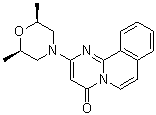
Physicochemical Properties
| Molecular Formula | C18H19N3O2 |
| Molecular Weight | 309.36236 |
| Exact Mass | 309.14773 |
| Elemental Analysis | C, 69.88; H, 6.19; N, 13.58; O, 10.34 |
| CAS # | 503465-21-2 |
| PubChem CID | 11771277 |
| Appearance | Typically exists as solid at room temperature |
| Density | 1.3±0.1 g/cm3 |
| Boiling Point | 461.5±55.0 °C at 760 mmHg |
| Flash Point | 232.9±31.5 °C |
| Vapour Pressure | 0.0±1.1 mmHg at 25°C |
| Index of Refraction | 1.668 |
| LogP | 2.1 |
| InChi Key | WEXIWJYAPCUIPH-BETUJISGSA-N |
| InChi Code | InChI=1S/C18H19N3O2/c1-12-10-20(11-13(2)23-12)16-9-17(22)21-8-7-14-5-3-4-6-15(14)18(21)19-16/h3-9,12-13H,10-11H2,1-2H3/t12-,13+ |
| Chemical Name | 2-[(2S,6R)-2,6-dimethylmorpholin-4-yl]pyrimido[2,1-a]isoquinolin-4-one |
| Synonyms | NU-7107; NU 7107; NU7107; CHEMBL176436; 503465-21-2; 2-((2R,6S)-2,6-dimethylmorpholino)-4H-pyrimido[2,1-a]isoquinolin-4-one; 2-((2S,6R)-2,6-Dimethyl-morpholin-4-yl)-pyrimido[2,1-a]isoquinolin-4-one; SCHEMBL3536365; BDBM50159615; 2-[(2S,6R)-2,6-dimethylmorpholin-4-yl]pyrimido[2,1-a]isoquinolin-4-one |
| HS Tariff Code | 2934.99.9001 |
| Storage |
Powder-20°C 3 years 4°C 2 years In solvent -80°C 6 months -20°C 1 month |
| Shipping Condition | Room temperature (This product is stable at ambient temperature for a few days during ordinary shipping and time spent in Customs) |
Biological Activity
| Targets | DNA-PK |
| ln Vivo | In this study we investigated the in vitro time dependence of radiosensitisation, pharmacokinetics and metabolism of NU7026, a novel inhibitor of the DNA repair enzyme DNA-dependent protein kinase (DNA-PK). At a dose of 10 μM, which is nontoxic to cells per se, a minimum NU7026 exposure of 4 h in combination with 3 Gy radiation is required for a significant radiosensitisation effect in CH1 human ovarian cancer cells. Following intravenous administration to mice at 5 mg kg−1, NU7026 underwent rapid plasma clearance (0.108 l h−1) and this was largely attributed to extensive metabolism. Bioavailability following interperitoneal (i.p.) and p.o. administration at 20 mg kg−1 was 20 and 15%, respectively. Investigation of NU7026 metabolism profiles in plasma and urine indicated that the compound undergoes multiple hydroxylations. A glucuronide conjugate of a bis-hydroxylated metabolite represented the major excretion product in urine. Identification of the major oxidation site as C-2 of the morpholine ring was confirmed by the fact that the plasma clearance of NU-7107 (an analogue of NU7026 methylated at C-2 and C-6 of the morpholine ring) was four-fold slower than that of NU7026. The pharmacokinetic simulations performed predict that NU7026 will have to be administered four times per day at 100 mg kg−1 i.p. in order to obtain the drug exposure required for radiosensitisation. |
| Animal Protocol | In order to confirm if substitution of the hydroxylation positions could decrease metabolism and therefore plasma clearance, a bis-methylated morpholino derivative of NU7026 (NU-7107) (Figure 1) was synthesised and administered to mice i.p. at 20 mg kg−1. The pharmacokinetic profile of NU-7107 was significantly improved compared with NU7026 (Figure 7, Table 3), with a four-fold decrease in plasma clearance. Although there was no significant difference in the terminal half-life, NU-7107 was still detectable 6 h post administration (Figure 7). Although NU-7107 is significantly weaker at inhibiting DNA-PK (IC50>10 μM) in comparison to NU7026, synthesis of this compound demonstrated the importance of metabolism in the clearance of NU7026 and showed that pharmacokinetic properties can be modulated by the appropriate substitution.[1] |
| References | [1]. Preclinical pharmacokinetics and metabolism of a novel prototype DNA-PK inhibitor NU7026. Br J Cancer. 2005 Oct 31;93(9):1011-8. |
| Additional Infomation | Furthermore, we showed that NU7107, which has two positions on the morpholino ring blocked for metabolism by methyl groups, has a four-fold lower plasma clearance compared to NU7026. |
Solubility Data
| Solubility (In Vitro) | May dissolve in DMSO (in most cases), if not, try other solvents such as H2O, Ethanol, or DMF with a minute amount of products to avoid loss of samples |
| Solubility (In Vivo) |
Note: Listed below are some common formulations that may be used to formulate products with low water solubility (e.g. < 1 mg/mL), you may test these formulations using a minute amount of products to avoid loss of samples. Injection Formulations (e.g. IP/IV/IM/SC) Injection Formulation 1: DMSO : Tween 80: Saline = 10 : 5 : 85 (i.e. 100 μL DMSO stock solution → 50 μL Tween 80 → 850 μL Saline) *Preparation of saline: Dissolve 0.9 g of sodium chloride in 100 mL ddH ₂ O to obtain a clear solution. Injection Formulation 2: DMSO : PEG300 :Tween 80 : Saline = 10 : 40 : 5 : 45 (i.e. 100 μL DMSO → 400 μLPEG300 → 50 μL Tween 80 → 450 μL Saline) Injection Formulation 3: DMSO : Corn oil = 10 : 90 (i.e. 100 μL DMSO → 900 μL Corn oil) Example: Take the Injection Formulation 3 (DMSO : Corn oil = 10 : 90) as an example, if 1 mL of 2.5 mg/mL working solution is to be prepared, you can take 100 μL 25 mg/mL DMSO stock solution and add to 900 μL corn oil, mix well to obtain a clear or suspension solution (2.5 mg/mL, ready for use in animals). Injection Formulation 4: DMSO : 20% SBE-β-CD in saline = 10 : 90 [i.e. 100 μL DMSO → 900 μL (20% SBE-β-CD in saline)] *Preparation of 20% SBE-β-CD in Saline (4°C,1 week): Dissolve 2 g SBE-β-CD in 10 mL saline to obtain a clear solution. Injection Formulation 5: 2-Hydroxypropyl-β-cyclodextrin : Saline = 50 : 50 (i.e. 500 μL 2-Hydroxypropyl-β-cyclodextrin → 500 μL Saline) Injection Formulation 6: DMSO : PEG300 : castor oil : Saline = 5 : 10 : 20 : 65 (i.e. 50 μL DMSO → 100 μLPEG300 → 200 μL castor oil → 650 μL Saline) Injection Formulation 7: Ethanol : Cremophor : Saline = 10: 10 : 80 (i.e. 100 μL Ethanol → 100 μL Cremophor → 800 μL Saline) Injection Formulation 8: Dissolve in Cremophor/Ethanol (50 : 50), then diluted by Saline Injection Formulation 9: EtOH : Corn oil = 10 : 90 (i.e. 100 μL EtOH → 900 μL Corn oil) Injection Formulation 10: EtOH : PEG300:Tween 80 : Saline = 10 : 40 : 5 : 45 (i.e. 100 μL EtOH → 400 μLPEG300 → 50 μL Tween 80 → 450 μL Saline) Oral Formulations Oral Formulation 1: Suspend in 0.5% CMC Na (carboxymethylcellulose sodium) Oral Formulation 2: Suspend in 0.5% Carboxymethyl cellulose Example: Take the Oral Formulation 1 (Suspend in 0.5% CMC Na) as an example, if 100 mL of 2.5 mg/mL working solution is to be prepared, you can first prepare 0.5% CMC Na solution by measuring 0.5 g CMC Na and dissolve it in 100 mL ddH2O to obtain a clear solution; then add 250 mg of the product to 100 mL 0.5% CMC Na solution, to make the suspension solution (2.5 mg/mL, ready for use in animals). Oral Formulation 3: Dissolved in PEG400 Oral Formulation 4: Suspend in 0.2% Carboxymethyl cellulose Oral Formulation 5: Dissolve in 0.25% Tween 80 and 0.5% Carboxymethyl cellulose Oral Formulation 6: Mixing with food powders Note: Please be aware that the above formulations are for reference only. InvivoChem strongly recommends customers to read literature methods/protocols carefully before determining which formulation you should use for in vivo studies, as different compounds have different solubility properties and have to be formulated differently. (Please use freshly prepared in vivo formulations for optimal results.) |
| Preparing Stock Solutions | 1 mg | 5 mg | 10 mg | |
| 1 mM | 3.2325 mL | 16.1624 mL | 32.3248 mL | |
| 5 mM | 0.6465 mL | 3.2325 mL | 6.4650 mL | |
| 10 mM | 0.3232 mL | 1.6162 mL | 3.2325 mL |