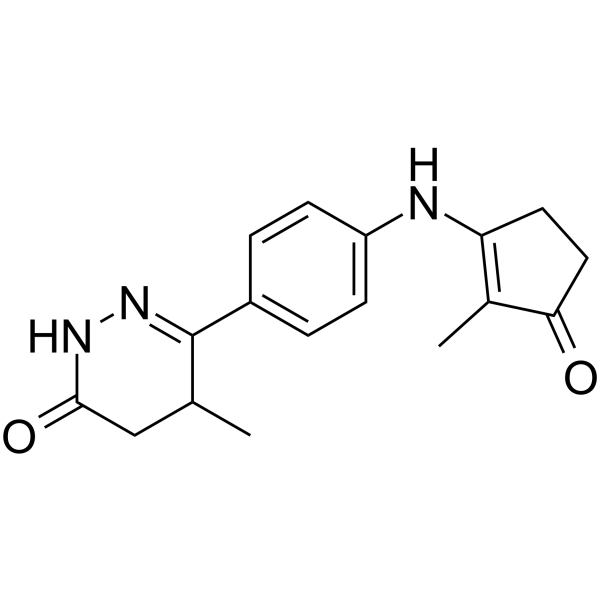
Physicochemical Properties
| Molecular Formula | C17H19N3O2 |
| Molecular Weight | 297.35166 |
| Exact Mass | 297.148 |
| CAS # | 125068-54-4 |
| PubChem CID | 130349 |
| Appearance | Light yellow to yellow solid powder |
| Density | 1.3g/cm3 |
| Index of Refraction | 1.656 |
| LogP | 2.38 |
| Hydrogen Bond Donor Count | 2 |
| Hydrogen Bond Acceptor Count | 4 |
| Rotatable Bond Count | 3 |
| Heavy Atom Count | 22 |
| Complexity | 542 |
| Defined Atom Stereocenter Count | 0 |
| InChi Key | DSRIICXPBQXOKK-UHFFFAOYSA-N |
| InChi Code | InChI=1S/C17H19N3O2/c1-10-9-16(22)19-20-17(10)12-3-5-13(6-4-12)18-14-7-8-15(21)11(14)2/h3-6,10,18H,7-9H2,1-2H3,(H,19,22) |
| Chemical Name | 4-methyl-3-[4-[(2-methyl-3-oxocyclopenten-1-yl)amino]phenyl]-4,5-dihydro-1H-pyridazin-6-one |
| HS Tariff Code | 2934.99.9001 |
| Storage |
Powder-20°C 3 years 4°C 2 years In solvent -80°C 6 months -20°C 1 month |
| Shipping Condition | Room temperature (This product is stable at ambient temperature for a few days during ordinary shipping and time spent in Customs) |
Biological Activity
| Targets |
NSP-805 is a potent and selective inhibitor of cardiac phosphodiesterase (PDE) III (IC₅₀ = 0.30 µM). [1] |
| ln Vitro |
In isolated guinea pig left atrium, NSP-805 displayed positive inotropic EC50 values ranked by potency of 0.18 μM. The inotropic effects of NSP-805 in vitro are accompanied by an increase in tissue cyclic adenosine monophosphate and are eliminated by carbachol [1]. In isolated guinea pig left atria, NSP-805 produced a concentration-dependent positive inotropic effect with an EC₅₀ of approximately 0.18 µM, making it the most potent among the cardiotonic agents tested (e.g., milrinone EC₅₀ = 1.7 µM, indolidan EC₅₀ = 0.39 µM). [1] In isolated guinea pig spontaneously beating right atria, NSP-805 produced a concentration-dependent positive chronotropic effect, although the increase in atrial rate was much less pronounced than its inotropic effect. [1] In isolated rat thoracic aortic strips pre-contracted with 40 mM K⁺, NSP-805 induced concentration-dependent vasodilation with an EC₅₀ of 6.5 µM. [1] The positive inotropic effect of NSP-805 (3 µM) in guinea pig left atria was completely abolished by carbachol (0.03 µM) and restored by atropine (0.3 µM), similar to the effects of isoproterenol and other PDE III inhibitors, indicating a mechanism mediated through cyclic AMP. [1] NSP-805 (3 µM) increased the tissue cyclic AMP content in guinea pig left atria concomitantly with the increase in developed tension. [1] NSP-805 potently and selectively inhibited guinea pig left ventricular PDE III activity with an IC₅₀ of 0.30 µM. Its inhibitory effects on PDE I (IC₅₀ > 1000 µM) and PDE II (IC₅₀ = 530 µM) were significantly weaker. [1] |
| ln Vivo |
Intravenous treatment of NSP-805 in sedated dogs produced a slight rise in heart rate (HR), a decrease in aortic blood pressure (ABP), and a dose-dependent increase in left ventricular VVdp/dtmax. The ED50 value of LVdP/dtmax for NSP-805 is 12 μg/kg. The ED50 value of NSP-805, when given intraduodenally to dogs under anesthesia, is roughly 10 μg/kg. NSP-805 restored the hemodynamic status of heart failure to normal levels in a model of propranolol-induced heart failure [1]. Rabbit eyes treated with NSP-805 at a dose of 100 μg/kg showed a considerable decrease in systemic blood pressure, but the rise in chorioretinal blood flow was less than that observed in eyes treated with NSP-805 at a low dose of 40 μg/kg [2]. In anesthetized dogs, intravenous (i.v.) injection of NSP-805 produced dose-dependent increases in left ventricular dP/dtmax (ED₅₀ = 12 µg/kg) and decreases in mean aortic blood pressure, with relatively small increases in heart rate. No arrhythmias were observed in the tested dose range. [1] Intraduodenal (i.d.) administration of NSP-805 (single bolus) in anesthetized dogs also produced dose-dependent increases in left ventricular dP/dtmax (ED₅₀ = 10 µg/kg), with a long duration of action (>4 hours at 10 µg/kg). The cardiotonic effect was accompanied by a minor increase in heart rate and a decrease in mean aortic blood pressure. [1] In a propranolol-induced acute heart failure model in anesthetized open-chest dogs, a single i.v. bolus of NSP-805 (10 µg/kg) significantly improved hemodynamics: it increased left ventricular dP/dtmax, cardiac output, and stroke volume, while reducing right atrial pressure and total peripheral resistance to pre-propranolol levels. These beneficial effects lasted for more than 90 minutes. [1] |
| Enzyme Assay |
Phosphodiesterase (PDE) activity was measured using an assay based on the hydrolysis of tritiated cyclic nucleotides. The reaction mixture contained Tris-HCl buffer, MgSO₄, 2-mercaptoethanol, and the substrate ([³H]-cyclic AMP or [³H]-cyclic GMP) at a concentration of 1 µM. After incubation with a suitably diluted enzyme preparation, the reaction was stopped by heating. Snake venom was then added to convert the hydrolysis product to [³H]-adenosine or [³H]-guanosine, which was separated from the reaction mixture using an anion-exchange resin column. The radioactivity was quantified by liquid scintillation counting to determine PDE activity. The concentration of NSP-805 causing 50% inhibition of enzyme activity (IC₅₀) was calculated from concentration-inhibition curves. [1] |
| Animal Protocol |
For studies in anesthetized dogs, animals were anesthetized with sodium pentobarbital (30 mg/kg i.v.) and maintained under anesthesia by continuous infusion. Hemodynamic parameters (aortic blood pressure, left ventricular pressure, dP/dtmax, heart rate) were monitored. NSP-805 was dissolved in 20% DMSO-saline and administered either intravenously via the femoral vein in cumulative doses (volume: 0.1 ml/kg) at 5-minute intervals, or intraduodenally as a single bolus dose (volume: 0.5 ml/kg). [1] For the propranolol-induced heart failure model in anesthetized open-chest dogs, heart failure was induced by a single i.v. bolus of propranolol (4 mg/kg) followed by a continuous infusion (0.12 mg/kg/min). Thirty minutes later, a single i.v. bolus of NSP-805 (10 µg/kg, dissolved in 20% DMSO-saline) was administered via the femoral vein, and hemodynamic parameters were monitored for 90 minutes. [1] |
| References |
[1]. Cardiovascular effects of NSP-804 and NSP-805, novel cardiotonic agents with vasodilator properties. J Cardiovasc Pharmacol. 1993 Jun;21(6):983-95. [2]. [The effect of phosphodiesterase type 3 inhibitor on chorio-retinal blood flow in rabbits eyes]. Nippon Ganka Gakkai Zasshi. 2002 Oct;106(10):615-20. |
| Additional Infomation |
NSP-805 (4,5-dihydro-5-methyl-6-[4-[(2-methyl-3-oxo-1-cyclopentenyl)amino]phenyl]-3(2H)-pyridazinone) is a novel cardiotonic agent with vasodilator properties. [1] The primary mechanism of its positive inotropic action is considered to be selective inhibition of cardiac PDE III, leading to an increase in intracellular cyclic AMP levels. [1] The cardiovascular profile of NSP-805 suggests it may have beneficial effects in the treatment of congestive heart failure. [1] |
Solubility Data
| Solubility (In Vitro) | DMSO : ~41.67 mg/mL (~140.14 mM) |
| Solubility (In Vivo) |
Note: Listed below are some common formulations that may be used to formulate products with low water solubility (e.g. < 1 mg/mL), you may test these formulations using a minute amount of products to avoid loss of samples. Injection Formulations (e.g. IP/IV/IM/SC) Injection Formulation 1: DMSO : Tween 80: Saline = 10 : 5 : 85 (i.e. 100 μL DMSO stock solution → 50 μL Tween 80 → 850 μL Saline) *Preparation of saline: Dissolve 0.9 g of sodium chloride in 100 mL ddH ₂ O to obtain a clear solution. Injection Formulation 2: DMSO : PEG300 :Tween 80 : Saline = 10 : 40 : 5 : 45 (i.e. 100 μL DMSO → 400 μLPEG300 → 50 μL Tween 80 → 450 μL Saline) Injection Formulation 3: DMSO : Corn oil = 10 : 90 (i.e. 100 μL DMSO → 900 μL Corn oil) Example: Take the Injection Formulation 3 (DMSO : Corn oil = 10 : 90) as an example, if 1 mL of 2.5 mg/mL working solution is to be prepared, you can take 100 μL 25 mg/mL DMSO stock solution and add to 900 μL corn oil, mix well to obtain a clear or suspension solution (2.5 mg/mL, ready for use in animals). Injection Formulation 4: DMSO : 20% SBE-β-CD in saline = 10 : 90 [i.e. 100 μL DMSO → 900 μL (20% SBE-β-CD in saline)] *Preparation of 20% SBE-β-CD in Saline (4°C,1 week): Dissolve 2 g SBE-β-CD in 10 mL saline to obtain a clear solution. Injection Formulation 5: 2-Hydroxypropyl-β-cyclodextrin : Saline = 50 : 50 (i.e. 500 μL 2-Hydroxypropyl-β-cyclodextrin → 500 μL Saline) Injection Formulation 6: DMSO : PEG300 : castor oil : Saline = 5 : 10 : 20 : 65 (i.e. 50 μL DMSO → 100 μLPEG300 → 200 μL castor oil → 650 μL Saline) Injection Formulation 7: Ethanol : Cremophor : Saline = 10: 10 : 80 (i.e. 100 μL Ethanol → 100 μL Cremophor → 800 μL Saline) Injection Formulation 8: Dissolve in Cremophor/Ethanol (50 : 50), then diluted by Saline Injection Formulation 9: EtOH : Corn oil = 10 : 90 (i.e. 100 μL EtOH → 900 μL Corn oil) Injection Formulation 10: EtOH : PEG300:Tween 80 : Saline = 10 : 40 : 5 : 45 (i.e. 100 μL EtOH → 400 μLPEG300 → 50 μL Tween 80 → 450 μL Saline) Oral Formulations Oral Formulation 1: Suspend in 0.5% CMC Na (carboxymethylcellulose sodium) Oral Formulation 2: Suspend in 0.5% Carboxymethyl cellulose Example: Take the Oral Formulation 1 (Suspend in 0.5% CMC Na) as an example, if 100 mL of 2.5 mg/mL working solution is to be prepared, you can first prepare 0.5% CMC Na solution by measuring 0.5 g CMC Na and dissolve it in 100 mL ddH2O to obtain a clear solution; then add 250 mg of the product to 100 mL 0.5% CMC Na solution, to make the suspension solution (2.5 mg/mL, ready for use in animals). Oral Formulation 3: Dissolved in PEG400 Oral Formulation 4: Suspend in 0.2% Carboxymethyl cellulose Oral Formulation 5: Dissolve in 0.25% Tween 80 and 0.5% Carboxymethyl cellulose Oral Formulation 6: Mixing with food powders Note: Please be aware that the above formulations are for reference only. InvivoChem strongly recommends customers to read literature methods/protocols carefully before determining which formulation you should use for in vivo studies, as different compounds have different solubility properties and have to be formulated differently. (Please use freshly prepared in vivo formulations for optimal results.) |
| Preparing Stock Solutions | 1 mg | 5 mg | 10 mg | |
| 1 mM | 3.3630 mL | 16.8152 mL | 33.6304 mL | |
| 5 mM | 0.6726 mL | 3.3630 mL | 6.7261 mL | |
| 10 mM | 0.3363 mL | 1.6815 mL | 3.3630 mL |