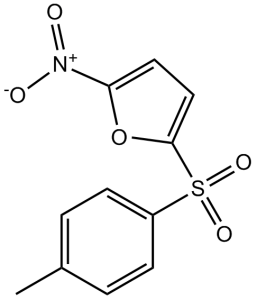
NSC697923 (NSC 697923; NSC-697923) is a potent, cell-permeable and selective inhibitor of the Ub-conjugating enzyme E2 (UBE2) complex Ubc13-Uev1A with potential anticancer activity. NSC697923 can inhibit proliferation and survival of diffuse large B-cell lymphoma cells (DLBCL). Importantly, NSC697923 is able to induce apoptosis. It can also induce nuclear accumulation of p53, which led to its increased transcriptional activity and tumor suppressor function.NSC697923 blocks the formation of the Ubc13-Uev1A by inhibiting the formation of the Ubc13_Ub conjugate while it is a key component for DLBCL grown. In the long term, the cell cannot survive without Ubc13 expression. In conclusion, compound NSC697923 is an efficient inhibitor of DLBAL survival.
Physicochemical Properties
| Molecular Formula | C11H9NO5S | |
| Molecular Weight | 267.255 | |
| Exact Mass | 267.02 | |
| Elemental Analysis | C, 49.44; H, 3.39; N, 5.24; O, 29.93; S, 12.00 | |
| CAS # | 343351-67-7 | |
| Related CAS # |
|
|
| PubChem CID | 394449 | |
| Appearance | White to light yellow solid powder | |
| LogP | 3.933 | |
| Hydrogen Bond Donor Count | 0 | |
| Hydrogen Bond Acceptor Count | 5 | |
| Rotatable Bond Count | 2 | |
| Heavy Atom Count | 18 | |
| Complexity | 402 | |
| Defined Atom Stereocenter Count | 0 | |
| SMILES | O=S(C1=CC=C([N+]([O-])=O)O1)(C2=CC=C(C)C=C2)=O |
|
| InChi Key | GAUHIPWCDXOLCZ-UHFFFAOYSA-N | |
| InChi Code | InChI=1S/C11H9NO5S/c1-8-2-4-9(5-3-8)18(15,16)11-7-6-10(17-11)12(13)14/h2-7H,1H3 | |
| Chemical Name | 2-[(4-Methylphenyl)sulfonyl]-5-nitrofuran | |
| Synonyms | NSC697923; NSC 697923; NSC-697923 | |
| HS Tariff Code | 2934.99.9001 | |
| Storage |
Powder-20°C 3 years 4°C 2 years In solvent -80°C 6 months -20°C 1 month |
|
| Shipping Condition | Room temperature (This product is stable at ambient temperature for a few days during ordinary shipping and time spent in Customs) |
Biological Activity
| ln Vitro | NSC697923 selectively inhibits PMA-induced NF-κB activation, and also inhibits IκBα phosphorylation by both RANKL and LPS. NSC697923 impedes the formation of the Ubc13 and ubiquitin thioester conjugate and suppresses constitutive NF-κB activity in ABC-DLBCL cells. In addition, NSC697923 inhibits the proliferation and survival of ABC-DLBCL cells and GCB-DLBCL cells, and also induces apoptosis of primary DLBCL cells. In neuroblastoma (NB) cell lines, NSC697923 shows cytotoxic effect, and inhibits both anchorage-dependent and -independent colony formation | ||
| ln Vivo |
|
||
| Enzyme Assay | The reactions are carried out at 37°C for 40 minutes in a buffer containing 50mM Tris-HCl, pH 7.5, 5mM MgCl2, 200μM ATP, 120μM Ub (U-100H), and 0.1μM E1 (E-304). For Ubc13-mediated Ub chain synthesis, the reaction mixture includes 0.2 μM Ubc13 (E2-600) and 0.2 mM Uev1A (E2-662) with or without GST-TRAF6. For UbcH5c-catalyzed ubiquitination, UbcH5c (E2-627) instead of Ubc13 and Uev1A is used in the reaction. Compound NSC697923 is added into the reaction mixtures at the indicated concentrations. The reactions are terminated with an equal volume of SDS-PAGE sample buffer and the products are analyzed by Western blotting with a Ub-specific antibody. For detecting the E2-Ub (Ubc13∼Ub or UbcH5c∼Ub) thioester conjugates, the reactions are carried out as described in “In vitro ubiquitination assay” without GST-TRAF6. The reactions are terminated by the addition of the SDS-PAGE sample buffer without a reducing agent unless specified. The products are analyzed by Western blotting with an anti-Ubc13 or anti-UbcH5c antibody. | ||
| Cell Assay | Cell viability is measured by trypan blue exclusion assay. | ||
| Animal Protocol |
|
||
| References | Blood.2012 Aug 23;120(8):1668-77;Cell Death Dis.2014 Feb 20;5:e1079. |
Solubility Data
| Solubility (In Vitro) | DMSO : 200~53 mg/mL (748.33 ~198.3 mM) |
| Solubility (In Vivo) |
Solubility in Formulation 1: ≥ 5 mg/mL (18.71 mM) (saturation unknown) in 10% DMSO + 40% PEG300 + 5% Tween80 + 45% Saline (add these co-solvents sequentially from left to right, and one by one), clear solution. For example, if 1 mL of working solution is to be prepared, you can add 100 μL of 50.0 mg/mL clear DMSO stock solution to 400 μL PEG300 and mix evenly; then add 50 μL Tween-80 to the above solution and mix evenly; then add 450 μL normal saline to adjust the volume to 1 mL. Preparation of saline: Dissolve 0.9 g of sodium chloride in 100 mL ddH₂ O to obtain a clear solution. Solubility in Formulation 2: ≥ 5 mg/mL (18.71 mM) (saturation unknown) in 10% DMSO + 90% Corn Oil (add these co-solvents sequentially from left to right, and one by one), clear solution. For example, if 1 mL of working solution is to be prepared, you can add 100 μL of 50.0 mg/mL clear DMSO stock solution to 900 μL of corn oil and mix evenly. (Please use freshly prepared in vivo formulations for optimal results.) |
| Preparing Stock Solutions | 1 mg | 5 mg | 10 mg | |
| 1 mM | 3.7417 mL | 18.7084 mL | 37.4167 mL | |
| 5 mM | 0.7483 mL | 3.7417 mL | 7.4833 mL | |
| 10 mM | 0.3742 mL | 1.8708 mL | 3.7417 mL |