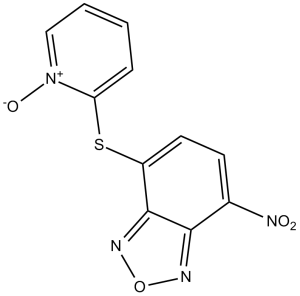
NSC228155 is a novel and potent activator of EGFR, which binds to the sEGFR dimerization domain II and modulate EGFR tyrosine phosphorylation. Previous study found that NSC228155 could dose-dependently inhibit KIX–KID interaction as measured by the split RLuc assay. In living HEK 293T cells, NSC228155 could inhibit CREB-mediated gene transcription with an IC50 of 2.09 μM. NSC228155 also inhibited VP16-CREB-mediated gene transcription with an IC50 of 6.14 μM. Though this was around 3-fold higher than the IC50 of CREB-mediated gene transcription, such results indicated that NSC228155 was not particularly selective in inhibiting KIX–KID interaction inside these living cells.
Physicochemical Properties
| Molecular Formula | C11H6N4O4S | |
| Molecular Weight | 290.25 | |
| Exact Mass | 290.01 | |
| CAS # | 113104-25-9 | |
| Related CAS # |
|
|
| PubChem CID | 313619 | |
| Appearance | Light yellow to orange solid powder | |
| Density | 1.7±0.1 g/cm3 | |
| Boiling Point | 627.3±65.0 °C at 760 mmHg | |
| Flash Point | 333.2±34.3 °C | |
| Vapour Pressure | 0.0±1.8 mmHg at 25°C | |
| Index of Refraction | 1.793 | |
| LogP | 0.07 | |
| Hydrogen Bond Donor Count | 0 | |
| Hydrogen Bond Acceptor Count | 7 | |
| Rotatable Bond Count | 2 | |
| Heavy Atom Count | 20 | |
| Complexity | 369 | |
| Defined Atom Stereocenter Count | 0 | |
| InChi Key | ICCFXXDUYSPKOL-UHFFFAOYSA-N | |
| InChi Code | InChI=1S/C11H6N4O4S/c16-14-6-2-1-3-9(14)20-8-5-4-7(15(17)18)10-11(8)13-19-12-10/h1-6H | |
| Chemical Name | 7-nitro-4-(1-oxidopyridin-1-ium-2-yl)sulfanyl-2,1,3-benzoxadiazole | |
| Synonyms |
|
|
| HS Tariff Code | 2934.99.9001 | |
| Storage |
Powder-20°C 3 years 4°C 2 years In solvent -80°C 6 months -20°C 1 month |
|
| Shipping Condition | Room temperature (This product is stable at ambient temperature for a few days during ordinary shipping and time spent in Customs) |
Biological Activity
| ln Vitro | Through the activity of SOD1, NSC 228155 (100 μM) increases EGFR tyrosine phosphorylation[1]. With IC50 values of 2.09 and 6.14 μM, respectively, NSC 228155 (compound 1) suppresses CREB- and VP16-CREB-mediated gene transcription in vivo HEK 293T cells [2]. In live HEK 293T cells, NSC 228155 is not selective for CREB-mediated gene transcription [2]. | ||
| ln Vivo |
|
||
| Animal Protocol |
|
||
| References |
[1]. Activation of EGFR by small compounds through coupling the generation of hydrogen peroxide to stable dimerization of Cu/Zn SOD1. Sci Rep. 2016 Feb 17;6:21088. [2]. Identification, synthesis and evaluation of substituted benzofurazans as inhibitors of CREB-mediated gene transcription. Bioorg Med Chem Lett. 2013 Oct 1;23(19):5371-5. |
Solubility Data
| Solubility (In Vitro) |
|
|||
| Solubility (In Vivo) |
Solubility in Formulation 1: 2 mg/mL (6.89 mM) in 15% Cremophor EL + 85% Saline (add these co-solvents sequentially from left to right, and one by one), suspension solution; with sonication. Preparation of saline: Dissolve 0.9 g of sodium chloride in 100 mL ddH₂ O to obtain a clear solution. Solubility in Formulation 2: ≥ 1.6 mg/mL (5.51 mM) (saturation unknown) in 10% DMSO + 90% Corn Oil (add these co-solvents sequentially from left to right, and one by one), clear solution. For example, if 1 mL of working solution is to be prepared, you can add 100 μL of 16.0 mg/mL clear DMSO stock solution to 900 μL of corn oil and mix evenly. (Please use freshly prepared in vivo formulations for optimal results.) |
| Preparing Stock Solutions | 1 mg | 5 mg | 10 mg | |
| 1 mM | 3.4453 mL | 17.2265 mL | 34.4531 mL | |
| 5 mM | 0.6891 mL | 3.4453 mL | 6.8906 mL | |
| 10 mM | 0.3445 mL | 1.7227 mL | 3.4453 mL |