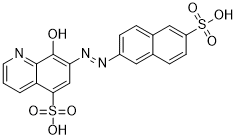
NSC-87877 (NSC87877) is a novel, potent, cell-permeable small molecule and competitive inhibitor of SHP-1 and SHP-2 PTP (protein tyrosine phosphatase) with anticancer activity. With an IC50 of 55 and 318 nM, respectively, it inhibits SHP-1 and SHP-2 PTP.
Physicochemical Properties
| Molecular Formula | C19H13N3O7S2 | |
| Molecular Weight | 459.45 | |
| Exact Mass | 459.019 | |
| Elemental Analysis | C, 49.67; H, 2.85; N, 9.15; O, 24.38; S, 13.96 | |
| CAS # | 56990-57-9 | |
| Related CAS # | NSC-87877 disodium;56932-43-5 | |
| PubChem CID | 92577 | |
| Appearance | Light brown to black solid powder | |
| Density | 1.7±0.1 g/cm3 | |
| Index of Refraction | 1.758 | |
| LogP | 0.12 | |
| Hydrogen Bond Donor Count | 3 | |
| Hydrogen Bond Acceptor Count | 10 | |
| Rotatable Bond Count | 4 | |
| Heavy Atom Count | 31 | |
| Complexity | 883 | |
| Defined Atom Stereocenter Count | 0 | |
| SMILES | N1C=CC=C2C(S(=O)(O)=O)=CC(/N=N/C3C=CC4C=C(S(O)(=O)=O)C=CC=4C=3)=C(O)C=12 |
|
| InChi Key | XGMFVZOKHBRUTL-UHFFFAOYSA-N | |
| InChi Code | InChI=1S/C19H13N3O7S2/c23-19-16(10-17(31(27,28)29)15-2-1-7-20-18(15)19)22-21-13-5-3-12-9-14(30(24,25)26)6-4-11(12)8-13/h1-10,23H,(H,24,25,26)(H,27,28,29) | |
| Chemical Name | 8-hydroxy-7-[(6-sulfonaphthalen-2-yl)diazenyl]quinoline-5-sulfonic acid | |
| Synonyms |
|
|
| HS Tariff Code | 2934.99.9001 | |
| Storage |
Powder-20°C 3 years 4°C 2 years In solvent -80°C 6 months -20°C 1 month Note: Please store this product in a sealed and protected environment, avoid exposure to moisture. |
|
| Shipping Condition | Room temperature (This product is stable at ambient temperature for a few days during ordinary shipping and time spent in Customs) |
Biological Activity
| Targets |
shp2 (IC50 = 0.318 μM); shp1 (IC50 = 0.355 μM)
SHP2 (protein tyrosine phosphatase, PTP) ( binds to the catalytic cleft) [1] - SHP1 (protein tyrosine phosphatase, PTP) (cross-inhibited in vitro) [1] - Dual-specificity phosphatase 26 (DUSP26) (competitive inhibition mode) [2][3] |
| ln Vitro |
NSC-87877 is a novel, potent, and cell-permeable small molecule inhibitor of SHP-1 and SHP-2 PTP (protein tyrosine phosphatase) that is soluble in cells. Its IC50 values are 55 and 318 nM, respectively. Protein phosphorylation is essential to many regulatory processes that govern cellular activity and, consequently, to a number of disorders. The functions of protein kinases and phosphatases control the equilibrium of phosphorylation within cells. These regulatory proteins have therefore become attractive targets for pharmaceutical development. NSC-87877 reduced the phosphotase activity of dual-specificity protein phosphatase 26 (DUSP26) in a dose-dependent way. NSC-87877 and DUSP26 kinetic studies showed a competitive inhibition. DUSP26-mediated dephosphorylation of p38, a member of the mitogen-activated protein kinase (MAPK) family, was efficiently inhibited by NSC-87877. NSC-87877 may be a therapeutic reagent for the treatment of anaplastic thyroid cancer (ATC) because DUSP26 is involved in the survival of ATC cells. NSC-87877 (chemical name: 8-hydroxy-7-(6-sulfonaphthalen-2-yl)diazenyl-quinoline-5-sulfonic acid) is a potent and selective inhibitor of SHP2 PTP. It cross-inhibits SHP1 in vitro but shows selectivity over other PTPs including PTP1B, HePTP, DEP1, CD45, and LAR [1] - It inhibits epidermal growth factor (EGF)-induced activation of SHP2 PTP, Ras, and Erk1/2 in cell cultures without blocking EGF-induced Gab1 tyrosine phosphorylation or Gab1-Shp2 association. It also inhibits Erk1/2 activation by a Gab1-Shp2 chimera but does not affect Shp2-independent Erk1/2 activation by phorbol 12-myristate 13-acetate [1] - NSC-87877 inhibits DUSP26 phosphatase activity in a dose-dependent manner and exhibits competitive inhibition kinetics with DUSP26. It effectively blocks DUSP26-mediated dephosphorylation of p38 MAP kinase [2] - In neuroblastoma (NB) cell lines (IMR32, NB-19, SH-SY5Y, SK-N-SH, SK-N-AS, SHEP), NSC-87877 shows dose- and time-dependent growth inhibition and induces apoptosis. The IC₅₀ values vary among different NB cell lines, with measurable cytotoxicity observed at concentrations starting from 0.25 μM [3] - Treatment with NSC-87877 increases p53 phosphorylation at Ser37 and Ser46, activates p53, and enhances the activation of downstream p38 effector proteins (HSP27 and MAPKAPK2) in NB cells. It also induces cleavage of PARP and caspase-3, markers of apoptosis [3] - The cytotoxicity of NSC-87877 in NB cells is partially reversed by knocking down p53 expression with shRNA or inhibiting p38 activity with SB203580. It also suppresses anchorage-independent growth of NB cells in soft agar assays [3] |
| ln Vivo |
NSC-87877 treatment inhibits tumor growth and increases p53 and p38 activity in an intrarenal mouse model of NB. NSC-87877's DUSP26 inhibition works well to activate the p53 and p38 mitogen-activated protein kinase (MAPK) tumor-suppressor pathways, which in turn causes NB cell cytotoxicity both in vitro and in vivo. NSC-87877 affects NB tumor growth in vivo[3] In order to test the effect of small molecule inhibition of DUSP26 in vivo, we used a well-established intrarenal NB tumor mouse model.30 SH-SY5Y cells with luciferase expression levels were injected into the left kidney of female nude mice. After 10 days of tumor growth, mice were treated with i.p. injection of placebo control (control) or 30 mg/kg of NSC-87877 once daily for 15 days. Mice were monitored weekly with i.p. injection of luciferin and bioluminescence imaging. Figure 7a demonstrates equivalent tumor burden with similar bioluminescent signal at day 1 of therapy and a difference in signal at 15 days of therapy. On day 15, necropsy was performed and the tumors were weighed. The control group tumors were significantly larger than the NSC-87877-treated group (P<0.01; Figure 7b). In an intrarenal xenograft mouse model of NB (female NCr nude mice implanted with luciferase-tagged SH-SY5Y cells), intraperitoneal injection of NSC-87877 at 30 mg/kg for 15 days results in significant tumor growth inhibition, as evidenced by reduced tumor weight and bioluminescent signal [3] - Tumor tissues from NSC-87877-treated mice show increased activation of p53 (phospho-p53 Ser46) and p38 pathway (phospho-MAPKAPK2, phospho-HSP27) compared to vehicle control. Cleavage of PARP and caspase-7 is also detected in tumor tissues from treated mice [3] |
| Enzyme Assay |
Prior to being further incubated with active phosphorylated p38 (10 ng) for 15 min at 37 °C, the six-His-tagged DUSP26 (1 μg) was pre-mixed with various NSC-87877 concentrations (0, 10, or 50 μM) in PTP assay buffer. Beginning with the pre-incubated samples, kinase reaction buffer (20 mM Tris–HCl (pH 7.5), 20 mM MgCl2, 0.1 mM sodium orthovanadate, and 1 mM DTT) was added, along with 20 μM ATP/10 μCi [γ-32P]ATP and 1 μg of GST-activating transcription factor 2 (ATF2) as a substrate, to start the kinase assay reactions. The kinase reaction products were separated by SDS-PAGE for autoradiography and the reactions were stopped after 30 minutes at 30 °C by adding SDS-PAGE sample buffer. In order to verify that DUSP26 does not dephosphorylate ATF2, ATF2 underwent 32P labeling through p38 incubation. Samples were incubated for an additional 30 minutes at 30 °C with or without DUSP26, and SDS-PAGE was used to resolve the results. After drying, the gels were exposed to X-ray film. \n\nImmune complex kinase tests. Co-transfection of HA-p38 and FLAG-DUSP26 expression plasmids into HEK 293 cells was done for the immune complex kinase assay. Cells were stimulated with H2O2 (1 mM, 30 min) after 48 h of transfection, and NSC-87877 (0–100 μM, 3 h) was pretreated. Using anti-HA agarose beads, cell extracts were immunoprecipitated after being centrifuged to remove excess liquid. The beads were treated with the PTP lysis buffer once, 150 mM NaCl, 5 mM EDTA, 2 mM DTT, and 1 mM PMSF twice, and once more with a mixture of 20 mM Tris–HCl (pH 7.5), 20 mM MgCl2, and 5 mM EDTA. Subsequently, the beads were again suspended in kinase reaction buffer (20 mM Tris–HCl (pH 7.5), 20 mM MgCl2, and 1 mM DTT) containing 20 μM ATP, 0.3 μCi of [γ-32P]ATP, and 1 μg of GST-ATF2 for 1 hour at 30 degrees Celsius. The SDS–PAGE technique was used to separate the kinase reaction products. Film was exposed to the gels after they had dried. \n\nAssays for phosphatase in vitro and kinetic evaluation. Using a 96-well microtiter plate assay based on previously published techniques, the activity of phosphatases was assessed using the substrate 3-O-methylfluorescein Phosphate at concentrations varying with the Km of each enzyme. H2O and DMSO were used to solubilize NSC-87877 and OMFP, respectively. Every reaction was carried out with 1% DMSO as the final concentration. The final incubation mixture (150 μl) contained 30 mM Tris–HCl (pH 7), 75 mM NaCl, 1 mM ethylenediaminetetraacetic acid (EDTA), 0.1 mM dithiothreitol (DTT), 0.33% bovine serum albumin (BSA), and 100 nM PTPs. This mixture was optimized for enzyme activity. OMFP was added to start the reaction, and it was incubated for 30 minutes at 37 °C. Using a multi-well plate reader (GENios Pro; excitation filter, 485 nm; emission filter, 535 nm), the product's fluorescence emission was measured. Throughout the course of the experiment, the reaction was linear and directly correlated with the concentrations of the enzyme and substrate. An inhibitor's half-maximal inhibition constant (IC50) was defined as the concentration at which PTP activity decreased by 50%. The best curve fit and half-maximal inhibition constants for Lineweaver–Burk plots were found using the curve fitting application Prism 3.0 . Every experiment was run through at least three repetitions in triplicate. \n\nAssays for dephosphorylation using phosphorylated MAPKs that are active. In the PTP assay buffer (30 mM Tris–HCl (pH 7), 75 mM NaCl, 1 mM EDTA, 0.1 mM DTT, and 0.33% BSA), the six-His-tagged DUSP26 (1 μg) was mixed with active phosphorylated p38 (10 ng), ERK (10 ng), or JNK (50 ng). The mixture was then incubated for 30 minutes at 37 °C. In a 30-μl reaction volume, 1 μg of DUSP26 was combined with 10 ng of active phosphorylated p38 and different concentrations of NSC-87877 (0, 10, or 100 μM) to see if NSC-87877 down-regulates the DUSP26 effect on p38 in vitro. The mixture was then incubated for 30 minutes at 37 °C. Using phospho-MAPK antibodies, the samples were subjected to Western blotting analysis to determine the phosphorylation state of MAPKs. PTP activity inhibition assay: Prepare reaction mixtures containing purified SHP2, SHP1, or other PTPs (PTP1B, HePTP, DEP1, CD45, LAR) with a phosphopeptide substrate. Add different concentrations of NSC-87877 to the reaction mixtures and incubate for a specified time. Measure the release of phosphate to determine the inhibitory effect on PTP activity and assess selectivity [1] - DUSP26 phosphatase activity assay: Prepare reaction mixtures with purified DUSP26 and a p38 MAP kinase substrate. Incubate with varying concentrations of NSC-87877 and measure the phosphatase activity by detecting the dephosphorylation of the substrate. Perform kinetic analysis to determine the inhibition mode (competitive inhibition) [2] |
| Cell Assay |
Following cell harvesting, lysing was done by sonication in 50 mM Tris–HCl (pH 8), 300 mM NaCl, 1% NP-40, and 1 mM PMSF (phenylmethylsulphonyl fluoride). For 30 minutes at 4 °C, the lysates were clarified at 4000 rpm. A column of Ni-NTA resin received the supernatant by gravity flow. Following an elution step using 20 mM Tris–HCl (pH 8), 500 mM NaCl, and 200–300 mM imidazole, the resin was rinsed with 20 mM Tris–HCl (pH 8), 50 mM imidazole, and 500 mM NaCl. After being dialyzed overnight against 20 mM Tris–HCl, 100 mM NaCl, 30% glycerol, and 0.5 mM PMSF, the eluted proteins were stored at −80 °C. Cell viability and proliferation assay: Seed NB cell lines or other target cells in 96-well plates. Treat with NSC-87877 at concentrations ranging from 0.25 μM to 50 μM for 24–72 h. Assess cell viability using MTT assay (measuring absorbance at 540 nm) and calculate IC₅₀ values. For long-term proliferation analysis, monitor cell growth every 24 h for up to 5–9 days [3] - Western blot analysis: Treat cells with NSC-87877 at specified concentrations and time points. Lyse cells, extract total proteins, separate by SDS-PAGE, and transfer to membranes. Probe with antibodies against target proteins (p-SHP2, Ras, Erk1/2, p-p53, p53, p-p38, HSP27, MAPKAPK2, PARP, caspase-3, caspase-7, β-actin) to detect protein expression, phosphorylation, or cleavage [1][3] - Soft agar colony formation assay: Seed NB cells in six-well plates with agar, media, and different concentrations of NSC-87877. Incubate for 2–3 weeks, stain colonies with MTT, count colonies, and quantify anchorage-independent growth [3] - shRNA knockdown rescue assay: Transduce NB cells with p53 shRNA or non-silencing control shRNA. Seed transduced cells in 96-well plates, treat with NSC-87877 for 48–72 h, and assess cell viability by MTT assay to verify the role of p53 in drug-induced cytotoxicity [3] - p38 inhibition rescue assay: Seed NB cells in 96-well plates, pretreat with 5 μM SB203580 (p38 inhibitor) or vehicle, then add increasing concentrations of NSC-87877. Measure cell viability by MTT assay to evaluate the contribution of p38 pathway to drug-induced cytotoxicity [3] |
| Animal Protocol |
Intrarenal neuroblastoma (NB) tumor mouse model in female nude mice. 30 mg/kg. IP once daily for 15 days. Effect of RNA interference and NSC-87877 on NB cell growth in an orthotopic mouse model[3] Female Nu-nude mice (Taconic Biosciences, Hudson, NY, USA) were used for in vivo testing of NSC-87877 compared with control. SH-SY5Y transduced luciferase cells (SY5Y-Luc) and SH-SY5Y transduced with shDUSP26-1 were implanted into the left kidney as previously described.30 The mice were imaged 10 days after implantation and flux measured. A threshold of 5 × 10⁷ total flux (p/s) was used to standardize the mice who would be treated. Two groups were treated, one with NSC-87877 using a dose of 30 mg/kg/day, and the other with a carrier control composed of an equivalent volume of 0.9% NaCl via i.p. injection. After 15 days, necropsy was performed and tumor weights measured. For phosphor-immunoblotting, SH-SY5Y-Luc were implanted into the kidneys of three mice, once the previously indicated threshold for flux was reached, two mice were treated with 30 mg/kg of NSC-87877 and one control mouse was treated with carrier control. The mice were killed, at 12 and 24 h after administration of NSC-87877, and necropsy was performed. Tumors were immediately flash frozen with liquid nitrogen for later protein extraction. Protein was extracted by grinding 10 mg of tumor tissue, which was mixed with protein lysis buffer, passed through a 22 G needle, and incubated on ice for 30 min.[3] NB intrarenal xenograft model: Implant luciferase-tagged SH-SY5Y cells into the left kidney of female NCr nude mice. After confirming tumor establishment via bioluminescent imaging, randomly divide mice into treatment and control groups (n ≥ 3 per group). Administer NSC-87877 at 30 mg/kg via intraperitoneal injection once daily for 15 days; the control group receives normal saline. Monitor tumor growth weekly using bioluminescent imaging. At the end of the study, euthanize mice, dissect tumors, weigh them, and extract proteins for western blot analysis [3] |
| References |
[1]. Discovery of a novel shp2 protein tyrosine phosphatase inhibitor. Mol Pharmacol. 2006 Aug;70(2):562-70. [2]. NSC-87877, inhibitor of SHP-1/2 PTPs, inhibits dual-specificity phosphatase 26 (DUSP26). Biochem Biophys Res Commun. 2009 Apr 17;381(4):491-5. [3]. NSC-87877 inhibits DUSP26 function in neuroblastoma resulting in p53-mediated apoptosis. Cell Death Dis. 2015 Aug 6;6(8):e1841. |
| Additional Infomation |
8-oxo-7-[(6-sulfo-2-naphthalenyl)hydrazinylidene]-5-quinolinesulfonic acid is a naphthalenesulfonic acid. \n\nShp2 is a nonreceptor protein tyrosine phosphatase (PTP) encoded by the PTPN11 gene. It is involved in growth factorinduced activation of mitogen-activated protein (MAP) kinases Erk1 and Erk2 (Erk1/2) and has been implicated in the pathogenicity of the oncogenic bacterium Helicobacter pylori. Moreover, gain-of-function Shp2 mutations have been found in childhood leukemias and Noonan syndrome. Thus, small molecule Shp2 PTP inhibitors are much needed reagents for evaluation of Shp2 as a therapeutic target and for chemical biology studies of Shp2 function. By screening the National Cancer Institute (NCI) Diversity Set chemical library, we identified 8-hydroxy-7-(6-sulfonaphthalen-2-yl)diazenyl-quinoline-5-sulfonic acid (NSC-87877) as a potent Shp2 PTP inhibitor. Molecular modeling and site-directed mutagenesis studies suggested that NSC-87877 binds to the catalytic cleft of Shp2 PTP. NSC-87877 cross-inhibited Shp1 in vitro, but it was selective for Shp2 over other PTPs (PTP1B, HePTP, DEP1, CD45, and LAR). It is noteworthy that NSC-87877 inhibited epidermal growth factor (EGF)-induced activation of Shp2 PTP, Ras, and Erk1/2 in cell cultures but did not block EGF-induced Gab1 tyrosine phosphorylation or Gab1-Shp2 association. Furthermore, NSC-87877 inhibited Erk1/2 activation by a Gab1-Shp2 chimera but did not affect the Shp2-independent Erk1/2 activation by phorbol 12-myristate 13-acetate. These results identified NSC-87877 as the first PTP inhibitor capable of inhibiting Shp2 PTP in cell cultures without a detectable off-target effect. Our study also provides the first pharmacological evidence that Shp2 mediates EGF-induced Erk1/2 MAP kinase activation.[1] \n\nProtein phosphorylation plays critical roles in many regulatory mechanisms controlling cell activities and thus involved in various diseases. The cellular equilibrium of phosphorylation is regulated through the actions of protein kinases and phosphatases. Therefore, these regulatory proteins have emerged as promising targets for drug development. In this study, we screened protein tyrosine phosphatases (PTPs) by in vitro phosphatase assays to identify PTPs that are inhibited by 8-hydroxy-7-(6-sulfonaphthalen-2-yl)diazenyl-quinoline-5-sulfonic acid (NSC-87877), a potent inhibitor of SHP-1 and SHP-2 PTPs. Phosphatase activity of dual-specificity protein phosphatase 26 (DUSP26) was decreased by the inhibitor in a dose-dependent manner. Kinetic studies with NSC-87877 and DUSP26 revealed a competitive inhibition. NSC-87877 effectively inhibited DUSP26-mediated dephosphorylation of p38, a member of mitogen-activated protein kinase (MAPK) family. Since DUSP26 is involved in survival of anaplastic thyroid cancer (ATC) cells, NSC-87877 could be a therapeutic reagent for treating ATC.[2] \n\nDual specificity protein phosphatase 26 (DUSP26) is overexpressed in high-risk neuroblastoma (NB) and contributes to chemoresistance by inhibiting p53 function. In vitro, DUSP26 has also been shown to effectively inhibit p38 MAP kinase. We hypothesize that inhibiting DUSP26 will result in decreased NB cell growth in a p53 and/or p38-mediated manner. NSC-87877 (8-hydroxy-7-[(6-sulfo-2-naphthyl)azo]-5-quinolinesulfonic acid), a novel DUSP26 small molecule inhibitor, shows effective growth inhibition and induction of apoptosis in NB cell lines. NB cell lines treated with small hairpin RNA (shRNA) targeting DUSP26 also exhibit a proliferation defect both in vitro and in vivo. Treatment of NB cell lines with NSC-87877 results in increased p53 phosphorylation (Ser37 and Ser46) and activation, increased activation of downstream p38 effector proteins (heat shock protein 27 (HSP27) and MAP kinase-activated protein kinase 2 (MAPKAPK2)) and poly ADP ribose polymerase/caspase-3 cleavage. The cytotoxicity resulting from DUSP26 inhibition is partially reversed by knocking down p53 expression with shRNA and also by inhibiting p38 activity with SB203580 (4-[4-(4-fluorophenyl)-2-(4-methylsulfinylphenyl)-1H-imidazol-5-yl]pyridine). In an intrarenal mouse model of NB, NSC-87877 treatment results in decreased tumor growth and increased p53 and p38 activity. Together, these results suggest that DUSP26 inhibition with NSC-87877 is an effective strategy to induce NB cell cytotoxicity in vitro and in vivo through activation of the p53 and p38 mitogen-activated protein kinase (MAPK) tumor-suppressor pathways.[3] NSC-87877 was identified as a Shp2 PTP inhibitor through screening the National Cancer Institute (NCI) Diversity Set chemical library. Molecular modeling and site-directed mutagenesis studies suggest it binds to the catalytic cleft of Shp2 [1] - It is the first PTP inhibitor capable of inhibiting Shp2 PTP in cell cultures without detectable off-target effects, providing pharmacological evidence that Shp2 mediates EGF-induced Erk1/2 MAP kinase activation [1] - DUSP26 is overexpressed in high-risk NB and contributes to chemoresistance by inhibiting p53 function. NSC-87877 targeting DUSP26 represents a potential therapeutic strategy for NB and anaplastic thyroid cancer (ATC) [2][3] |
Solubility Data
| Solubility (In Vitro) |
|
|||
| Solubility (In Vivo) |
Solubility in Formulation 1: ≥ 2.08 mg/mL (4.53 mM) (saturation unknown) in 10% DMSO + 90% (20% SBE-β-CD in Saline) (add these co-solvents sequentially from left to right, and one by one), clear solution. For example, if 1 mL of working solution is to be prepared, you can add 100 μL of 20.8 mg/mL clear DMSO stock solution to 900 μL of 20% SBE-β-CD physiological saline solution and mix evenly. Preparation of 20% SBE-β-CD in Saline (4°C,1 week): Dissolve 2 g SBE-β-CD in 10 mL saline to obtain a clear solution. Solubility in Formulation 2: ≥ 1.67 mg/mL (3.63 mM) (saturation unknown) in 10% DMSO + 40% PEG300 + 5% Tween80 + 45% Saline (add these co-solvents sequentially from left to right, and one by one), clear solution. For example, if 1 mL of working solution is to be prepared, you can add 100 μL of 16.7 mg/mL clear DMSO stock solution to 400 μL PEG300 and mix evenly; then add 50 μL Tween-80 to the above solution and mix evenly; then add 450 μL normal saline to adjust the volume to 1 mL. Preparation of saline: Dissolve 0.9 g of sodium chloride in 100 mL ddH₂ O to obtain a clear solution. Solubility in Formulation 3: 3.33 mg/mL (7.25 mM) in PBS (add these co-solvents sequentially from left to right, and one by one), clear solution; with ultrasonication (<60°C). (Please use freshly prepared in vivo formulations for optimal results.) |
| Preparing Stock Solutions | 1 mg | 5 mg | 10 mg | |
| 1 mM | 2.1765 mL | 10.8826 mL | 21.7652 mL | |
| 5 mM | 0.4353 mL | 2.1765 mL | 4.3530 mL | |
| 10 mM | 0.2177 mL | 1.0883 mL | 2.1765 mL |