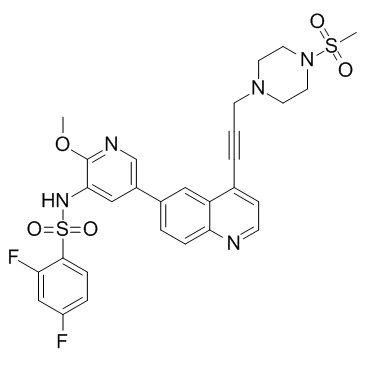
NSC781406 is a novel and highly potent dual inhibitor of PI3K and mTOR with an IC50 of 2 nM for PI3Kα. In the xenograft model for hepatocellular carcinoma BEL-7404, NSC781406 exhibits strong tumor growth inhibition.
Physicochemical Properties
| Molecular Formula | C29H27F2N5O5S2 |
| Molecular Weight | 627.681990861893 |
| Exact Mass | 627.142 |
| Elemental Analysis | C, 55.49; H, 4.34; F, 6.05; N, 11.16; O, 12.74; S, 10.22 |
| CAS # | 1676893-24-5 |
| Related CAS # | 1676893-24-5 |
| PubChem CID | 127025628 |
| Appearance | White to off-white solid powder |
| LogP | 3.1 |
| Hydrogen Bond Donor Count | 1 |
| Hydrogen Bond Acceptor Count | 12 |
| Rotatable Bond Count | 8 |
| Heavy Atom Count | 43 |
| Complexity | 1230 |
| Defined Atom Stereocenter Count | 0 |
| InChi Key | BBRINJUWZRLWKK-UHFFFAOYSA-N |
| InChi Code | InChI=1S/C29H27F2N5O5S2/c1-41-29-27(34-43(39,40)28-8-6-23(30)18-25(28)31)17-22(19-33-29)21-5-7-26-24(16-21)20(9-10-32-26)4-3-11-35-12-14-36(15-13-35)42(2,37)38/h5-10,16-19,34H,11-15H2,1-2H3 |
| Chemical Name | 2,4-difluoro-N-[2-methoxy-5-[4-[3-(4-methylsulfonylpiperazin-1-yl)prop-1-ynyl]quinolin-6-yl]pyridin-3-yl]benzenesulfonamide |
| Synonyms | NSC-781406; NSC 781406; NSC781406 |
| HS Tariff Code | 2934.99.03.00 |
| Storage |
Powder-20°C 3 years 4°C 2 years In solvent -80°C 6 months -20°C 1 month |
| Shipping Condition | Room temperature (This product is stable at ambient temperature for a few days during ordinary shipping and time spent in Customs) |
Biological Activity
| Targets | PI3Kα (IC50 = 2 nM); PI3Kβ (IC50 = 9.4 nM); PI3Kδ (IC50 = 14 nM); PI3Kγ (IC50 = 2.7 nM); mTOR (IC50 = 5.4 nM) |
| ln Vitro | NSC781406 exhibits strong PI3K inhibition (PI3Kα IC50=2.0 nM), which results in inhibition of BEL-7404 cell proliferation (IC50=20 nM). Reasonable liver microsome stability is shown by NSC781406. Leukemia, non-small cell, lung, colon, central nervous system, melanoma, ovarian, renal, prostate, and breast cancer are among the cancers that NSC781406 exhibits cytotoxic activities against. With a mean GI50 value of 65 nM and a GI50 value of less than 10 nM against four cancer cell lines, it is effective against 60 cancer cell lines[1]. |
| ln Vivo | Treatment with 30 mg/kg of NSC781406 in the xenograft models causes statistically significant antitumor activity, with a mean decrease in relative tumor volume ratio of 52%. At 50 mg/kg, sorafenib shows a 44% inhibition ratio. With no observed mortality or appreciable weight loss, NSC781406 is well tolerated at 30 mg/kg[1]. |
| Enzyme Assay | The IC50 values for PI3K inhibition are calculated. We use PI-103 as our reference substance. The substances (NSC781406) are examined in duplicate for 10 concentrations, with the highest concentration being either 100 nM or 500 nM. Kinase buffer is used to dilute all the chemicals. In kinase buffer, three-fold, ten-point serial compound (NSC781406) dilutions are carried out[1]. |
| Cell Assay | Human lung adenocarcinoma cells A549), human colon cancer cells HCT-116), human breast cancer cells MDA-MB-231), and human hepatocellular carcinoma cells BEL-7404 are used to test the cytotoxic effects. These four tumor cells are diluted to a logarithmic phase density of 40,000–50,000 cells/mL. NSC781406 compounds are given to the cells for 72 hours, and then MTT solution (5 mg/mL, 20 μL) is added for an additional 4 hours at 37°C. An analysis using nonlinear regression is used to calculate IC50 values[1]. |
| Animal Protocol | Mice: NSC781406 is given orally once daily at a dose of 30 mg/kg for 14 days straight, alone or in combination with 50 mg/kg sorafenib. Monitoring is done of the tumor volume in relation to the vehicle-treated control mice[1]. |
| References |
[1]. Discovery of benzenesulfonamide derivatives as potent PI3K/mTOR dual inhibitors with in vivo efficacies against hepatocellular carcinoma. Bioorg Med Chem. 2016 Mar 1;24(5):957-66. |
Solubility Data
| Solubility (In Vitro) | DMSO: ~150 mg/mL (~239 mM) |
| Solubility (In Vivo) |
Solubility in Formulation 1: 3.75 mg/mL (5.97 mM) in 10% DMSO + 40% PEG300 + 5% Tween80 + 45% Saline (add these co-solvents sequentially from left to right, and one by one), suspension solution; with sonication. For example, if 1 mL of working solution is to be prepared, you can add 100 μL of 37.5 mg/mL clear DMSO stock solution to 400 μL PEG300 and mix evenly; then add 50 μL Tween-80 to the above solution and mix evenly; then add 450 μL normal saline to adjust the volume to 1 mL. Preparation of saline: Dissolve 0.9 g of sodium chloride in 100 mL ddH₂ O to obtain a clear solution. Solubility in Formulation 2: ≥ 3.75 mg/mL (5.97 mM) (saturation unknown) in 10% DMSO + 90% Corn Oil (add these co-solvents sequentially from left to right, and one by one), clear solution. For example, if 1 mL of working solution is to be prepared, you can add 100 μL of 37.5 mg/mL clear DMSO stock solution to 900 μL of corn oil and mix evenly. (Please use freshly prepared in vivo formulations for optimal results.) |
| Preparing Stock Solutions | 1 mg | 5 mg | 10 mg | |
| 1 mM | 1.5932 mL | 7.9658 mL | 15.9317 mL | |
| 5 mM | 0.3186 mL | 1.5932 mL | 3.1863 mL | |
| 10 mM | 0.1593 mL | 0.7966 mL | 1.5932 mL |