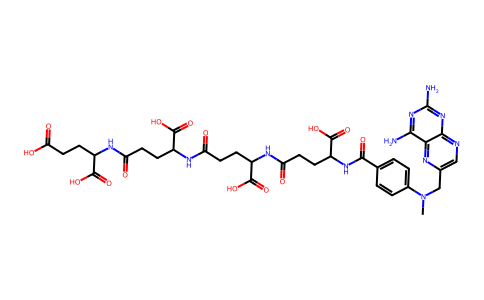
Physicochemical Properties
| Molecular Formula | C35H43N11O14 |
| Molecular Weight | 841.79 |
| Exact Mass | 841.299 |
| Elemental Analysis | C, 49.94; H, 5.15; N, 18.30; O, 26.61 |
| CAS # | 73610-81-8 |
| PubChem CID | 456145 |
| Appearance | Typically exists as solid at room temperature |
| Density | 1.541g/cm3 |
| Index of Refraction | 1.669 |
| LogP | 1.043 |
| Hydrogen Bond Donor Count | 11 |
| Hydrogen Bond Acceptor Count | 21 |
| Rotatable Bond Count | 24 |
| Heavy Atom Count | 60 |
| Complexity | 1560 |
| Defined Atom Stereocenter Count | 4 |
| SMILES | CN(CC1=CN=C2C(=N1)C(=NC(=N2)N)N)C3=CC=C(C=C3)C(=O)NC(CCC(=O)NC(CCC(=O)NC(CCC(=O)NC(CCC(=O)O)C(=O)O)C(=O)O)C(=O)O)C(=O)O |
| InChi Key | UORBZCNWEGKEOP-CMOCDZPBSA-N |
| InChi Code | InChI=1S/C35H43N11O14/c1-46(15-17-14-38-29-27(39-17)28(36)44-35(37)45-29)18-4-2-16(3-5-18)30(52)43-22(34(59)60)8-12-25(49)41-20(32(55)56)6-10-23(47)40-19(31(53)54)7-11-24(48)42-21(33(57)58)9-13-26(50)51/h2-5,14,19-22H,6-13,15H2,1H3,(H,40,47)(H,41,49)(H,42,48)(H,43,52)(H,50,51)(H,53,54)(H,55,56)(H,57,58)(H,59,60)(H4,36,37,38,44,45)/t19-,20-,21-,22-/m0/s1 |
| Chemical Name | (2S)-2-[[(4S)-4-carboxy-4-[[(4S)-4-carboxy-4-[[(4S)-4-carboxy-4-[[4-[(2,4-diaminopteridin-6-yl)methyl-methylamino]benzoyl]amino]butanoyl]amino]butanoyl]amino]butanoyl]amino]pentanedioic acid |
| Synonyms | NSC341077; NSC-341077; 73610-81-8; NSC 341077; L-Glutamic acid, N-(N-(N-(N-(4-(((2,4-diamino-6-pteridinyl)methyl)-methylamino)benzoyl)-L-gamma-glutamyl)-L-gamma-glutamyl)-L-gamma-glutamyl)-; (2S)-2-[[(4S)-4-Carboxy-4-[[(4S)-4-carboxy-4-[[(4S)-4-carboxy-4-[[4-[(2,4-diaminopteridin-6-yl)methyl-methylamino]benzoyl]amino]butanoyl]amino]butanoyl]amino]butanoyl]amino]pentanedioic acid; L-Glutamic acid, N-(4-(((2,4-diamino-6-pteridinyl)methyl)methylamino)benzoyl)-L-g-glutamyl-L-g-glutamyl-L-g-glutamyl-; NSC341077; L-Glutamic acid, N-[4-[[(2,4-diamino-6-pteridinyl)methyl]methylamino]benzoyl]-L-g-glutamyl-L-g-glutamyl-L-g-glutamyl-; CHEMBL2074969; NSC 341077 |
| HS Tariff Code | 2934.99.9001 |
| Storage |
Powder-20°C 3 years 4°C 2 years In solvent -80°C 6 months -20°C 1 month |
| Shipping Condition | Room temperature (This product is stable at ambient temperature for a few days during ordinary shipping and time spent in Customs) |
Biological Activity
| Targets | MTX/methotrexate analog; DHFR/dihydrofolate reductase; anticancer |
| ln Vitro | ABCG2 is a plasma membrane efflux pump that is able to confer resistance to several anticancer agents, including mitoxantrone, camptothecins, anthracyclines, and flavopiridol. The antimetabolite methotrexate (MTX) was inferred recently to be an additional substrate of the pump based on the analysis of ABCG2-overexpressing cell lines. However, the transport characteristics of the pump with regard to this agent have not been determined. In addition, physiological substrates of ABCG2 have not been identified. Here we examine the in vitro transport properties of the pump using membrane vesicles prepared from HEK293 cells transfected with ABCG2 expression vector. In so doing it is shown that MTX is a high capacity low affinity substrate of the pump, with K(m) and V(max) values of 1.34 +/- 0.18 mM and 687 +/- 87 pmol/mg/min, respectively. Unlike previously characterized multidrug resistance protein family members, ABCG2 is also able to transport MTX diglutamate and MTX triglutamate. However, addition of even one more glutamyl residue is sufficient to completely abrogate ABCG2-mediated transport. By contrast with the wild-type protein (ABCG2-R482), two ABCG2 variants that have been identified in drug selected cell lines, R482T and R482G, were unable to transport MTX to any extent. Similarly, folic acid was subject to efflux by the wild-type protein but not by the two mutants. However, transport of the reduced folate leucovorin was not detected for either the wild-type or the mutant proteins. Finally, it is shown that ABCG2 is capable of transporting E(2)17betaG with K(m) and V(max) values of 44.2 +/- 4.3 micro M and 103 +/- 17 pmol/mg/min, respectively. These results indicate that ABCG2 is a component of the energy-dependent efflux system for certain folates and antifolates, but that its transport characteristics with respect to polyglutamates and reduced folates are not identical to those of multidrug resistance protein family members. In addition, it is demonstrated that R482 mutations observed in drug-resistant cell lines have profound effects on the in vitro transport properties of the pump[1]. |
| References | [1]. Transport of methotrexate, methotrexate polyglutamates, and 17beta-estradiol 17-(beta-D-glucuronide) by ABCG2: effects of acquired mutations at R482 on methotrexate transport. Cancer Res. 2003 Jul 15;63(14):4048-54. |
Solubility Data
| Solubility (In Vitro) | May dissolve in DMSO (in most cases), if not, try other solvents such as H2O, Ethanol, or DMF with a minute amount of products to avoid loss of samples |
| Solubility (In Vivo) |
Note: Listed below are some common formulations that may be used to formulate products with low water solubility (e.g. < 1 mg/mL), you may test these formulations using a minute amount of products to avoid loss of samples. Injection Formulations (e.g. IP/IV/IM/SC) Injection Formulation 1: DMSO : Tween 80: Saline = 10 : 5 : 85 (i.e. 100 μL DMSO stock solution → 50 μL Tween 80 → 850 μL Saline) *Preparation of saline: Dissolve 0.9 g of sodium chloride in 100 mL ddH ₂ O to obtain a clear solution. Injection Formulation 2: DMSO : PEG300 :Tween 80 : Saline = 10 : 40 : 5 : 45 (i.e. 100 μL DMSO → 400 μLPEG300 → 50 μL Tween 80 → 450 μL Saline) Injection Formulation 3: DMSO : Corn oil = 10 : 90 (i.e. 100 μL DMSO → 900 μL Corn oil) Example: Take the Injection Formulation 3 (DMSO : Corn oil = 10 : 90) as an example, if 1 mL of 2.5 mg/mL working solution is to be prepared, you can take 100 μL 25 mg/mL DMSO stock solution and add to 900 μL corn oil, mix well to obtain a clear or suspension solution (2.5 mg/mL, ready for use in animals). Injection Formulation 4: DMSO : 20% SBE-β-CD in saline = 10 : 90 [i.e. 100 μL DMSO → 900 μL (20% SBE-β-CD in saline)] *Preparation of 20% SBE-β-CD in Saline (4°C,1 week): Dissolve 2 g SBE-β-CD in 10 mL saline to obtain a clear solution. Injection Formulation 5: 2-Hydroxypropyl-β-cyclodextrin : Saline = 50 : 50 (i.e. 500 μL 2-Hydroxypropyl-β-cyclodextrin → 500 μL Saline) Injection Formulation 6: DMSO : PEG300 : castor oil : Saline = 5 : 10 : 20 : 65 (i.e. 50 μL DMSO → 100 μLPEG300 → 200 μL castor oil → 650 μL Saline) Injection Formulation 7: Ethanol : Cremophor : Saline = 10: 10 : 80 (i.e. 100 μL Ethanol → 100 μL Cremophor → 800 μL Saline) Injection Formulation 8: Dissolve in Cremophor/Ethanol (50 : 50), then diluted by Saline Injection Formulation 9: EtOH : Corn oil = 10 : 90 (i.e. 100 μL EtOH → 900 μL Corn oil) Injection Formulation 10: EtOH : PEG300:Tween 80 : Saline = 10 : 40 : 5 : 45 (i.e. 100 μL EtOH → 400 μLPEG300 → 50 μL Tween 80 → 450 μL Saline) Oral Formulations Oral Formulation 1: Suspend in 0.5% CMC Na (carboxymethylcellulose sodium) Oral Formulation 2: Suspend in 0.5% Carboxymethyl cellulose Example: Take the Oral Formulation 1 (Suspend in 0.5% CMC Na) as an example, if 100 mL of 2.5 mg/mL working solution is to be prepared, you can first prepare 0.5% CMC Na solution by measuring 0.5 g CMC Na and dissolve it in 100 mL ddH2O to obtain a clear solution; then add 250 mg of the product to 100 mL 0.5% CMC Na solution, to make the suspension solution (2.5 mg/mL, ready for use in animals). Oral Formulation 3: Dissolved in PEG400 Oral Formulation 4: Suspend in 0.2% Carboxymethyl cellulose Oral Formulation 5: Dissolve in 0.25% Tween 80 and 0.5% Carboxymethyl cellulose Oral Formulation 6: Mixing with food powders Note: Please be aware that the above formulations are for reference only. InvivoChem strongly recommends customers to read literature methods/protocols carefully before determining which formulation you should use for in vivo studies, as different compounds have different solubility properties and have to be formulated differently. (Please use freshly prepared in vivo formulations for optimal results.) |
| Preparing Stock Solutions | 1 mg | 5 mg | 10 mg | |
| 1 mM | 1.1879 mL | 5.9397 mL | 11.8794 mL | |
| 5 mM | 0.2376 mL | 1.1879 mL | 2.3759 mL | |
| 10 mM | 0.1188 mL | 0.5940 mL | 1.1879 mL |