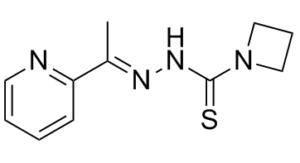
NSC319726 is a novel and potent p53(R175) mutant reactivator with with potential anticancer activity. It exhibits growth inhibition in cells expressing mutant p53 (IC50 for p53(R175) mutant is 8 nM), but it has no effect on p53 wild-type cells.
Physicochemical Properties
| Molecular Formula | C11H14N4S | |
| Molecular Weight | 234.32 | |
| Exact Mass | 234.093 | |
| Elemental Analysis | C, 56.38; H, 6.02; N, 23.91; S, 13.68 | |
| CAS # | 71555-25-4 | |
| Related CAS # |
|
|
| PubChem CID | 5351307 | |
| Appearance | Off-white to light yellow solid powder | |
| Density | 1.3±0.1 g/cm3 | |
| Boiling Point | 367.7±34.0 °C at 760 mmHg | |
| Flash Point | 176.2±25.7 °C | |
| Vapour Pressure | 0.0±0.8 mmHg at 25°C | |
| Index of Refraction | 1.659 | |
| LogP | 0.17 | |
| Hydrogen Bond Donor Count | 1 | |
| Hydrogen Bond Acceptor Count | 3 | |
| Rotatable Bond Count | 2 | |
| Heavy Atom Count | 16 | |
| Complexity | 286 | |
| Defined Atom Stereocenter Count | 0 | |
| SMILES | S=C(N([H])/N=C(\C([H])([H])[H])/C1=C([H])C([H])=C([H])C([H])=N1)N1C([H])([H])C([H])([H])C1([H])[H] |
|
| InChi Key | XDHBUMNIQRLHGO-UKTHLTGXSA-N | |
| InChi Code | InChI=1S/C11H14N4S/c1-9(10-5-2-3-6-12-10)13-14-11(16)15-7-4-8-15/h2-3,5-6H,4,7-8H2,1H3,(H,14,16)/b13-9+ | |
| Chemical Name | N-[(E)-1-pyridin-2-ylethylideneamino]azetidine-1-carbothioamide | |
| Synonyms |
|
|
| HS Tariff Code | 2934.99.9001 | |
| Storage |
Powder-20°C 3 years 4°C 2 years In solvent -80°C 6 months -20°C 1 month |
|
| Shipping Condition | Room temperature (This product is stable at ambient temperature for a few days during ordinary shipping and time spent in Customs) |
Biological Activity
| Targets | R175 (p53 = 8 nM) | |||
| ln Vitro | NSC319726 is a p53(R175) mutant reactivator, exhibits growth inhibition in cells expressing mutant p53, with an IC50 for p53(R175) mutant of 8 nM, showing no inhibition for p53 wild-type cells, and exhibiting selectivity of 10- to 100-fold over other hotspot p53 mutants. p53(R175)-dependent apoptosis is induced by NSC319276. The p53(R175) mutant protein undergoes a conformational change similar to that of the WT after being treated with NSC319726, which restores sequence-specific p53 transcription. NSC319726's ability to chelate zinc ions and undergo redox changes are both necessary for the compound to be active. [1] | |||
| ln Vivo | NSC319726 (5mg/kg, 7days) exhibits greater toxicity for p53(R172H/R172H) mice, with only 30% survival, as opposed to 100% survival for p53+/+ and p53-/- mice. NSC319726 inhibits the growth of TOV112D-p53(R175H) xenografts, but not H460 (p53+/+) and MDAMB468-p53(R273W) xenografts.[1] | |||
| Enzyme Assay | After two days of serial compound dilution treatment, 5,000 TOV112D cells (5,000 cells/well, in a 100 ml culture) are cultured in a 96-well plate and reach a confluence of 50% to 60%. Following a 3-day incubation period, the growth is assessed using the MTS reagent and a Victor Plate reader instrument. | |||
| Cell Assay | Viability assays are done. The cells are cultured in a 12-well plate at a density of 5×10⁴ cells per well in a 1 ml of culture, and are treated with serial dilutions of the compound on the second day to reach a confluence of 50% to 60%. Guava ViaCount reagent and Guava PCA instrument are used to measure the growth after three days of incubation. | |||
| Animal Protocol |
|
|||
| References |
[1]. Cancer Cell . 2012 May 15;21(5):614-625. |
Solubility Data
| Solubility (In Vitro) |
|
|||
| Solubility (In Vivo) |
Solubility in Formulation 1: ≥ 2.08 mg/mL (8.88 mM) (saturation unknown) in 10% DMSO + 40% PEG300 + 5% Tween80 + 45% Saline (add these co-solvents sequentially from left to right, and one by one), clear solution. For example, if 1 mL of working solution is to be prepared, you can add 100 μL of 20.8 mg/mL clear DMSO stock solution to 400 μL PEG300 and mix evenly; then add 50 μL Tween-80 to the above solution and mix evenly; then add 450 μL normal saline to adjust the volume to 1 mL. Preparation of saline: Dissolve 0.9 g of sodium chloride in 100 mL ddH₂ O to obtain a clear solution. Solubility in Formulation 2: ≥ 2.08 mg/mL (8.88 mM) (saturation unknown) in 10% DMSO + 90% Corn Oil (add these co-solvents sequentially from left to right, and one by one), clear solution. For example, if 1 mL of working solution is to be prepared, you can add 100 μL of 20.8 mg/mL clear DMSO stock solution to 900 μL of corn oil and mix evenly. (Please use freshly prepared in vivo formulations for optimal results.) |
| Preparing Stock Solutions | 1 mg | 5 mg | 10 mg | |
| 1 mM | 4.2677 mL | 21.3383 mL | 42.6767 mL | |
| 5 mM | 0.8535 mL | 4.2677 mL | 8.5353 mL | |
| 10 mM | 0.4268 mL | 2.1338 mL | 4.2677 mL |