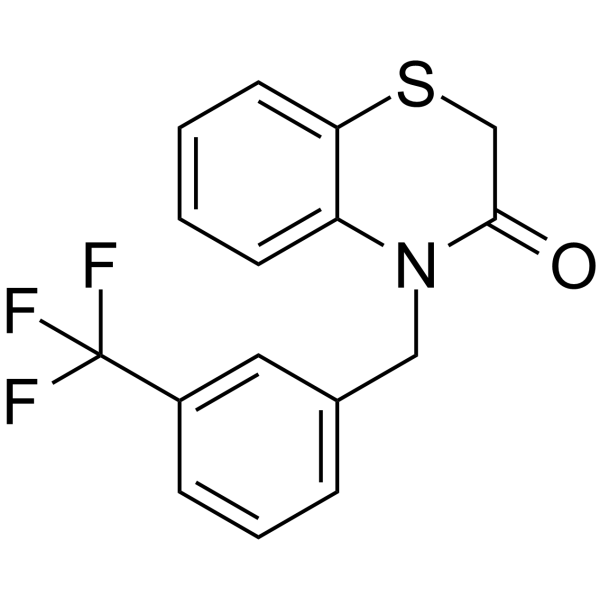
NS6180 is a novel potent and selective KCa3.1 channel inhibitor with IC50 of 9 nM. KCa3.1 channels are targets for pharmacological control of intestinal inflammation. NS6180 prevents T-cell activation and inflammation in a rat model of inflammatory bowel disease. NS6180 inhibited cloned human KCa3.1 channels via T250 and V275, the same amino acid residues conferring sensitivity to triarylmethanes such as like TRAM-34. NS6180 inhibited endogenously expressed KCa3.1 channels in human, mouse and rat erythrocytes, with similar potencies (15–20 nM).
Physicochemical Properties
| Molecular Formula | C₁₆H₁₂F₃NOS | |
| Molecular Weight | 323.33 | |
| Exact Mass | 323.059 | |
| Elemental Analysis | C, 59.44; H, 3.74; F, 17.63; N, 4.33; O, 4.95; S, 9.92 | |
| CAS # | 353262-04-1 | |
| Related CAS # |
|
|
| PubChem CID | 11837221 | |
| Appearance | White to off-white solid powder | |
| Density | 1.4±0.1 g/cm3 | |
| Boiling Point | 476.9±45.0 °C at 760 mmHg | |
| Flash Point | 242.2±28.7 °C | |
| Vapour Pressure | 0.0±1.2 mmHg at 25°C | |
| Index of Refraction | 1.594 | |
| LogP | 3.89 | |
| Hydrogen Bond Donor Count | 0 | |
| Hydrogen Bond Acceptor Count | 5 | |
| Rotatable Bond Count | 2 | |
| Heavy Atom Count | 22 | |
| Complexity | 415 | |
| Defined Atom Stereocenter Count | 0 | |
| SMILES | S1C([H])([H])C(N(C2=C([H])C([H])=C([H])C([H])=C12)C([H])([H])C1C([H])=C([H])C([H])=C(C(F)(F)F)C=1[H])=O |
|
| InChi Key | ZUIJXKLTUFCDGO-UHFFFAOYSA-N | |
| InChi Code | InChI=1S/C16H12F3NOS/c17-16(18,19)12-5-3-4-11(8-12)9-20-13-6-1-2-7-14(13)22-10-15(20)21/h1-8H,9-10H2 | |
| Chemical Name | 4-[[3-(trifluoromethyl)phenyl]methyl]-1,4-benzothiazin-3-one | |
| Synonyms |
|
|
| HS Tariff Code | 2934.99.9001 | |
| Storage |
Powder-20°C 3 years 4°C 2 years In solvent -80°C 6 months -20°C 1 month |
|
| Shipping Condition | Room temperature (This product is stable at ambient temperature for a few days during ordinary shipping and time spent in Customs) |
Biological Activity
| Targets |
NS6180 targets small-conductance Ca²⁺-activated K⁺ channel 3.1 (K(Ca)3.1, KCNN4) with an IC50 of 0.6 nM (recombinant human K(Ca)3.1) [1] NS6180 shows high selectivity for K(Ca)3.1 over other K⁺ channels (K(Ca)2.1-2.3, KV1.3, BK channels) with IC50 > 10 μM [1] |
| ln Vitro |
Human KCa3.1 is inhibited by NS6180 (0.001–1 μM), with an IC50 of 9.4 nM and a K50 of 11 1.7 nM, respectively[1]. The inhibition of NS6180 (30 nM, 10 μM) is reliant on the amino acid residues T250 and V275[1]. Human erythrocytes with CCCP-reported hyperpolarizations are shown in NS6180 (1, 10, 100, and 1000 nM; 1 min)[1]. With IC50 values of 14 nM for human KCa3.1 channels, 15 nM for mouse KCa3.1 channels, and 9 nM for rat KCa3.1 channels, respectively, NS6180 (1, 10, 100, and 1000 nM; 1 min) blocks the erythrocyte KCa3.1 channels[1]. NS6180 (0-5 μM, 48 h) potently inhibits the production of IL-2 and IFN-g and suppresses the proliferation of rat and mouse splenocytes at submicrolar concentrations; it has no effect on the production of IL-17 and has smaller effects on IL-4 and TNF-α[1]. In HEK293 cells expressing recombinant human K(Ca)3.1, NS6180 (0.01-10 nM) dose-dependently inhibited channel currents, with an IC50 of 0.6 nM (patch-clamp recording, p < 0.001) [1] - In rat splenic T cells activated by anti-CD3/CD28 antibodies, NS6180 (0.1-10 μM) suppressed T cell proliferation, with an IC50 of 0.8 μM (MTT assay, p < 0.01); 10 μM reduced proliferation by 76% compared to vehicle [1] - NS6180 (1-10 μM) dose-dependently reduced secretion of pro-inflammatory cytokines IL-2 (48% reduction at 10 μM) and IFN-γ (53% reduction at 10 μM) in activated T cells (ELISA, p < 0.05) [1] - In primary rat colonic epithelial cells, NS6180 (0.1-10 μM) showed no cytotoxicity after 48-hour incubation (cell viability > 90% by trypan blue exclusion assay) [1] |
| ln Vivo |
With its extremely low bioavailability, NS6180 (iv, ip, and oral administration; 10 mg/kg; twice daily or once daily) helps rats with DNBS-induced experimental colitis[1]. In 2,4-dinitrobenzene sulfonic acid (DNBS)-induced colitis rats, oral administration of NS6180 (10, 30 mg/kg once daily for 7 days) dose-dependently alleviated intestinal inflammation; 30 mg/kg reduced colonic inflammation score from 8.2 to 3.5 (p < 0.001) [1] - NS6180 (30 mg/kg, p.o.) reduced colonic TNF-α and IL-1β protein levels by 45% and 41%, respectively (ELISA, p < 0.01), and decreased IFN-γ mRNA expression by 52% (qPCR, p < 0.01) [1] - NS6180 (30 mg/kg) attenuated DNBS-induced weight loss (from -15% to -4%, p < 0.05) and colon shortening (from 6.1 cm to 7.8 cm, p < 0.01) [1] - NS6180 (30 mg/kg) reduced T cell infiltration in colonic mucosa by 63% (immunohistochemistry, p < 0.01) [1] |
| Enzyme Assay |
K(Ca)3.1 channel patch-clamp assay: HEK293 cells stably expressing recombinant human K(Ca)3.1 were enzymatically dissociated and placed in a recording chamber; whole-cell patch-clamp configuration was established with intracellular and extracellular solutions containing appropriate Ca²⁺ concentrations; NS6180 (0.001-10 nM) was applied via perfusion, and K⁺ currents were recorded at a holding potential of -60 mV; current amplitude was analyzed to calculate IC50 values from dose-response inhibition curves [1] - K⁺ channel selectivity assay: The same patch-clamp protocol was applied to HEK293 cells expressing other K⁺ channels (K(Ca)2.1, KV1.3, BK channels); NS6180 (0.1-10 μM) was tested to assess cross-inhibition, and inhibition rates were compared to K(Ca)3.1 to confirm selectivity [1] |
| Cell Assay |
T cell proliferation assay: Splenic T cells were isolated from male Wistar rats, purified by density gradient centrifugation, and seeded in 96-well plates; cells were activated with anti-CD3/CD28 antibodies (1 μg/mL each) and treated with NS6180 (0.1-10 μM) for 72 hours; MTT reagent was added for the last 4 hours, and absorbance at 570 nm was measured to assess proliferation [1] - Cytokine secretion assay: Activated T cells (as above) were treated with NS6180 (1-10 μM) for 48 hours; culture supernatant was collected, and IL-2/IFN-γ concentrations were quantified by ELISA [1] - Colonic epithelial cell viability assay: Primary rat colonic epithelial cells were isolated from rat colon mucosa, cultured in collagen-coated plates for 48 hours; NS6180 (0.1-10 μM) was added, and cells were incubated for another 48 hours; trypan blue staining was used to count viable cells and calculate viability rate [1] |
| Animal Protocol |
Animal/Disease Models: Rats[1] Doses: 10 mg/kg Route of Administration: iv, ip and oral administration; 10 mg/kg; twice (two times) daily or one time/day Experimental Results: Had a plasma half-life of 3.8 h, oral or ip administration gave low plasma exposure (Cmax: 186 nM and 33 nM, respectively, after administration of 10 mg/kg). DNBS-induced colitis rat model: 8-week-old male Wistar rats (200-250 g) were anesthetized, and 100 mg/kg DNBS dissolved in 50% ethanol was administered via intrarectal injection (5 cm from anus) to induce colitis; control rats received 50% ethanol alone [1] - Twenty-four hours after DNBS injection, rats were randomly divided into 3 groups (n=8 per group): vehicle control, NS6180 10 mg/kg, 30 mg/kg [1] - NS6180 was formulated in 0.5% methylcellulose aqueous solution; administered via oral gavage once daily for 7 consecutive days [1] - Study assessments: Body weight was measured daily; on day 8, rats were euthanized, colon was excised and measured for length; colonic tissue was collected for inflammation scoring (histological analysis), cytokine quantification (ELISA), and T cell infiltration detection (immunohistochemistry); colonic mRNA was extracted for qPCR analysis of IFN-γ [1] |
| Toxicity/Toxicokinetics |
In rats treated with NS6180 (30 mg/kg/day for 7 days), no significant changes in liver (ALT, AST) or kidney (creatinine, BUN) function parameters were observed [1] - NS6180 showed no acute toxicity in rats at doses up to 100 mg/kg (p.o.), with no mortality or adverse clinical signs (lethargy, diarrhea) [1] - In primary rat colonic epithelial cells and splenic T cells, NS6180 exhibited no cytotoxicity at concentrations up to 10 μM after 72-hour incubation [1] |
| References |
[1]. NS6180, a new K(Ca) 3.1 channel inhibitor prevents T-cell activation and inflammation in a rat model of inflammatory bowel disease. Br J Pharmacol. 2013 Jan;168(2):432-44. |
| Additional Infomation |
NS6180 is a potent, selective, orally active inhibitor of the small-conductance Ca²⁺-activated K⁺ channel 3.1 (K(Ca)3.1) [1] - Its mechanism of action involves blocking K(Ca)3.1 channels on T cells, inhibiting T cell activation, proliferation, and pro-inflammatory cytokine secretion, thereby reducing intestinal inflammation in inflammatory bowel disease (IBD) [1] - NS6180 demonstrates high selectivity for K(Ca)3.1 over other K⁺ channels, minimizing off-target effects on cardiac and neuronal tissues [1] - The compound shows preclinical efficacy in DNBS-induced rat colitis, supporting its potential as a therapeutic agent for inflammatory bowel diseases [1] |
Solubility Data
| Solubility (In Vitro) |
|
|||
| Solubility (In Vivo) |
Solubility in Formulation 1: ≥ 2.5 mg/mL (7.73 mM) (saturation unknown) in 10% DMSO + 40% PEG300 + 5% Tween80 + 45% Saline (add these co-solvents sequentially from left to right, and one by one), clear solution. For example, if 1 mL of working solution is to be prepared, you can add 100 μL of 25.0 mg/mL clear DMSO stock solution to 400 μL PEG300 and mix evenly; then add 50 μL Tween-80 to the above solution and mix evenly; then add 450 μL normal saline to adjust the volume to 1 mL. Preparation of saline: Dissolve 0.9 g of sodium chloride in 100 mL ddH₂ O to obtain a clear solution. Solubility in Formulation 2: ≥ 2.5 mg/mL (7.73 mM) (saturation unknown) in 10% DMSO + 90% Corn Oil (add these co-solvents sequentially from left to right, and one by one), clear solution. For example, if 1 mL of working solution is to be prepared, you can add 100 μL of 25.0 mg/mL clear DMSO stock solution to 900 μL of corn oil and mix evenly. (Please use freshly prepared in vivo formulations for optimal results.) |
| Preparing Stock Solutions | 1 mg | 5 mg | 10 mg | |
| 1 mM | 3.0928 mL | 15.4641 mL | 30.9282 mL | |
| 5 mM | 0.6186 mL | 3.0928 mL | 6.1856 mL | |
| 10 mM | 0.3093 mL | 1.5464 mL | 3.0928 mL |