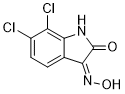
NS309 is a nonselective activator of small- and intermediate-conductance Ca2+-activated K+ (SK/KCa2 and IK/KCa3.1) channels (EC50s range from 0.12-1.2 µM for SK channels and 10-90 nM for IK channels). NS309 decreases rat detrusor smooth muscle membrane potential and phasic contractions by activating SK3 channels. NS309 restores EDHF-type relaxation in mesenteric small arteries from type 2 diabetic ZDF rats.
Physicochemical Properties
| Molecular Formula | C8H4CL2N2O2 |
| Molecular Weight | 231.032 |
| Exact Mass | 229.964 |
| CAS # | 18711-16-5 |
| Related CAS # | 18711-16-5 |
| PubChem CID | 135502903 |
| Appearance | White to off-white solid powder |
| Density | 1.8±0.1 g/cm3 |
| Index of Refraction | 1.742 |
| LogP | 2.66 |
| Hydrogen Bond Donor Count | 2 |
| Hydrogen Bond Acceptor Count | 3 |
| Rotatable Bond Count | 0 |
| Heavy Atom Count | 14 |
| Complexity | 241 |
| Defined Atom Stereocenter Count | 0 |
| InChi Key | CVOUSAVHMDXCKG-UHFFFAOYSA-N |
| InChi Code | InChI=1S/C8H4Cl2N2O2/c9-4-2-1-3-6(5(4)10)11-8(13)7(3)12-14/h1-2,14H,(H,11,12,13) |
| Chemical Name | (Z)-6,7-dichloro-3-(hydroxyimino)indolin-2-one |
| Synonyms | NS309 NS-309 NS 309. |
| HS Tariff Code | 2934.99.9001 |
| Storage |
Powder-20°C 3 years 4°C 2 years In solvent -80°C 6 months -20°C 1 month |
| Shipping Condition | Room temperature (This product is stable at ambient temperature for a few days during ordinary shipping and time spent in Customs) |
Biological Activity
| ln Vitro | hSK3 and hIK channels are activated by NS309 (40 nM), with hIK channels experiencing the largest effects (an 8.5-fold increase in current and a 1.9-fold rise in hSK3 channel current) [2]. The whole-cell SK currents are greatly increased and the resting membrane potential of the detrusor smooth muscle (DSM) cell is hyperpolarized by NS309 (10 μM) [5]. In a concentration-dependent manner, NS309 suppresses the amplitude, force, frequency, duration, pitch, and spontaneous phasic contraction of isolated DSM strips [5]. |
| ln Vivo | In rabbits, SCI/R is prevented by NS309 (2 mg/kg; intraperitoneal injection) [6]. |
| Animal Protocol |
Animal/Disease Models: Adult New Zealand White Rabbit (2.5-3.0 kg) [6] Doses: 2 mg/kg Route of Administration: intraperitoneal (ip) injection Experimental Results: Neurological outcomes in SCI/R-challenged rabbits were Dramatically improved. |
| References |
[1]. Specific enhancement of SK channel activity selectively potentiates the afterhyperpolarizing current I(AHP) and modulates the firing properties of hippocampal pyramidal neurons. [2]. Selective positive modulation of the SK3 and SK2 subtypes of small conductance Ca2+-activated K+ channels. Br J Pharmacol. 2007 Jul; 151(5): 655–665. [3]. New Positive Ca2+-Activated K+ Channel Gating Modulators with Selectivity for KCa3.1. Mol Pharmacol. 2014 Sep; 86(3): 342–357. [4]. Activation of human IK and SK Ca2+-activated K+ channels by NS309 (6,7-dichloro-1H-indole-2,3-dione 3-oxime). Biochim Biophys Acta. 2004 Oct 11;1665(1-2):1-5. [5]. NS309 decreases rat detrusor smooth muscle membrane potential and phasic contractions by activating SK3 channels. Br J Pharmacol. 2013 Apr; 168(7): 1611–1625. [6]. Activation of SK/KCa Channel Attenuates Spinal Cord Ischemia-Reperfusion Injury via Anti-oxidative Activity and Inhibition of Mitochondrial Dysfunction in Rabbits. Front Pharmacol. 2019; 10: 325. |
Solubility Data
| Solubility (In Vitro) | DMSO : ~100 mg/mL (~432.83 mM) |
| Solubility (In Vivo) |
Note: Listed below are some common formulations that may be used to formulate products with low water solubility (e.g. < 1 mg/mL), you may test these formulations using a minute amount of products to avoid loss of samples. Injection Formulations (e.g. IP/IV/IM/SC) Injection Formulation 1: DMSO : Tween 80: Saline = 10 : 5 : 85 (i.e. 100 μL DMSO stock solution → 50 μL Tween 80 → 850 μL Saline) *Preparation of saline: Dissolve 0.9 g of sodium chloride in 100 mL ddH ₂ O to obtain a clear solution. Injection Formulation 2: DMSO : PEG300 :Tween 80 : Saline = 10 : 40 : 5 : 45 (i.e. 100 μL DMSO → 400 μLPEG300 → 50 μL Tween 80 → 450 μL Saline) Injection Formulation 3: DMSO : Corn oil = 10 : 90 (i.e. 100 μL DMSO → 900 μL Corn oil) Example: Take the Injection Formulation 3 (DMSO : Corn oil = 10 : 90) as an example, if 1 mL of 2.5 mg/mL working solution is to be prepared, you can take 100 μL 25 mg/mL DMSO stock solution and add to 900 μL corn oil, mix well to obtain a clear or suspension solution (2.5 mg/mL, ready for use in animals). Injection Formulation 4: DMSO : 20% SBE-β-CD in saline = 10 : 90 [i.e. 100 μL DMSO → 900 μL (20% SBE-β-CD in saline)] *Preparation of 20% SBE-β-CD in Saline (4°C,1 week): Dissolve 2 g SBE-β-CD in 10 mL saline to obtain a clear solution. Injection Formulation 5: 2-Hydroxypropyl-β-cyclodextrin : Saline = 50 : 50 (i.e. 500 μL 2-Hydroxypropyl-β-cyclodextrin → 500 μL Saline) Injection Formulation 6: DMSO : PEG300 : castor oil : Saline = 5 : 10 : 20 : 65 (i.e. 50 μL DMSO → 100 μLPEG300 → 200 μL castor oil → 650 μL Saline) Injection Formulation 7: Ethanol : Cremophor : Saline = 10: 10 : 80 (i.e. 100 μL Ethanol → 100 μL Cremophor → 800 μL Saline) Injection Formulation 8: Dissolve in Cremophor/Ethanol (50 : 50), then diluted by Saline Injection Formulation 9: EtOH : Corn oil = 10 : 90 (i.e. 100 μL EtOH → 900 μL Corn oil) Injection Formulation 10: EtOH : PEG300:Tween 80 : Saline = 10 : 40 : 5 : 45 (i.e. 100 μL EtOH → 400 μLPEG300 → 50 μL Tween 80 → 450 μL Saline) Oral Formulations Oral Formulation 1: Suspend in 0.5% CMC Na (carboxymethylcellulose sodium) Oral Formulation 2: Suspend in 0.5% Carboxymethyl cellulose Example: Take the Oral Formulation 1 (Suspend in 0.5% CMC Na) as an example, if 100 mL of 2.5 mg/mL working solution is to be prepared, you can first prepare 0.5% CMC Na solution by measuring 0.5 g CMC Na and dissolve it in 100 mL ddH2O to obtain a clear solution; then add 250 mg of the product to 100 mL 0.5% CMC Na solution, to make the suspension solution (2.5 mg/mL, ready for use in animals). Oral Formulation 3: Dissolved in PEG400 Oral Formulation 4: Suspend in 0.2% Carboxymethyl cellulose Oral Formulation 5: Dissolve in 0.25% Tween 80 and 0.5% Carboxymethyl cellulose Oral Formulation 6: Mixing with food powders Note: Please be aware that the above formulations are for reference only. InvivoChem strongly recommends customers to read literature methods/protocols carefully before determining which formulation you should use for in vivo studies, as different compounds have different solubility properties and have to be formulated differently. (Please use freshly prepared in vivo formulations for optimal results.) |
| Preparing Stock Solutions | 1 mg | 5 mg | 10 mg | |
| 1 mM | 4.3284 mL | 21.6422 mL | 43.2844 mL | |
| 5 mM | 0.8657 mL | 4.3284 mL | 8.6569 mL | |
| 10 mM | 0.4328 mL | 2.1642 mL | 4.3284 mL |