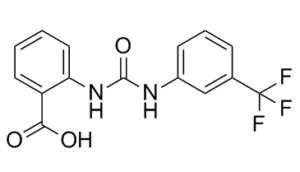
NS1652 is a novel, reversible anion conductance inhibitor which blocks chloride channel with an IC50 of 1.6 μM in human and mouse red blood cells. In vitro application of NS1652 lowers the net KCl loss from deoxygenated sickle cells from about 12 mmol/L cells/h to about 4 mmol/L cells/h, a value similar to that observed in oxygenated cells. Experiments performed in mice demonstrate that NS1652 is well tolerated and decreases red cell anion conductance in vivo. A low cation conductance and a high anion conductance are characteristic of normal erythrocytes. In sickle cell anemia, the polymerization of hemoglobin S (HbS) under conditions of low oxygen tension is preceded by an increase in cation conductance. This increase in conductance is mediated in part through Ca(++)-activated K(+) channels. A net efflux of potassium chloride (KCl) leads to a decrease in intracellular volume, which in turn increases the rate of HbS polymerization. Treatments minimizing the passive transport of ions and solvent to prevent such volume depletion might include inhibitors targeting either the Ca(++)-activated K(+) channel or the anion conductance.
Physicochemical Properties
| Molecular Formula | C₁₅H₁₁F₃N₂O₃ | |
| Molecular Weight | 324.25 | |
| Exact Mass | 324.072 | |
| Elemental Analysis | C, 55.56; H, 3.42; F, 17.58; N, 8.64; O, 14.80 | |
| CAS # | 1566-81-0 | |
| Related CAS # |
|
|
| PubChem CID | 9883705 | |
| Appearance | White to off-white solid powder | |
| Density | 1.5±0.1 g/cm3 | |
| Boiling Point | 355.9±42.0 °C at 760 mmHg | |
| Flash Point | 169.1±27.9 °C | |
| Vapour Pressure | 0.0±0.8 mmHg at 25°C | |
| Index of Refraction | 1.632 | |
| LogP | 5.01 | |
| Hydrogen Bond Donor Count | 3 | |
| Hydrogen Bond Acceptor Count | 6 | |
| Rotatable Bond Count | 3 | |
| Heavy Atom Count | 23 | |
| Complexity | 442 | |
| Defined Atom Stereocenter Count | 0 | |
| SMILES | O=C(O)C1=CC=CC=C1NC(NC2=CC=CC(C(F)(F)F)=C2)=O |
|
| InChi Key | CTNQAPPDQTYTHM-UHFFFAOYSA-N | |
| InChi Code | InChI=1S/C15H11F3N2O3/c16-15(17,18)9-4-3-5-10(8-9)19-14(23)20-12-7-2-1-6-11(12)13(21)22/h1-8H,(H,21,22)(H2,19,20,23) | |
| Chemical Name |
|
|
| Synonyms |
|
|
| HS Tariff Code | 2934.99.9001 | |
| Storage |
Powder-20°C 3 years 4°C 2 years In solvent -80°C 6 months -20°C 1 month |
|
| Shipping Condition | Room temperature (This product is stable at ambient temperature for a few days during ordinary shipping and time spent in Customs) |
Biological Activity
| Targets |
NS1652 targets volume-regulated anion channel (VRAC/VSOR, volume-sensitive outwardly rectifying chloride channel) in sickle red blood cells (IC50 = 1.5 μM for inhibition of swelling-induced chloride efflux) [2] NS1652 targets chloride channels in microglial BV2 cells [1] |
| ln Vitro |
With human and mouse erythrocytes, NS1652 potently inhibits chloride conductance (IC50, 1.6 μM), but in HEK293 cells, it only weakly inhibits VRAC (IC50, 125 μM). At an IC50 of 3.1 μM, NS1652 dramatically inhibits the production of NO in BV2 cells. Additionally, NS1652 completely eliminates iNOS expression in BV2 cells at 10 μM after downregulating it at 3 μM [1]. Normal red blood cells experience increased hyperpolarization as a result of NS1652 (0, 1.0, 3.3, 10 and 20 μM) inhibiting their chloride conductance. When NS1652 is added, the net loss of KCl from deoxysickle cells decreases to about 4 mM cells/hour from about 12 mM cells/hour. Erythrocyte Cl conductance is totally and reversibly inhibited by NS1652 (20 μM) [2]. 1. In IFNγ-stimulated murine microglial BV2 cells, NS1652 (10–100 μM) dose-dependently inhibits nitric oxide (NO) production; 100 μM NS1652 reduces NO levels by ~70% compared with IFNγ-only treated cells, and 30 μM NS1652 reduces NO levels by ~40% [1] 2. Western blot analysis shows that NS1652 (30–100 μM) dose-dependently downregulates inducible nitric oxide synthase (iNOS) protein expression in IFNγ-stimulated BV2 cells; 100 μM NS1652 decreases iNOS protein levels by ~80% [1] 3. RT-PCR analysis reveals that NS1652 (100 μM) has no significant effect on iNOS mRNA expression in IFNγ-stimulated BV2 cells, indicating post-transcriptional regulation of iNOS by NS1652 [1] 4. In human sickle red blood cells (SS RBCs), NS1652 (0.1–10 μM) inhibits swelling-induced chloride efflux with an IC50 of 1.5 μM; 10 μM NS1652 completely abolishes chloride efflux in SS RBCs [2] 5. NS1652 (10 μM) reduces deoxygenation-induced dehydration of SS RBCs by ~60% (measured by cell volume analysis), and inhibits the increase in intracellular Ca²⁺ concentration in deoxygenated SS RBCs [2] 6. NS1652 (1–10 μM) has no effect on chloride efflux in normal human red blood cells (AA RBCs) at concentrations up to 10 μM, showing selectivity for sickle red blood cell anion channels [2] |
| ln Vivo | Mice's Cl- conductivity of erythrocytes can be blocked >90% by NS1652 (50 mg/kg, intravenous injection) [2]. |
| Enzyme Assay |
1. Chloride efflux assay for VRAC activity in red blood cells: Isolated human sickle red blood cells (SS RBCs) and normal red blood cells (AA RBCs) were suspended in isotonic buffer and swollen by exposure to hypotonic buffer (200 mOsm/kg). Different concentrations of NS1652 (0.1–10 μM) were added to the cell suspension, and chloride efflux was measured using a chloride-selective electrode over a 10-minute period. The rate of chloride efflux was calculated, and dose-response curves were generated to determine the IC50 value for SS RBCs [2] 2. NO production assay for iNOS activity in BV2 cells: Murine microglial BV2 cells were seeded in 24-well plates and stimulated with IFNγ (10 ng/mL) in the presence or absence of NS1652 (10–100 μM) for 24 hours. The culture supernatant was collected, and NO concentration was determined using the Griess reaction (colorimetric assay). The absorbance at 540 nm was measured to quantify nitrite (stable metabolite of NO) levels, reflecting iNOS activity [1] |
| Cell Assay |
1. NO production and iNOS expression assay in BV2 cells: Murine microglial BV2 cells were cultured in complete medium and seeded at a density of 1×10⁵ cells/well in 24-well plates. After 24 hours of adherence, cells were pretreated with NS1652 (10–100 μM) for 1 hour, then stimulated with IFNγ (10 ng/mL) for 24 hours (for NO measurement) or 48 hours (for protein/mRNA analysis). NO production was assessed by Griess reaction; iNOS protein expression was detected by Western blot, and iNOS mRNA expression was analyzed by RT-PCR [1] 2. SS RBC volume and Ca²⁺ measurement assay: Human sickle red blood cells (SS RBCs) were isolated from whole blood and suspended in physiological buffer. NS1652 (1–10 μM) was added to the cell suspension, which was then deoxygenated by bubbling with nitrogen gas for 30 minutes. Cell volume was measured using a Coulter counter, and intracellular Ca²⁺ concentration was detected with a fluorescent Ca²⁺ indicator (Fura-2 AM) and fluorometry [2] 3. Chloride channel selectivity assay in RBCs: Isolated AA RBCs and SS RBCs were treated with NS1652 (0.1–10 μM) and subjected to hypotonic swelling. Chloride efflux was measured using a chloride-selective electrode, and the inhibitory effect of NS1652 on chloride efflux in AA vs. SS RBCs was compared to evaluate channel selectivity [2] |
| Toxicity/Toxicokinetics |
1. In BV2 cells, NS1652 (up to 100 μM) shows no significant cytotoxicity, as assessed by MTT assay (cell viability >90% compared with control) [1] 2. In human red blood cells (AA and SS RBCs), NS1652 (up to 10 μM) does not induce hemolysis or morphological abnormalities, as observed by light microscopy [2] |
| References |
[1]. Chloride channel blockers inhibit iNOS expression and NO production in IFNgamma-stimulated microglial BV2 cells. Brain Res. 2009 Jul 24;1281:15-24. [2]. Volume control in sickle cells is facilitated by the novel anion conductance inhibitor NS1652. Blood. 2000 Mar 1;95(5):1842-8. |
| Additional Infomation |
1. NS1652 is a synthetic small-molecule chloride channel blocker developed for the study of volume-regulated anion channels (VRAC) and potential treatment of sickle cell disease [2] 2. NS1652 exerts its effect on microglial cells by inhibiting post-transcriptional expression of iNOS, thereby reducing NO production in neuroinflammatory conditions [1] 3. NS1652 selectively inhibits the volume-regulated anion channel in sickle red blood cells, preventing deoxygenation-induced cell dehydration and sickling, which are key pathological events in sickle cell disease [2] 4. The inhibitory effect of NS1652 on NO production in microglia suggests its potential application in the treatment of neuroinflammatory disorders (e.g., Alzheimer’s disease, multiple sclerosis) [1] 5. NS1652 is a tool compound for investigating the role of VRAC/VSOR chloride channels in cellular volume regulation and disease pathogenesis [1][2] |
Solubility Data
| Solubility (In Vitro) |
|
|||
| Solubility (In Vivo) |
Note: Listed below are some common formulations that may be used to formulate products with low water solubility (e.g. < 1 mg/mL), you may test these formulations using a minute amount of products to avoid loss of samples. Injection Formulations (e.g. IP/IV/IM/SC) Injection Formulation 1: DMSO : Tween 80: Saline = 10 : 5 : 85 (i.e. 100 μL DMSO stock solution → 50 μL Tween 80 → 850 μL Saline) *Preparation of saline: Dissolve 0.9 g of sodium chloride in 100 mL ddH ₂ O to obtain a clear solution. Injection Formulation 2: DMSO : PEG300 :Tween 80 : Saline = 10 : 40 : 5 : 45 (i.e. 100 μL DMSO → 400 μLPEG300 → 50 μL Tween 80 → 450 μL Saline) Injection Formulation 3: DMSO : Corn oil = 10 : 90 (i.e. 100 μL DMSO → 900 μL Corn oil) Example: Take the Injection Formulation 3 (DMSO : Corn oil = 10 : 90) as an example, if 1 mL of 2.5 mg/mL working solution is to be prepared, you can take 100 μL 25 mg/mL DMSO stock solution and add to 900 μL corn oil, mix well to obtain a clear or suspension solution (2.5 mg/mL, ready for use in animals). Injection Formulation 4: DMSO : 20% SBE-β-CD in saline = 10 : 90 [i.e. 100 μL DMSO → 900 μL (20% SBE-β-CD in saline)] *Preparation of 20% SBE-β-CD in Saline (4°C,1 week): Dissolve 2 g SBE-β-CD in 10 mL saline to obtain a clear solution. Injection Formulation 5: 2-Hydroxypropyl-β-cyclodextrin : Saline = 50 : 50 (i.e. 500 μL 2-Hydroxypropyl-β-cyclodextrin → 500 μL Saline) Injection Formulation 6: DMSO : PEG300 : castor oil : Saline = 5 : 10 : 20 : 65 (i.e. 50 μL DMSO → 100 μLPEG300 → 200 μL castor oil → 650 μL Saline) Injection Formulation 7: Ethanol : Cremophor : Saline = 10: 10 : 80 (i.e. 100 μL Ethanol → 100 μL Cremophor → 800 μL Saline) Injection Formulation 8: Dissolve in Cremophor/Ethanol (50 : 50), then diluted by Saline Injection Formulation 9: EtOH : Corn oil = 10 : 90 (i.e. 100 μL EtOH → 900 μL Corn oil) Injection Formulation 10: EtOH : PEG300:Tween 80 : Saline = 10 : 40 : 5 : 45 (i.e. 100 μL EtOH → 400 μLPEG300 → 50 μL Tween 80 → 450 μL Saline) Oral Formulations Oral Formulation 1: Suspend in 0.5% CMC Na (carboxymethylcellulose sodium) Oral Formulation 2: Suspend in 0.5% Carboxymethyl cellulose Example: Take the Oral Formulation 1 (Suspend in 0.5% CMC Na) as an example, if 100 mL of 2.5 mg/mL working solution is to be prepared, you can first prepare 0.5% CMC Na solution by measuring 0.5 g CMC Na and dissolve it in 100 mL ddH2O to obtain a clear solution; then add 250 mg of the product to 100 mL 0.5% CMC Na solution, to make the suspension solution (2.5 mg/mL, ready for use in animals). Oral Formulation 3: Dissolved in PEG400 Oral Formulation 4: Suspend in 0.2% Carboxymethyl cellulose Oral Formulation 5: Dissolve in 0.25% Tween 80 and 0.5% Carboxymethyl cellulose Oral Formulation 6: Mixing with food powders Note: Please be aware that the above formulations are for reference only. InvivoChem strongly recommends customers to read literature methods/protocols carefully before determining which formulation you should use for in vivo studies, as different compounds have different solubility properties and have to be formulated differently. (Please use freshly prepared in vivo formulations for optimal results.) |
| Preparing Stock Solutions | 1 mg | 5 mg | 10 mg | |
| 1 mM | 3.0840 mL | 15.4202 mL | 30.8404 mL | |
| 5 mM | 0.6168 mL | 3.0840 mL | 6.1681 mL | |
| 10 mM | 0.3084 mL | 1.5420 mL | 3.0840 mL |