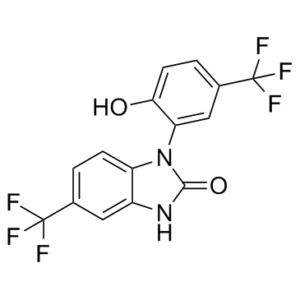
NS-1619 is a selective activator of the large conductance Ca2+-activated K+-channel (BKCa, KCa1.1). NS1619 pretreatment protects against shock-induced vascular hyporeactivity through PDZ-Rho GEF-RhoA-Rho kinase pathway in rats. NS1619 modulates calcium homeostasis in muscle cells by inhibiting SERCA. NS1619 decreases myogenic and neurogenic contractions of rat detrusor smooth muscle. NS-1619 induced concentration-dependent activation of BKCa channels with a calculated EC50 of 32 µM. The NS 1619-induced activity was dependent on the presence of free Ca2+ at the intracellular surface, but was not associated with a change in channel voltage sensitivity. NS 1619 (50 µM) inhibited the noradrenaline-induced contraction.
Physicochemical Properties
| Molecular Formula | C15H8F6N2O2 | |
| Molecular Weight | 362.23 | |
| Exact Mass | 362.049 | |
| CAS # | 153587-01-0 | |
| Related CAS # |
|
|
| PubChem CID | 4552 | |
| Appearance | White to off-white solid powder | |
| Density | 1.563g/cm3 | |
| Melting Point | 234 °C(dec.) | |
| Index of Refraction | 1.538 | |
| LogP | 4.062 | |
| Hydrogen Bond Donor Count | 2 | |
| Hydrogen Bond Acceptor Count | 8 | |
| Rotatable Bond Count | 1 | |
| Heavy Atom Count | 25 | |
| Complexity | 523 | |
| Defined Atom Stereocenter Count | 0 | |
| InChi Key | YLFMCMWKHSDUCT-UHFFFAOYSA-N | |
| InChi Code | InChI=1S/C15H8F6N2O2/c16-14(17,18)7-1-3-10-9(5-7)22-13(25)23(10)11-6-8(15(19,20)21)2-4-12(11)24/h1-6,24H,(H,22,25) | |
| Chemical Name | 3-[2-hydroxy-5-(trifluoromethyl)phenyl]-6-(trifluoromethyl)-1H-benzimidazol-2-one | |
| Synonyms |
|
|
| HS Tariff Code | 2934.99.9001 | |
| Storage |
Powder-20°C 3 years 4°C 2 years In solvent -80°C 6 months -20°C 1 month |
|
| Shipping Condition | Room temperature (This product is stable at ambient temperature for a few days during ordinary shipping and time spent in Customs) |
Biological Activity
| Targets |
NS1619 targets large-conductance Ca²⁺-activated K⁺ channels (BK channels, KCa1.1) with an EC50 of 3.2 μM for channel activation in porcine coronary artery smooth muscle cells [1] NS1619 shows selectivity for BK channels over other K⁺ channels (e.g., small-conductance Ca²⁺-activated K⁺ channels, voltage-gated K⁺ channels) [1][3] |
| ln Vitro |
A2780 cell proliferation is inhibited by NS1619 (5, 10, 30, 50, and 100 μM) in a dosage and time dependent manner (IC50=31.1 μM for 48 h pretreatment)[2]. Human ovarian cancer cells A2780 show an augmenting effect of NS1619 (30 μM) on whole cell IK[2]. In A2780 cells, NS1619 (10, 30, 50, and 100 μM) raises the levels of the proteins p53, p21Cip1, and Bax[2]. A2780 cells' DNA content dramatically dropped 36 and 48 hours after pretreatment. Tumor cells die as a result of DNA deterioration[2]. In freshly isolated porcine coronary artery smooth muscle cells, NS1619 (1-30 μM) dose-dependently activated BK channels, increasing whole-cell K⁺ currents by 2.8-fold at 10 μM (patch-clamp recording, p < 0.01); this activation was partially mediated by intracellular Ca²⁺ release from sarcoplasmic reticulum [1] - NS1619 (10 μM) induced concentration-dependent relaxation of porcine coronary artery rings pre-contracted with U46619 (thromboxane A2 analog), achieving 76% relaxation compared to vehicle (p < 0.001) [1] - In human ovarian cancer A2780 cells, NS1619 (10-100 μM) dose-dependently inhibited cell proliferation; 50 μM reduced cell viability by 52% after 48-hour incubation (MTT assay, p < 0.05); 100 μM induced apoptosis in 38% of cells (flow cytometry with Annexin V/PI staining, p < 0.01) [2] - In primary mouse cardiomyocytes, NS1619 (1-10 μM) pretreatment for 15 minutes reduced intracellular reactive oxygen species (ROS) production induced by hypoxia-reoxygenation (H/R) by 45% at 10 μM (DCFH-DA fluorescence assay, p < 0.05) [3] |
| ln Vivo |
In mouse hearts, KCa channel opening with NS-1619 (1 mg/kg; ip) can postpone protection[3]. In C57BL/6 mice subjected to myocardial ischemia-reperfusion (I/R) injury (30 minutes ischemia, 24 hours reperfusion), intraperitoneal administration of NS1619 (10 mg/kg) 15 minutes before ischemia reduced myocardial infarction size by 32% compared to vehicle control (TTC staining, p < 0.01) [3] - NS1619 (10 mg/kg, i.p.) induced both early preconditioning (15 minutes before I/R) and delayed preconditioning (24 hours before I/R) against myocardial I/R injury, with delayed preconditioning reducing infarction size by 28% (p < 0.05); this protection was independent of nitric oxide synthase (NOS) activity [3] |
| Enzyme Assay |
BK channel patch-clamp assay: Freshly isolated porcine coronary artery smooth muscle cells were enzymatically dissociated and placed in a recording chamber; whole-cell patch-clamp configuration was established with appropriate intracellular and extracellular solutions; NS1619 (0.1-30 μM) was applied via perfusion, and K⁺ currents were recorded at a holding potential of -60 mV; current amplitude and activation kinetics were analyzed to determine EC50 [1] - Intracellular Ca²⁺ measurement assay: Porcine coronary artery smooth muscle cells were loaded with a fluorescent Ca²⁺ indicator for 30 minutes at 37°C; NS1619 (1-30 μM) was added, and intracellular Ca²⁺ concentration changes were monitored by fluorescence microscopy; Ca²⁺ release from sarcoplasmic reticulum was confirmed by pre-treatment with Ca²⁺ store depletor [1] |
| Cell Assay |
Cell Viability Assay[2] Cell Types: The human ovarian cancer cell line A2780 Tested Concentrations: 5, 10, 30, 50, and 100 μM Incubation Duration: 48 hrs (hours) Experimental Results: Inhibited cell growth in a time and concentration-dependent manner, IC50=31.1 μM. Proliferation was Dramatically inhibited at concentrations of NS1619 higher than 10 μM. Western Blot Analysis[2] Cell Types: A2780 cells Tested Concentrations: 0, 5, 10, 30, 50, and 100 μM Incubation Duration: 48 hrs (hours) Experimental Results: Expression of p53, p21, and Bax in A2780 cells was Dramatically increased in comparison with control. Western Blot Analysis[2] Cell Types: A2780 cells Tested Concentrations: 30 μM Incubation Duration: 36 and 48 hrs (hours) Experimental Results: DNA content of A2780 cells was Dramatically diminished after 36 and 48 h of pretreatment. The breakdown of DNA results in death of the tumor cells. Porcine coronary artery relaxation assay: Porcine coronary artery rings (2-3 mm in length) were mounted in an organ bath with Krebs-Ringer solution (37°C, 95% O₂/5% CO₂); rings were pre-contracted with U46619 (100 nM) until steady tension was achieved; NS1619 (1-30 μM) was added cumulatively, and tension changes were recorded to calculate relaxation rate [1] - A2780 cell proliferation assay: A2780 cells were seeded in 96-well plates at 5×10³ cells/well and cultured for 24 hours; NS1619 (10-100 μM) was added, and cells were incubated for 48 hours; MTT reagent was added for the last 4 hours, and absorbance at 570 nm was measured to assess cell viability [2] - A2780 cell apoptosis assay: A2780 cells were treated with NS1619 (50-100 μM) for 48 hours; cells were harvested, stained with Annexin V-FITC and propidium iodide (PI), and analyzed by flow cytometry to quantify apoptotic cells (Annexin V⁺/PI⁻ and Annexin V⁺/PI⁺ populations) [2] - Cardiomyocyte ROS assay: Primary mouse cardiomyocytes were isolated from neonatal mice, seeded in 24-well plates, and cultured for 48 hours; cells were loaded with DCFH-DA (ROS probe) for 30 minutes, pretreated with NS1619 (1-10 μM) for 15 minutes, then subjected to H/R (2 hours hypoxia, 1 hour reoxygenation); fluorescence intensity was measured by microplate reader to assess ROS levels [3] |
| Animal Protocol |
Animal/Disease Models: Adult male outbred ICR mice[3] Doses: 1 mg/kg Route of Administration: Pretreated ip 24 h before I/R Experimental Results: Pretreatment induced delayed protection 24 h later. Resulted in significant cardioprotection 24 h later, ie, infarct size was decreased from 38.8 ± 3.7% to 19.8 ± 2.9%. Mouse myocardial ischemia-reperfusion (I/R) model: 8-week-old male C57BL/6 mice were anesthetized, intubated, and ventilated; the left anterior descending coronary artery was occluded with a silk suture for 30 minutes (ischemia), followed by suture release for 24 hours (reperfusion) [3] - NS1619 was formulated in 10% DMSO, 40% polyethylene glycol 400, and 50% saline; administered via intraperitoneal injection at 10 mg/kg 15 minutes before ischemia (early preconditioning) or 24 hours before ischemia (delayed preconditioning); control mice received vehicle [3] - Myocardial infarction size measurement: At 24 hours post-reperfusion, mice were euthanized, hearts were excised, and stained with Evans blue (to identify perfused tissue) and TTC (to identify viable myocardium); infarction size was calculated as the percentage of infarcted area relative to the area at risk [3] - NOS independence assay: A subset of mice was pretreated with NOS inhibitor L-NAME (10 mg/kg, i.p.) 30 minutes before NS1619 administration; infarction size was measured to confirm that NS1619-mediated protection was not affected by NOS inhibition [3] |
| Toxicity/Toxicokinetics |
In primary porcine coronary artery smooth muscle cells and mouse cardiomyocytes, NS1619 showed no cytotoxicity at concentrations up to 30 μM after 24-hour incubation [1][3] - In A2780 ovarian cancer cells, NS1619 exhibited antiproliferative and pro-apoptotic effects with an IC50 of 47 μM for cell viability inhibition [2] - In mice treated with NS1619 (10 mg/kg, i.p.), no significant changes in body weight, heart rate, or blood pressure were observed during the I/R experiment [3] |
| References |
[1]. BK channel activation by NS-1619 is partially mediated by intracellular Ca2+ release in smooth muscle cells of porcine coronary artery. Br J Pharmacol. 2001 Feb;132(4):828-34. [2]. The potassium ion channel opener NS1619 inhibits proliferation and induces apoptosis in A2780 ovarian cancer cells. Biochem Biophys Res Commun. 2008 Oct 17;375(2):205-9. [3]. Opening of Ca2+-activated K+ channels triggers early and delayed preconditioning against I/R injury independent of NOS in mice. Am J Physiol Heart Circ Physiol. 2004 Nov;287(5):H2070-7. |
| Additional Infomation |
NS 1619 is a member of the class of benzimidazoles that is 1,3-dihydro-2H-benzimidazol-2-one in which the hydrogens at positions 1 and 5 are replaced are replaced by 2-hydroxy-5-(trifluoromethyl)phenyl and trifluoromethyl groups, respectively. It is an opener/activator of the large-conductance calcium-activated potassium channel (Bkca). It has a role as a potassium channel opener. It is a member of benzimidazoles, a member of phenols and a member of (trifluoromethyl)benzenes. NS1619 is a selective opener of large-conductance Ca²⁺-activated K⁺ (BK) channels, widely used as a research tool compound [1][2][3] - Its mechanism of action involves direct activation of BK channels, leading to K⁺ efflux, membrane hyperpolarization, and subsequent physiological effects (e.g., smooth muscle relaxation, inhibition of cancer cell proliferation, myocardial protection) [1][2][3] - NS1619-mediated BK channel activation in smooth muscle cells is partially dependent on intracellular Ca²⁺ release from sarcoplasmic reticulum, forming a positive feedback loop for channel activation [1] - The compound exhibits cardioprotective effects against ischemia-reperfusion injury via BK channel opening, independent of nitric oxide signaling [3] - NS1619 has potential applications in researching vascular disorders, cancer therapy, and myocardial ischemia-related diseases [1][2][3] |
Solubility Data
| Solubility (In Vitro) |
|
|||
| Solubility (In Vivo) |
Solubility in Formulation 1: ≥ 2.5 mg/mL (6.90 mM) (saturation unknown) in 10% DMSO + 40% PEG300 + 5% Tween80 + 45% Saline (add these co-solvents sequentially from left to right, and one by one), clear solution. For example, if 1 mL of working solution is to be prepared, you can add 100 μL of 25.0 mg/mL clear DMSO stock solution to 400 μL PEG300 and mix evenly; then add 50 μL Tween-80 to the above solution and mix evenly; then add 450 μL normal saline to adjust the volume to 1 mL. Preparation of saline: Dissolve 0.9 g of sodium chloride in 100 mL ddH₂ O to obtain a clear solution. Solubility in Formulation 2: ≥ 2.5 mg/mL (6.90 mM) (saturation unknown) in 10% DMSO + 90% (20% SBE-β-CD in Saline) (add these co-solvents sequentially from left to right, and one by one), clear solution. For example, if 1 mL of working solution is to be prepared, you can add 100 μL of 25.0 mg/mL clear DMSO stock solution to 900 μL of 20% SBE-β-CD physiological saline solution and mix evenly. Preparation of 20% SBE-β-CD in Saline (4°C,1 week): Dissolve 2 g SBE-β-CD in 10 mL saline to obtain a clear solution. (Please use freshly prepared in vivo formulations for optimal results.) |
| Preparing Stock Solutions | 1 mg | 5 mg | 10 mg | |
| 1 mM | 2.7607 mL | 13.8034 mL | 27.6068 mL | |
| 5 mM | 0.5521 mL | 2.7607 mL | 5.5214 mL | |
| 10 mM | 0.2761 mL | 1.3803 mL | 2.7607 mL |