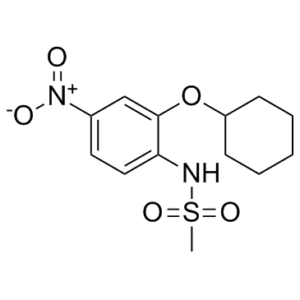
NS-398 [also called NS 398, N-(2-cyclohexyloxy-4-nitrophenyl)methane sulfonamide] is a novel, highly potent and selective inhibitor of cyclooxygenase-2 (COX-2) that is used as a non-steroidal an-inflammatory agent with analgesic and antipyretic effects. The IC50 values for human recombinant COX-1 and -2 are 75 and 1.77 μM, respectively, which means the COX-1 activity is completely unaffected by 75 μM NS-398, whereas the COX-2 activity was concentration-dependently inhibited with the IC50 value being 1.77 μM. NS-398 inhibits proliferation and induces apoptosis in human osteosarcoma cells via downregulation of the survivin pathway. NS-398-enhanced apoptosis of esophageal carcinoma cell EC9706 by adjusting expression of survivin and caspase-3.
Physicochemical Properties
| Molecular Formula | C13H18N2O5S | |
| Molecular Weight | 314.36 | |
| Exact Mass | 314.093 | |
| CAS # | 123653-11-2 | |
| Related CAS # |
|
|
| PubChem CID | 4553 | |
| Appearance | Light yellow to yellow solid powder | |
| Density | 1.4±0.1 g/cm3 | |
| Boiling Point | 490.6±55.0 °C at 760 mmHg | |
| Melting Point | 139 °C | |
| Flash Point | 250.5±31.5 °C | |
| Vapour Pressure | 0.0±1.2 mmHg at 25°C | |
| Index of Refraction | 1.593 | |
| LogP | 3.67 | |
| Hydrogen Bond Donor Count | 1 | |
| Hydrogen Bond Acceptor Count | 6 | |
| Rotatable Bond Count | 4 | |
| Heavy Atom Count | 21 | |
| Complexity | 450 | |
| Defined Atom Stereocenter Count | 0 | |
| SMILES | 0 |
|
| InChi Key | KTDZCOWXCWUPEO-UHFFFAOYSA-N | |
| InChi Code | InChI=1S/C13H18N2O5S/c1-21(18,19)14-12-8-7-10(15(16)17)9-13(12)20-11-5-3-2-4-6-11/h7-9,11,14H,2-6H2,1H3 | |
| Chemical Name | N-(2-cyclohexyloxy-4-nitrophenyl)methanesulfonamide | |
| Synonyms |
|
|
| HS Tariff Code | 2934.99.9001 | |
| Storage |
Powder-20°C 3 years 4°C 2 years In solvent -80°C 6 months -20°C 1 month |
|
| Shipping Condition | Room temperature (This product is stable at ambient temperature for a few days during ordinary shipping and time spent in Customs) |
Biological Activity
| ln Vitro | With an IC50 of 3.8 μM and no effect on COX-1 at 100 μM, NS-398 is a nonsteroidal anti-inflammatory drug that specifically inhibits prostaglandin G/H synthase/cyclooxygenase (COX-2) activity. [1]. In sheep seminal vesicle microsomes, NS-398 weakly inhibits PG endoperoxide synthase activity (IC50: 11 μM)[2]. | ||
| ln Vivo | Rats with an ED30 of 1.14 mg/kg showed dose-dependent inhibition of paw edema when treated with NS-398 (0.5-10 mg/kg, po), and this treatment was effective in managing adjuvant arthritis (ED30, 4.69 mg/kg). In rats, it has an antipyretic effect (ED50, 1.84 mg/kg) and a dose-dependent analgesic effect (ED50, 1.65 mg/kg). With an ED50 of 8.2 mg/kg, NS-398 suppresses the writhing response brought on by acetic acid in mice[2]. | ||
| Animal Protocol |
|
||
| References |
[1]. NS-398, a new anti-inflammatory agent, selectively inhibits prostaglandin G/H synthase/cyclooxygenase (COX-2) activity in vitro. Prostaglandins. 1994 Jan;47(1):55-9. [2]. NS-398, a novel non-steroidal anti-inflammatory drug with potent analgesic and antipyretic effects, which causes minimal stomach lesions. Gen Pharmacol. 1993 Jan;24(1):105-10. |
||
| Additional Infomation |
NS-398 is a C-nitro compound that is N-methylsulfonyl-4-nitroaniline bearing an additional cyclohexyloxy substituent at position 2. It has a role as a cyclooxygenase 2 inhibitor and an antineoplastic agent. It is a sulfonamide, an aromatic ether and a C-nitro compound. It is functionally related to a 4-nitroaniline. NS-398 is a COX-2 inhibitor. It was developed as part of the mechanistic study of the cyclooxygenases. N-(2-Cyclohexyloxy-4-nitrophenyl)methanesulfonamide has been reported in Plantago major with data available. |
Solubility Data
| Solubility (In Vitro) |
|
|||
| Solubility (In Vivo) |
Solubility in Formulation 1: 2.5 mg/mL (7.95 mM) in 10% DMSO + 90% (20% SBE-β-CD in Saline) (add these co-solvents sequentially from left to right, and one by one), suspension solution; with sonication. For example, if 1 mL of working solution is to be prepared, you can add 100 μL of 25.0 mg/mL clear DMSO stock solution to 900 μL of 20% SBE-β-CD physiological saline solution and mix evenly. Preparation of 20% SBE-β-CD in Saline (4°C,1 week): Dissolve 2 g SBE-β-CD in 10 mL saline to obtain a clear solution. Solubility in Formulation 2: ≥ 1.67 mg/mL (5.31 mM) (saturation unknown) in 10% DMSO + 40% PEG300 + 5% Tween80 + 45% Saline (add these co-solvents sequentially from left to right, and one by one), clear solution. For example, if 1 mL of working solution is to be prepared, you can add 100 μL of 16.7 mg/mL clear DMSO stock solution to 400 μL PEG300 and mix evenly; then add 50 μL Tween-80 to the above solution and mix evenly; then add 450 μL normal saline to adjust the volume to 1 mL. Preparation of saline: Dissolve 0.9 g of sodium chloride in 100 mL ddH₂ O to obtain a clear solution. Solubility in Formulation 3: ≥ 1.67 mg/mL (5.31 mM) (saturation unknown) in 10% DMSO + 90% Corn Oil (add these co-solvents sequentially from left to right, and one by one), clear solution. For example, if 1 mL of working solution is to be prepared, you can add 100 μL of 16.7 mg/mL clear DMSO stock solution to 900 μL of corn oil and mix evenly. (Please use freshly prepared in vivo formulations for optimal results.) |
| Preparing Stock Solutions | 1 mg | 5 mg | 10 mg | |
| 1 mM | 3.1811 mL | 15.9053 mL | 31.8107 mL | |
| 5 mM | 0.6362 mL | 3.1811 mL | 6.3621 mL | |
| 10 mM | 0.3181 mL | 1.5905 mL | 3.1811 mL |