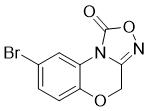
Physicochemical Properties
| Molecular Formula | C9H5BRN2O3 |
| Molecular Weight | 269.05 |
| Exact Mass | 267.948 |
| CAS # | 204326-43-2 |
| PubChem CID | 4551 |
| Appearance | White to off-white solid powder |
| Density | 2.1±0.1 g/cm3 |
| Boiling Point | 353.8±52.0 °C at 760 mmHg |
| Melting Point | 161-162ºC |
| Flash Point | 167.8±30.7 °C |
| Vapour Pressure | 0.0±0.8 mmHg at 25°C |
| Index of Refraction | 1.778 |
| LogP | 0.27 |
| Hydrogen Bond Donor Count | 0 |
| Hydrogen Bond Acceptor Count | 4 |
| Rotatable Bond Count | 0 |
| Heavy Atom Count | 15 |
| Complexity | 333 |
| Defined Atom Stereocenter Count | 0 |
| InChi Key | MUDRLQRJCGJJTB-UHFFFAOYSA-N |
| InChi Code | InChI=1S/C9H5BrN2O3/c10-5-1-2-7-6(3-5)12-8(4-14-7)11-15-9(12)13/h1-3H,4H2 |
| Chemical Name | 8-bromo-4H-[1,2,4]oxadiazolo[3,4-c][1,4]benzoxazin-1-one |
| Synonyms | NS2028 NS-2028 NS 2028 |
| HS Tariff Code | 2934.99.9001 |
| Storage |
Powder-20°C 3 years 4°C 2 years In solvent -80°C 6 months -20°C 1 month |
| Shipping Condition | Room temperature (This product is stable at ambient temperature for a few days during ordinary shipping and time spent in Customs) |
Biological Activity
| ln Vitro | When compared to cells cultured in a vehicle, NS -2028 (10 μM) suppresses cell number growth by 25% [2]. By preventing p38 MAPK activation, NS -2028 (10 μM; 30 min) stimulates cell proliferation test in the presence of VEGF [2]. |
| ln Vivo | After VEGF particles were ingested, NS-2028 (a powder medication; 1 g/L; 8 days) dramatically decreased the formation of new blood vessels in avascular rabbits [2]. |
| Cell Assay |
Cell Proliferation Assay[2] Cell Types: HUVEC Cell Tested Concentrations: 10 μM Incubation Duration: 24 hrs (hours) Experimental Results: diminished number of cells in culture. EC migration[2]. Western Blot Analysis[2] Cell Types: HUVEC Cell Tested Concentrations: 10 μM Incubation Duration: 30 minutes Experimental Results: VEGF-enhanced p38 phosphorylation is attenuated. |
| Animal Protocol |
Animal/Disease Models: Rabbit[2] Doses: 1 g/L Route of Administration: Oral administration; 1 g/L; 8 days Experimental Results: Inhibits VEGF-induced angiogenesis in vivo. |
| References |
[1]. Characterization of NS 2028 as a specific inhibitor of soluble guanylyl cyclase. Br J Pharmacol. 1998 Jan;123(2):299-309. [2]. The soluble guanylyl cyclase inhibitor NS-2028 reduces vascular endothelial growth factor-induced angiogenesis and permeability. Am J Physiol Regul Integr Comp Physiol. 2010 Mar;298(3):R824-32. |
Solubility Data
| Solubility (In Vitro) | DMSO : ~250 mg/mL (~929.20 mM) |
| Solubility (In Vivo) |
Solubility in Formulation 1: ≥ 2.17 mg/mL (8.07 mM) (saturation unknown) in 10% DMSO + 40% PEG300 + 5% Tween80 + 45% Saline (add these co-solvents sequentially from left to right, and one by one), clear solution. For example, if 1 mL of working solution is to be prepared, you can add 100 μL of 21.7 mg/mL clear DMSO stock solution to 400 μL PEG300 and mix evenly; then add 50 μL Tween-80 to the above solution and mix evenly; then add 450 μL normal saline to adjust the volume to 1 mL. Preparation of saline: Dissolve 0.9 g of sodium chloride in 100 mL ddH₂ O to obtain a clear solution. Solubility in Formulation 2: ≥ 2.17 mg/mL (8.07 mM) (saturation unknown) in 10% DMSO + 90% Corn Oil (add these co-solvents sequentially from left to right, and one by one), clear solution. For example, if 1 mL of working solution is to be prepared, you can add 100 μL of 21.7 mg/mL clear DMSO stock solution to 900 μL of corn oil and mix evenly. (Please use freshly prepared in vivo formulations for optimal results.) |
| Preparing Stock Solutions | 1 mg | 5 mg | 10 mg | |
| 1 mM | 3.7168 mL | 18.5839 mL | 37.1678 mL | |
| 5 mM | 0.7434 mL | 3.7168 mL | 7.4336 mL | |
| 10 mM | 0.3717 mL | 1.8584 mL | 3.7168 mL |