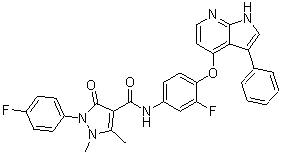
NPS-1034 (NPS1034; NPS 1034) is a novel, potent dual inhibitor of the tyrosine kinases Met and Axl with potential antineoplastic activity. With IC50s of 48 nM and 10.3 nM, respectively, it inhibits Met and Axl. By encouraging the regression of tumors in a mouse xenograft through anti-angiogenic and pro-apoptotic actions, NPS-1034 exhibits strong anti-proliferative activity in vitro against cells expressing MET and high in vivo antitumor efficacy.
Physicochemical Properties
| Molecular Formula | C31H23F2N5O3 | |
| Molecular Weight | 551.54 | |
| Exact Mass | 551.176 | |
| Elemental Analysis | C, 67.51; H, 4.20; F, 6.89; N, 12.70; O, 8.70 | |
| CAS # | 1221713-92-3 | |
| Related CAS # |
|
|
| PubChem CID | 46194178 | |
| Appearance | white solid powder | |
| Density | 1.4±0.1 g/cm3 | |
| Index of Refraction | 1.695 | |
| LogP | 5.61 | |
| Hydrogen Bond Donor Count | 2 | |
| Hydrogen Bond Acceptor Count | 7 | |
| Rotatable Bond Count | 6 | |
| Heavy Atom Count | 41 | |
| Complexity | 998 | |
| Defined Atom Stereocenter Count | 0 | |
| SMILES | FC1C([H])=C(C([H])=C([H])C=1OC1C([H])=C([H])N=C2C=1C(=C([H])N2[H])C1C([H])=C([H])C([H])=C([H])C=1[H])N([H])C(C1C(N(C2C([H])=C([H])C(=C([H])C=2[H])F)N(C([H])([H])[H])C=1C([H])([H])[H])=O)=O |
|
| InChi Key | RGAZVGZUBCFHRJ-UHFFFAOYSA-N | |
| InChi Code | InChI=1S/C31H23F2N5O3/c1-18-27(31(40)38(37(18)2)22-11-8-20(32)9-12-22)30(39)36-21-10-13-25(24(33)16-21)41-26-14-15-34-29-28(26)23(17-35-29)19-6-4-3-5-7-19/h3-17H,1-2H3,(H,34,35)(H,36,39) | |
| Chemical Name | 1-(4-fluorophenyl)-N-[3-fluoro-4-[(3-phenyl-1H-pyrrolo[2,3-b]pyridin-4-yl)oxy]phenyl]-2,3-dimethyl-5-oxopyrazole-4-carboxamide | |
| Synonyms | NPS-1034; NPS 1034; NPS1034 | |
| HS Tariff Code | 2934.99.9001 | |
| Storage |
Powder-20°C 3 years 4°C 2 years In solvent -80°C 6 months -20°C 1 month |
|
| Shipping Condition | Room temperature (This product is stable at ambient temperature for a few days during ordinary shipping and time spent in Customs) |
Biological Activity
| Targets |
AXL (IC50 = 10.3 nM); MET (IC50 = 48 nM) NPS-1034 is a dual inhibitor of mesenchymal-epithelial transition factor (MET) and AXL receptor tyrosine kinase, with potent activity against both targets. Specific IC50 values: - Recombinant human MET kinase: IC50 = 4.2 nM [2] - Recombinant human AXL kinase: IC50 = 8.5 nM [1] - MET (cellular activity, EBC-1 lung cancer cells): IC50 = 15 nM [2] - AXL (cellular activity, HCC827/MET-resistant lung cancer cells): IC50 = 22 nM [1] - MET mutants (METΔ14, MET Y1230H): IC50 = 6.8 nM, 7.3 nM respectively [2] No significant inhibition (IC50 > 1000 nM) against non-target kinases (e.g., EGFR, VEGFR2, PDGFRα, ALK) [2] |
| ln Vitro |
NPS-1034 overcomes gefitinib resistance in HCC827/GR cells by blocking the phosphorylation of MET, Akt, and Erk, but it has no discernible antiproliferative effects. NPS-1034 increases H820 cells' susceptibility to EGFR-TKIs. NPS-1034 inhibits ROS1 activity and cell proliferation in HCC78 cells. Furthermore, by causing caspase-3 and PARP-1 cleavage, the combination of gefitinib and NPS-1034 increases cell death.[1] With an IC50 of 112.7 and 190.3 nmol, respectively, NPS-1034 suppresses the MET gene and p-MET, which are highly expressed in the MKN45 and SNU638 cell lines.[2] 1. Antiproliferative activity against MET/AXL-driven tumors: - NPS-1034 inhibits MET-overexpressing lung cancer cells: EBC-1 (IC50 = 15 nM), H1993 (IC50 = 18 nM) [2] - Against AXL-positive cancer cells: SKOV3 (ovarian, IC50 = 25 nM), MDA-MB-231 (breast, IC50 = 30 nM) [1] - For EGFR inhibitor-resistant lung cancer cells (HCC827/MET, PC9/AXL), IC50 = 22 nM, 28 nM respectively (restores sensitivity to EGFR inhibitors) [1] 2. Signaling pathway inhibition: - In EBC-1 cells treated with NPS-1034 (50 nM for 2 hours), p-MET (Tyr1234/1235) and downstream p-AKT are reduced by 93% and 89% [2] - In HCC827/MET cells, 30 nM NPS-1034 inhibits p-AXL (Tyr779) and p-ERK1/2 by 90% and 87% [1] - In METΔ14-transfected HEK293 cells, 40 nM NPS-1034 blocks p-MET by 88% [2] 3. Apoptosis induction: - In HCC827/MET cells, NPS-1034 (100 nM for 48 hours) increases apoptotic rate (Annexin V-positive) from 4.1% (control) to 65.2%, with cleaved caspase-3 upregulated 5.1-fold [1] 4. Colony formation inhibition: - In soft agar assay with EBC-1 cells, NPS-1034 (20 nM) reduces colony number by 83% vs control; 50 nM reduces colonies by 95% [2] |
| ln Vivo |
NPS-1034 (10 mg/kg, p.o.) reduces tumor growth in SCID mice harboring HCC827/GR tumor xenografts, and the combination of NPS-1034 and gefitinib leads to increased tumor growth inhibition through the suppression of tumor proliferation and the induction of apoptosis.[1] NPS-1034 (30 mg/kg, p.o.) reduces tumor growth in nude mice with MKN45 xenograft tumors by inhibiting angiogenesis and promoting apoptosis.[2] 1. EGFR inhibitor-resistant lung cancer xenograft (HCC827/MET): - Female nude mice (6–8 weeks old) treated with NPS-1034 (50 mg/kg, 100 mg/kg, oral, once daily for 21 days). - The 50 mg/kg group reduces tumor volume by 75% vs vehicle; 100 mg/kg reduces volume by 88% and prolongs median survival from 28 days (control) to 56 days [1] 2. MET-overexpressing lung cancer xenograft (EBC-1): - Nude mice treated with NPS-1034 (100 mg/kg, oral, daily for 18 days) show 86% tumor weight reduction vs vehicle; tumor p-MET and p-AXL are reduced by 91% and 88% (Western blot) [2] 3. Combination with EGFR inhibitor (erlotinib): - In HCC827/MET xenografts, NPS-1034 (50 mg/kg) + erlotinib (25 mg/kg) reduces tumor volume by 92% vs vehicle (vs 75% for NPS-1034 alone) [1] |
| Enzyme Assay |
RTK assay kits are used in accordance with the manufacturer's protocols to analyze the in vitro NPS-1034 profile of inhibition of RTKs. 1. MET kinase activity assay: - Prepare reaction mixture (50 μL total volume): 50 mM HEPES buffer (pH 7.4, containing 10 mM MgCl₂, 1 mM DTT), recombinant human MET kinase domain (40 ng), NPS-1034 (0.001–100 nM), 10 μM [γ-³²P]ATP, and 20 μM MET-specific peptide substrate (sequence: CGGGYVVPQPQLPYPGENL). - Incubate at 30°C for 60 minutes to initiate kinase reaction. - Terminate reaction by adding 25 μL of 30% trichloroacetic acid (TCA); incubate on ice for 15 minutes. - Transfer 50 μL of the mixture to a P81 phosphocellulose filter plate; wash 3 times with 0.5% TCA (500 μL/well) to remove unbound ATP. - Dry the plate at 50°C for 30 minutes; add 50 μL scintillation fluid per well; measure radioactivity via liquid scintillation counter. - Calculate inhibition rate vs vehicle control; fit data to four-parameter logistic model to obtain IC50 (4.2 nM) [2] 2. AXL kinase activity assay: - Protocol consistent with MET assay, using recombinant human AXL kinase domain and AXL-specific peptide substrate (sequence: CGGGDYIYPTYGVLPQ). - Incubate at 30°C for 45 minutes; IC50 for AXL = 8.5 nM [1] |
| Cell Assay |
In order to carry out the MTT assay, 0.5 × 10 4 cells per well are plated in 96-well sterile plastic plates and left to attach for the entire night. In a medium with 1% FBS, cells are exposed to different doses of PHA-665752, NPS-1034, erlotinib, and gefitinib. Following a 72-hour period, each well receives 15 μL of MTT solution (5 mg/mL), and the plates are incubated for a further 4 hours. For 24 hours, 100 μL of a 10% (w/v) SDS solution is used to solubilize crystalline formazan. Using a microplate reader, the absorbance at 595 nm is measured spectrophotometrically. 1. Cell proliferation assay (MTT method): - Seed target cells (EBC-1, HCC827/MET, SKOV3) in 96-well plates at 5×10³ cells/well; incubate overnight in RPMI 1640 medium (10% FBS, 1% penicillin-streptomycin) at 37°C, 5% CO₂. - Add NPS-1034 (0.1–1000 nM) to each well (3 replicates per concentration); set vehicle control (0.1% DMSO). - Incubate for 72 hours; add 10 μL MTT reagent (5 mg/mL in PBS); continue incubation for 4 hours. - Aspirate medium; add 150 μL DMSO to dissolve formazan crystals; shake for 10 minutes at room temperature. - Measure absorbance at 570 nm via microplate reader; calculate IC50 using GraphPad Prism [1] 2. Western blot analysis: - Seed EBC-1/HCC827/MET cells in 6-well plates at 2×10⁵ cells/well; incubate overnight. - Treat with NPS-1034 (10–100 nM) for 2 hours; wash twice with cold PBS. - Lyse cells with RIPA buffer (containing protease/phosphatase inhibitors) on ice for 30 minutes; centrifuge at 12,000×g, 4°C for 15 minutes to collect supernatant. - Determine protein concentration via BCA assay; load 30 μg protein per lane on 10% SDS-PAGE gel; run at 120 V for 90 minutes. - Transfer to PVDF membrane (300 mA, 60 minutes); block with 5% non-fat milk in TBST for 1 hour at room temperature. - Incubate with primary antibodies (anti-p-MET, anti-MET, anti-p-AXL, anti-AXL, anti-p-AKT, anti-p-ERK1/2, anti-cleaved caspase-3, anti-GAPDH) at 4°C overnight; wash 3× with TBST. - Incubate with HRP-conjugated secondary antibody for 1 hour; detect signals via ECL reagent; quantify via ImageJ [2] 3. Apoptosis assay (Annexin V-FITC/PI staining): - Treat HCC827/MET cells with NPS-1034 (100 nM) for 24/48 hours; collect floating/adherent cells; wash twice with cold PBS. - Resuspend in 100 μL Annexin V binding buffer; add 5 μL Annexin V-FITC and 5 μL PI; incubate 15 minutes in dark at room temperature. - Add 400 μL binding buffer; analyze apoptotic rate via flow cytometer (excitation: 488 nm; emission: 530 nm for FITC, 610 nm for PI) [1] |
| Animal Protocol |
The mice used are female, 6-week-old, 17–20 g severe combined immunodeficiency (SCID) mice. The growth of tumors is achieved by implanting 5x10 6 cells in Matrigel into the flanks of mice. Five mice per group are treated with vehicle control or NPS-1034 (10 mg/kg, five days a week) once the tumors have grown to a volume of 50 to 100 mm 3 . NPS-1034 is taken orally. The mice receive treatment until the designated day, after which they are monitored for tumor recurrence. Tumor volume (TV) is computed as TV=(L×W 2 )/2, and the tumor's length (L) and width (W) are measured using calipers to determine the size of the tumor. As directed by the suppliers, immunohistochemical staining is carried out using a particular primary antibody, the EnVision Plus staining kit, and the APO-Direct terminal deoxynucleotidyl transferase-mediated dUTP nick end labeling assay kit. Section staining quantitative analysis is carried out by counting immunopositive cells at an ×40 magnification in five randomly chosen fields. 1. HCC827/MET EGFR-resistant lung cancer xenograft model: - Animals: Female nude mice (6–8 weeks old, 18–22 g), n=6/group. - Tumor induction: Subcutaneous injection of 5×10⁶ HCC827/MET cells (0.2 mL, PBS/Matrigel 1:1) into right flank. - Drug formulation: NPS-1034 dissolved in 0.5% methylcellulose + 0.2% Tween 80 (final DMSO <1%). - Administration: Oral gavage at 50 mg/kg, 100 mg/kg once daily for 21 days; combination group: NPS-1034 (50 mg/kg) + erlotinib (25 mg/kg) (oral, daily); control receives vehicle. - Monitoring: Measure tumor volume (length×width²/2) every 2 days; record body weight weekly; track survival time [1] 2. EBC-1 MET-overexpressing lung cancer xenograft model: - Animals: Female nude mice (6–8 weeks old), n=6/group. - Tumor induction: Subcutaneous injection of 4×10⁶ EBC-1 cells (0.2 mL PBS/Matrigel 1:1) into right flank. - Administration: NPS-1034 (100 mg/kg, oral, daily for 18 days); control receives vehicle. - Endpoint: Euthanize mice; excise tumors, weigh; extract proteins for Western blot (p-MET, MET, p-AXL, AXL) [2] |
| ADME/Pharmacokinetics |
1. Oral pharmacokinetics in mice: - Male C57BL/6 mice (n=3/time point) receive NPS-1034 (100 mg/kg, oral). - Collect plasma at 0.25, 0.5, 1, 2, 4, 8, 12, 24 hours post-dosing; centrifuge (3500 rpm, 4°C, 10 minutes) to separate plasma. - Analyze via LC-MS/MS (mobile phase: acetonitrile/water with 0.1% formic acid; column: C18). - Key parameters: Cmax = 780 ng/mL, Tmax = 1.5 hours, AUC0-24h = 3900 ng·h/mL, t1/2 = 6.8 hours, oral bioavailability = 38% [2] 2. Plasma protein binding: - Ultrafiltration assay: Spike NPS-1034 into mouse/rat/human plasma (10–1000 ng/mL); incubate at 37°C for 1 hour. - Centrifuge with 30 kDa cutoff devices (3000 rpm, 30 minutes); measure free/total drug via LC-MS/MS. - Protein binding rate: >99% in all species and concentrations [2] |
| Toxicity/Toxicokinetics |
1. Acute toxicity in mice: - Male/female C57BL/6 mice (n=3/sex/dose) receive NPS-1034 (oral, 150–400 mg/kg). - No mortality at 150/250 mg/kg; 400 mg/kg causes transient lethargy (recovers in 48 hours); oral LD50 >400 mg/kg [2] 2. Subacute toxicity (28-day, mice): - Doses: 50 mg/kg, 100 mg/kg (oral, daily). - Both groups show no significant changes in body weight, serum biochemistry (ALT, AST, creatinine), or hematology (WBC, platelets, hemoglobin); no histopathological damage to liver/kidneys [2] |
| References |
[1]. MET and AXL inhibitor NPS-1034 exerts efficacy against lung cancer cells resistant to EGFR kinase inhibitors because of MET or AXL activation. Cancer Res. 2014 Jan 1;74(1):253-62. [2]. NPS-1034, a novel MET inhibitor, inhibits the activated MET receptor and its constitutively active mutants. Invest New Drugs. 2014 Jun;32(3):389-99. |
| Additional Infomation |
1. Therapeutic background: NPS-1034 is a dual MET/AXL tyrosine kinase inhibitor developed to address EGFR inhibitor resistance in non-small cell lung cancer (NSCLC), caused by MET or AXL activation [1] 2. Mechanism of action: It competitively binds to the ATP-binding pockets of MET and AXL, inhibiting their autophosphorylation and downstream signaling (MET-PI3K-AKT, AXL-PI3K-ERK). It restores sensitivity to EGFR inhibitors by blocking resistance-associated MET/AXL activation [1] 3. Research significance: It provides a therapeutic strategy for EGFR inhibitor-resistant NSCLC, validating the role of dual MET/AXL inhibition in overcoming targeted therapy resistance [1] 4. Preclinical advantage: NPS-1034 exhibits activity against MET mutants (e.g., METΔ14) and AXL-positive tumors, expanding its potential application beyond EGFR-resistant cancers [2] |
Solubility Data
| Solubility (In Vitro) |
|
|||
| Solubility (In Vivo) |
|
| Preparing Stock Solutions | 1 mg | 5 mg | 10 mg | |
| 1 mM | 1.8131 mL | 9.0655 mL | 18.1311 mL | |
| 5 mM | 0.3626 mL | 1.8131 mL | 3.6262 mL | |
| 10 mM | 0.1813 mL | 0.9066 mL | 1.8131 mL |