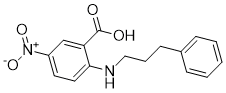
Physicochemical Properties
| Molecular Formula | C16H16N2O4 |
| Molecular Weight | 300.3092 |
| Exact Mass | 300.111 |
| CAS # | 107254-86-4 |
| PubChem CID | 4549 |
| Appearance | Light yellow to yellow solid powder |
| Density | 1.323 g/cm3 |
| Boiling Point | 523.5ºC at 760 mmHg |
| Melting Point | 178-179ºC |
| Vapour Pressure | 8.73E-12mmHg at 25°C |
| Index of Refraction | 1.653 |
| LogP | 3.933 |
| Hydrogen Bond Donor Count | 2 |
| Hydrogen Bond Acceptor Count | 5 |
| Rotatable Bond Count | 6 |
| Heavy Atom Count | 22 |
| Complexity | 377 |
| Defined Atom Stereocenter Count | 0 |
| InChi Key | WBSMIPAMAXNXFS-UHFFFAOYSA-N |
| InChi Code | InChI=1S/C16H16N2O4/c19-16(20)14-11-13(18(21)22)8-9-15(14)17-10-4-7-12-5-2-1-3-6-12/h1-3,5-6,8-9,11,17H,4,7,10H2,(H,19,20) |
| Chemical Name | 5-nitro-2-(3-phenylpropylamino)benzoic acid |
| HS Tariff Code | 2934.99.9001 |
| Storage |
Powder-20°C 3 years 4°C 2 years In solvent -80°C 6 months -20°C 1 month |
| Shipping Condition | Room temperature (This product is stable at ambient temperature for a few days during ordinary shipping and time spent in Customs) |
Biological Activity
| ln Vitro | The channel opening probability is decreased by NPPB (0.1 mM) from 0.89±0.06 to 0.11±0.04[1]. The concentration of NPPB (IC50=125 μM) chloride depends on the current. With a GI50 of roughly 500 μM, NPPB itself likewise demonstrates cytotoxicity to neuroastrological tumor cells [2]. |
| References |
[1]. Enhancement of an outwardly rectifying chloride channel in hippocampal pyramidal neurons after cerebral ischemia. Brain Res. 2016 Aug 1;1644:107-17. [2]. Double Blockade of Glioma Cell Proliferation and Migration by Temozolomide Conjugated withNPPB, a Chloride Channel Blocker. ACS Chem Neurosci. 2016 Mar 16;7(3):275-85. |
| Additional Infomation | 5-Nitro-2-(3-phenylpropylamino)benzoic acid is a nitrobenzoic acid. |
Solubility Data
| Solubility (In Vitro) | DMSO : ~100 mg/mL (~332.99 mM) |
| Solubility (In Vivo) |
Solubility in Formulation 1: ≥ 2.5 mg/mL (8.32 mM) (saturation unknown) in 10% DMSO + 40% PEG300 +5% Tween-80 + 45% Saline (add these co-solvents sequentially from left to right, and one by one), clear solution. For example, if 1 mL of working solution is to be prepared, you can add 100 μL of 25.0 mg/mL clear DMSO stock solution to 400 μL PEG300 and mix evenly; then add 50 μL Tween-80 + to the above solution and mix evenly; then add 450 μL normal saline to adjust the volume to 1 mL. Preparation of saline: Dissolve 0.9 g of sodium chloride in 100 mL ddH₂ O to obtain a clear solution. (Please use freshly prepared in vivo formulations for optimal results.) |
| Preparing Stock Solutions | 1 mg | 5 mg | 10 mg | |
| 1 mM | 3.3299 mL | 16.6495 mL | 33.2989 mL | |
| 5 mM | 0.6660 mL | 3.3299 mL | 6.6598 mL | |
| 10 mM | 0.3330 mL | 1.6649 mL | 3.3299 mL |