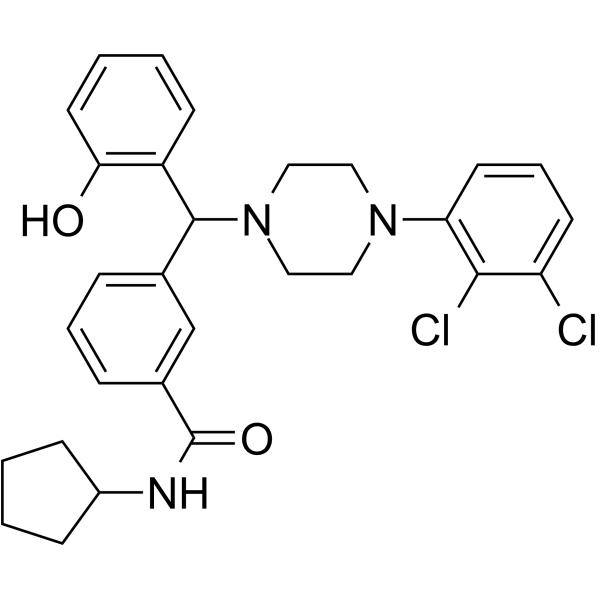
Physicochemical Properties
| Molecular Formula | C44H32N2 |
| Molecular Weight | 588.7383 |
| Exact Mass | 523.179 |
| CAS # | 2247491-97-8 |
| PubChem CID | 135363221 |
| Appearance | White to off-white solid powder |
| LogP | 6.5 |
| Hydrogen Bond Donor Count | 2 |
| Hydrogen Bond Acceptor Count | 4 |
| Rotatable Bond Count | 6 |
| Heavy Atom Count | 36 |
| Complexity | 713 |
| Defined Atom Stereocenter Count | 0 |
| SMILES | N(C1C([H])=C([H])C([H])=C([H])C=1[H])(C1C([H])=C([H])C(=C([H])C=1[H])C1C([H])=C([H])C(=C([H])C=1[H])N(C1C([H])=C([H])C([H])=C([H])C=1[H])C1=C([H])C([H])=C([H])C2=C([H])C([H])=C([H])C([H])=C12)C1=C([H])C([H])=C([H])C2=C([H])C([H])=C([H])C([H])=C12 |
| InChi Key | IQLVMUSOSDGQHW-UHFFFAOYSA-N |
| InChi Code | InChI=1S/C29H31Cl2N3O2/c30-24-12-6-13-25(27(24)31)33-15-17-34(18-16-33)28(23-11-3-4-14-26(23)35)20-7-5-8-21(19-20)29(36)32-22-9-1-2-10-22/h3-8,11-14,19,22,28,35H,1-2,9-10,15-18H2,(H,32,36) |
| Chemical Name | N-cyclopentyl-3-[[4-(2,3-dichlorophenyl)piperazin-1-yl]-(2-hydroxyphenyl)methyl]benzamide |
| HS Tariff Code | 2934.99.9001 |
| Storage |
Powder-20°C 3 years 4°C 2 years In solvent -80°C 6 months -20°C 1 month |
| Shipping Condition | Room temperature (This product is stable at ambient temperature for a few days during ordinary shipping and time spent in Customs) |
Biological Activity
| Targets | NPB targets BCL2-associated agonist of cell death (BAD) (IC50 = 0.3 μM for inhibiting BAD Ser112 phosphorylation; IC50 = 0.5 μM for inhibiting BAD Ser136 phosphorylation) [1] |
| ln Vitro |
- Inhibition of BAD specific serine phosphorylation: NPB dose-dependently inhibits phosphorylation of BAD at Ser112 and Ser136 in MCF-7 (breast cancer), HCT116 (colon cancer), and A549 (lung cancer) cells. At 1 μM, Ser112 phosphorylation is reduced by 78% and Ser136 by 70% compared to control. It does not affect phosphorylation of other proteins (AKT, ERK1/2, STAT3) at 10 μM, confirming specificity [1] - Induction of cancer cell apoptosis: NPB (0.1-2 μM) induces apoptosis in BAD-expressing cancer cells. At 1 μM, apoptotic rates are 45% (MCF-7), 42% (HCT116), and 38% (A549) vs. 3-5% in controls. Western blot detects upregulated cleaved caspase-3 (3.2-fold) and cleaved PARP (2.8-fold), and downregulated Bcl-2 (0.4-fold) [1] - Antiproliferative activity: The compound inhibits proliferation of BAD-dependent cancer cells with IC50 values of 0.6 μM (MCF-7), 0.8 μM (HCT116), and 1.0 μM (A549). It has minimal effect on BAD-knockout MCF-7 cells (IC50 > 20 μM) and normal human foreskin fibroblasts (NHF, IC50 > 20 μM) [1] - Enhancement of chemosensitivity: NPB (0.5 μM) synergizes with doxorubicin (0.1 μM) to inhibit MCF-7 cell proliferation, reducing cell viability by 75% (vs. 30% doxorubicin alone and 25% NPB alone). It also increases doxorubicin-induced apoptosis by 2.5-fold [1] |
| ln Vivo |
- Antitumor efficacy in MCF-7 xenograft model: Nude mice bearing MCF-7 breast cancer xenografts were intraperitoneally administered NPB (5 mg/kg, 10 mg/kg, once daily for 21 days). Tumor growth inhibition rates are 55% (5 mg/kg) and 72% (10 mg/kg) compared to vehicle control. Tumor weight is reduced by 68% (10 mg/kg) [1] - Inhibition of BAD phosphorylation in vivo: Tumor tissues from treated mice (10 mg/kg) show reduced BAD Ser112 (70% reduction) and Ser136 (65% reduction) phosphorylation. Western blot detects increased cleaved caspase-3 (2.6-fold) and decreased Bcl-2 (0.3-fold) in tumor tissues [1] - Tolerability: No significant body weight loss (< 6%) or obvious toxic signs (lethargy, organ damage) are observed in treated mice. Blood routine, liver function (ALT, AST), and kidney function (creatinine, urea nitrogen) indices remain within normal ranges [1] |
| Enzyme Assay |
- BAD phosphorylation inhibition assay: Recombinant BAD protein was mixed with recombinant AKT1 (for Ser136) or Raf-1 (for Ser112) kinase, ATP (10 μM), and NPB at gradient concentrations (0.01-2 μM) in kinase buffer (pH 7.4). The mixture was incubated at 37°C for 1 hour, and phosphorylated BAD (Ser112/Ser136) was detected by western blot. IC50 values were calculated by quantifying band intensities [1] - Surface plasmon resonance (SPR) binding assay: Recombinant human BAD protein was immobilized on a sensor chip. NPB at gradient concentrations (0.1-10 μM) was injected, and binding affinity was measured at 25°C. The equilibrium dissociation constant (KD) was 0.2 μM, confirming direct binding between NPB and BAD [1] |
| Cell Assay |
- BAD phosphorylation western blot assay: MCF-7, HCT116, or A549 cells were seeded into 6-well plates (5×10⁵ cells/well) and incubated overnight. Cells were treated with NPB (0.1-2 μM) for 6 hours, lysed, and phosphorylated BAD (Ser112/Ser136), total BAD, p-AKT, p-ERK1/2, and GAPDH were detected by western blot. Band intensities were quantified by densitometry [1] - Apoptosis assay: Cancer cells were seeded into 6-well plates (5×10⁵ cells/well) and treated with NPB (0.1-2 μM) for 24 hours. Cells were stained with Annexin V-FITC/PI and apoptotic cells were quantified by flow cytometry. Western blot was used to detect cleaved caspase-3, cleaved PARP, and Bcl-2 [1] - Cell proliferation assay: Cancer cells, BAD-knockout MCF-7 cells, and NHF cells were seeded into 96-well plates (5×10³ cells/well) and treated with NPB (0.01-20 μM) for 72 hours. Cell viability was measured by tetrazolium salt-based assay, and IC50 values were calculated [1] - Clonogenic assay: MCF-7 cells were seeded into 6-well plates (200 cells/well) and treated with NPB (0.2-1 μM) for 14 days. Colonies were fixed, stained, and counted. At 1 μM, colony formation rate was reduced by 80% compared to control [1] |
| Animal Protocol |
- MCF-7 breast cancer xenograft model: Female nude mice (6-8 weeks old) were subcutaneously injected with MCF-7 cells (5×10⁶ cells/mouse). When tumors reached ~100 mm³, mice were randomly divided into vehicle control, 5 mg/kg, and 10 mg/kg NPB groups (n=6 per group) [1] - Drug formulation and administration: NPB was dissolved in DMSO/PEG400/sterile water (volume ratio 1:3:6) to prepare injectable suspension. Mice were administered intraperitoneally once daily for 21 days; the control group received equal volume of vehicle [1] - Tumor monitoring and tissue analysis: Tumor volume was measured every 3 days (volume = length × width² / 2), and body weight was recorded weekly. At the end of treatment, mice were sacrificed, tumors were excised, weighed, and stored at -80°C. Tumor lysates were used for western blot analysis (p-BAD Ser112/Ser136, total BAD, cleaved caspase-3, Bcl-2) [1] |
| References |
[1]. Discovery of a small-molecule inhibitor of specific serine residue BAD phosphorylation. Proc Natl Acad Sci U S A. 2018 Oct 30;115(44):E10505-E10514. |
| Additional Infomation |
- Chemical classification: NPB is a small-molecule inhibitor that specifically targets BAD serine phosphorylation, belonging to the [specific scaffold not specified in literature] class of compounds [1] - Mechanism of action: The compound binds directly to the phosphorylation motif of BAD (near Ser112 and Ser136), blocking access of kinases (e.g., AKT, Raf-1) to these sites. This prevents BAD inactivation via phosphorylation, restoring its pro-apoptotic function, promoting cancer cell apoptosis, and inhibiting proliferation [1] - Target background: BAD is a pro-apoptotic member of the Bcl-2 family. Phosphorylation at Ser112 and Ser136 inactivates BAD, leading to its sequestration by 14-3-3 proteins and loss of pro-apoptotic activity. Aberrant BAD phosphorylation is associated with cancer cell survival and chemoresistance [1] - Therapeutic potential: NPB is a specific inhibitor of BAD phosphorylation, showing promising efficacy in inducing apoptosis and inhibiting tumor growth in preclinical models. It has potential applications in the treatment of BAD-dependent cancers and may overcome chemoresistance when combined with conventional chemotherapeutic agents [1] |
Solubility Data
| Solubility (In Vitro) | DMSO : ~50 mg/mL (~95.33 mM) |
| Solubility (In Vivo) |
Note: Listed below are some common formulations that may be used to formulate products with low water solubility (e.g. < 1 mg/mL), you may test these formulations using a minute amount of products to avoid loss of samples. Injection Formulations (e.g. IP/IV/IM/SC) Injection Formulation 1: DMSO : Tween 80: Saline = 10 : 5 : 85 (i.e. 100 μL DMSO stock solution → 50 μL Tween 80 → 850 μL Saline) *Preparation of saline: Dissolve 0.9 g of sodium chloride in 100 mL ddH ₂ O to obtain a clear solution. Injection Formulation 2: DMSO : PEG300 :Tween 80 : Saline = 10 : 40 : 5 : 45 (i.e. 100 μL DMSO → 400 μLPEG300 → 50 μL Tween 80 → 450 μL Saline) Injection Formulation 3: DMSO : Corn oil = 10 : 90 (i.e. 100 μL DMSO → 900 μL Corn oil) Example: Take the Injection Formulation 3 (DMSO : Corn oil = 10 : 90) as an example, if 1 mL of 2.5 mg/mL working solution is to be prepared, you can take 100 μL 25 mg/mL DMSO stock solution and add to 900 μL corn oil, mix well to obtain a clear or suspension solution (2.5 mg/mL, ready for use in animals). Injection Formulation 4: DMSO : 20% SBE-β-CD in saline = 10 : 90 [i.e. 100 μL DMSO → 900 μL (20% SBE-β-CD in saline)] *Preparation of 20% SBE-β-CD in Saline (4°C,1 week): Dissolve 2 g SBE-β-CD in 10 mL saline to obtain a clear solution. Injection Formulation 5: 2-Hydroxypropyl-β-cyclodextrin : Saline = 50 : 50 (i.e. 500 μL 2-Hydroxypropyl-β-cyclodextrin → 500 μL Saline) Injection Formulation 6: DMSO : PEG300 : castor oil : Saline = 5 : 10 : 20 : 65 (i.e. 50 μL DMSO → 100 μLPEG300 → 200 μL castor oil → 650 μL Saline) Injection Formulation 7: Ethanol : Cremophor : Saline = 10: 10 : 80 (i.e. 100 μL Ethanol → 100 μL Cremophor → 800 μL Saline) Injection Formulation 8: Dissolve in Cremophor/Ethanol (50 : 50), then diluted by Saline Injection Formulation 9: EtOH : Corn oil = 10 : 90 (i.e. 100 μL EtOH → 900 μL Corn oil) Injection Formulation 10: EtOH : PEG300:Tween 80 : Saline = 10 : 40 : 5 : 45 (i.e. 100 μL EtOH → 400 μLPEG300 → 50 μL Tween 80 → 450 μL Saline) Oral Formulations Oral Formulation 1: Suspend in 0.5% CMC Na (carboxymethylcellulose sodium) Oral Formulation 2: Suspend in 0.5% Carboxymethyl cellulose Example: Take the Oral Formulation 1 (Suspend in 0.5% CMC Na) as an example, if 100 mL of 2.5 mg/mL working solution is to be prepared, you can first prepare 0.5% CMC Na solution by measuring 0.5 g CMC Na and dissolve it in 100 mL ddH2O to obtain a clear solution; then add 250 mg of the product to 100 mL 0.5% CMC Na solution, to make the suspension solution (2.5 mg/mL, ready for use in animals). Oral Formulation 3: Dissolved in PEG400 Oral Formulation 4: Suspend in 0.2% Carboxymethyl cellulose Oral Formulation 5: Dissolve in 0.25% Tween 80 and 0.5% Carboxymethyl cellulose Oral Formulation 6: Mixing with food powders Note: Please be aware that the above formulations are for reference only. InvivoChem strongly recommends customers to read literature methods/protocols carefully before determining which formulation you should use for in vivo studies, as different compounds have different solubility properties and have to be formulated differently. (Please use freshly prepared in vivo formulations for optimal results.) |
| Preparing Stock Solutions | 1 mg | 5 mg | 10 mg | |
| 1 mM | 1.6985 mL | 8.4927 mL | 16.9854 mL | |
| 5 mM | 0.3397 mL | 1.6985 mL | 3.3971 mL | |
| 10 mM | 0.1699 mL | 0.8493 mL | 1.6985 mL |