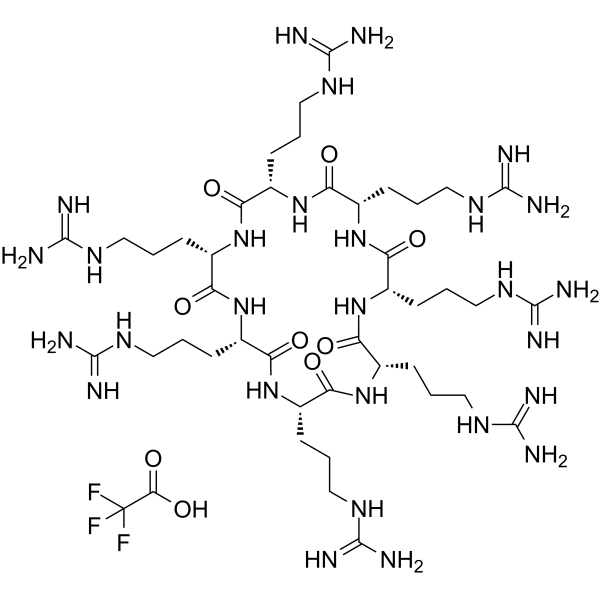
Physicochemical Properties
| Molecular Formula | C??H??F?N??O? |
| Molecular Weight | 1207.32 |
| Related CAS # | NP213;942577-31-3 |
| Appearance | White to off-white solid powder |
| Synonyms | NP213 TFA; NP213 TFA |
| HS Tariff Code | 2934.99.9001 |
| Storage |
Powder-20°C 3 years 4°C 2 years In solvent -80°C 6 months -20°C 1 month Note: Please store this product in a sealed and protected environment (e.g. under nitrogen), avoid exposure to moisture and light. |
| Shipping Condition | Room temperature (This product is stable at ambient temperature for a few days during ordinary shipping and time spent in Customs) |
Biological Activity
| ln Vitro | NP213 (500-1000 μg/mL; 18 hours) increases the quantity of T. rubrum NCPF0118 cells that are stained with PI in the samples. According to these findings, NP213 has fungicidal properties and acts through membrane permeabilization[1]. NP213 exhibits varying minimum inhibitory concentrations (MICs) in relation to T. rubrum NCPF0118, with the MICs being contingent on the keratin source. For NP213 in 1640 medium containing human nail keratin, human skin keratin, and lamb's wool keratin, respectively, the MIC values are 16–32 mg/L, 125 mg/L, and 250 mg/L[1].Great action is shown by NP213 TFA (2–3 hours; 0–8 μg/ml) against yeast that is clinically relevant, such as Candida species, Cryptococcus species, and Trichosporon species. The median MIC100 values for all 122 yeast isolates were found to be 1-2 µg/ml [3]. |
| ln Vivo | In mice, NP213 TFA (25 mg/kg) is well tolerated. NP213 has a half-life of roughly 4.5 hours and is well-tolerated and effective in murine models of acute disseminated candidiasis[3]. |
| Cell Assay |
Cell Cytotoxicity Assay[3] Cell Types: Clinically relevant yeast isolates Tested Concentrations: 0 μg/ml; 0.125 μg/ml; 0.25 μg/ml; 0.5 μg/ml; 1 μg/ml; 2 μg/ml; 4 μg/ml; 8 μg/ml Incubation Duration: 2 h, 2.5 h, 4 h Experimental Results: diminished isolates growth as a dose-dependent manner. |
| References |
[1]. Improved Methods for Assessing Therapeutic Potential of Antifungal Agents against Dermatophytes and Their Application in the Development of NP213, a Novel Onychomycosis Therapy Candidate.Antimicrob Agents Chemother. 2019 Apr 25;63(5). pii. [2]. Sequential and Structural Aspects of Antifungal Peptides from Animals, Bacteria and Fungi Based on Bioinformatics Tools.Probiotics Antimicrob Proteins. 2016 Jun;8(2):85-101. [3]. Novamycin®/NP339 Technology Summary. |
Solubility Data
| Solubility (In Vitro) | May dissolve in DMSO (in most cases), if not, try other solvents such as H2O, Ethanol, or DMF with a minute amount of products to avoid loss of samples |
| Solubility (In Vivo) |
Solubility in Formulation 1: ≥ 2.5 mg/mL (2.07 mM) (saturation unknown) in 10% DMSO + 40% PEG300 + 5% Tween80 + 45% Saline (add these co-solvents sequentially from left to right, and one by one), clear solution. For example, if 1 mL of working solution is to be prepared, you can add 100 μL of 25.0 mg/mL clear DMSO stock solution to 400 μL PEG300 and mix evenly; then add 50 μL Tween-80 to the above solution and mix evenly; then add 450 μL normal saline to adjust the volume to 1 mL. Preparation of saline: Dissolve 0.9 g of sodium chloride in 100 mL ddH₂ O to obtain a clear solution. Solubility in Formulation 2: ≥ 2.5 mg/mL (2.07 mM) (saturation unknown) in 10% DMSO + 90% (20% SBE-β-CD in Saline) (add these co-solvents sequentially from left to right, and one by one), clear solution. For example, if 1 mL of working solution is to be prepared, you can add 100 μL of 25.0 mg/mL clear DMSO stock solution to 900 μL of 20% SBE-β-CD physiological saline solution and mix evenly. Preparation of 20% SBE-β-CD in Saline (4°C,1 week): Dissolve 2 g SBE-β-CD in 10 mL saline to obtain a clear solution. Solubility in Formulation 3: ≥ 2.5 mg/mL (2.07 mM) (saturation unknown) in 10% DMSO + 90% Corn Oil (add these co-solvents sequentially from left to right, and one by one), clear solution. For example, if 1 mL of working solution is to be prepared, you can add 100 μL of 25.0 mg/mL clear DMSO stock solution to 900 μL of corn oil and mix evenly. Solubility in Formulation 4: 100 mg/mL (82.83 mM) in PBS (add these co-solvents sequentially from left to right, and one by one), clear solution; with ultrasonication. (Please use freshly prepared in vivo formulations for optimal results.) |
| Preparing Stock Solutions | 1 mg | 5 mg | 10 mg | |
| 1 mM | 0.8283 mL | 4.1414 mL | 8.2828 mL | |
| 5 mM | 0.1657 mL | 0.8283 mL | 1.6566 mL | |
| 10 mM | 0.0828 mL | 0.4141 mL | 0.8283 mL |