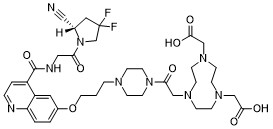
Physicochemical Properties
| Molecular Formula | C36H47F2N9O8 |
| Molecular Weight | 771.81 |
| Exact Mass | 771.35 |
| Elemental Analysis | C, 56.02; H, 6.14; F, 4.92; N, 16.33; O, 16.58 |
| CAS # | 2374782-03-1 |
| Related CAS # | 2374782-03-1; |
| PubChem CID | 139400498 |
| Appearance | Light yellow to yellow solid powder |
| LogP | -4.2 |
| Hydrogen Bond Donor Count | 3 |
| Hydrogen Bond Acceptor Count | 16 |
| Rotatable Bond Count | 14 |
| Heavy Atom Count | 55 |
| Complexity | 1380 |
| Defined Atom Stereocenter Count | 1 |
| SMILES | C1CN(CCN1CCCOC2=CC3=C(C=CN=C3C=C2)C(=O)NCC(=O)N4CC(C[C@H]4C#N)(F)F)C(=O)CN5CCN(CCN(CC5)CC(=O)O)CC(=O)O |
| InChi Key | XQARGGQZFNOLDH-SANMLTNESA-N |
| InChi Code | InChI=1S/C36H47F2N9O8/c37-36(38)19-26(20-39)47(25-36)31(48)21-41-35(54)28-4-5-40-30-3-2-27(18-29(28)30)55-17-1-6-42-13-15-46(16-14-42)32(49)22-43-7-9-44(23-33(50)51)11-12-45(10-8-43)24-34(52)53/h2-5,18,26H,1,6-17,19,21-25H2,(H,41,54)(H,50,51)(H,52,53)/t26-/m0/s1 |
| Chemical Name | (S)-2,2'-(7-(2-(4-(3-((4-((2-(2-cyano-4,4-difluoropyrrolidin-1-yl)-2-oxoethyl)carbamoyl)quinolin-6-yl)oxy)propyl)piperazin-1-yl)-2-oxoethyl)-1,4,7-triazonane-1,4-diyl)diacetic acid |
| Synonyms | NOTA-FAPI-4; NOTA-FAPI-04; NTFAPI; NTFAPI; NOTA-FAPI; 2374782-03-1; NOTA-FAPI-04; RD4ZKJ67G3; FAPI-42; (S)-2,2'-(7-(2-(4-(3-((4-((2-(2-Cyano-4,4-difluoropyrrolidin-1-yl)-2-oxoethyl)carbamoyl)quinolin-6-yl)oxy)propyl)piperazin-1-yl)-2-oxoethyl)-1,4,7-triazonane-1,4-diyl)diacetic acid; 1H-1,4,7-Triazonine-1,4(5H)-diacetic acid, 7-(2-(4-(3-((4-(((2-((2S)-2-cyano-4,4-difluoro-1-pyrrolidinyl)-2-oxoethyl)amino)carbonyl)-6-quinolinyl)oxy)propyl)-1-piperazinyl)-2-oxoethyl)hexahydro-; |
| HS Tariff Code | 2934.99.9001 |
| Storage |
Powder-20°C 3 years 4°C 2 years In solvent -80°C 6 months -20°C 1 month Note: This product requires protection from light (avoid light exposure) during transportation and storage. |
| Shipping Condition | Room temperature (This product is stable at ambient temperature for a few days during ordinary shipping and time spent in Customs) |
Biological Activity
| Targets | FAP (fibroblast activation protein) |
| ln Vitro | The radiolabelling yield of Al18F-NOTA-FAPI was 33.8 ± 3.2% using manual synthesis (n = 10), with a radiochemical purity over 99% and the specific activity of 9.3-55.5 MBq/nmol. [1] |
| ln Vivo |
In this study, a novel aluminium-[18F]fluoride (Al18F)-labelled 1,4,7‑triazacyclononane-N,N',N″-triacetic acid (NOTA)-conjugated fibroblast activation protein inhibitor (FAPI) probe, named Al18F-NOTA-FAPI, was developed for fibroblast activation protein (FAP)-targeted tumour imaging; it could deliver hundreds of millicuries of radioactivity using automated synthesis. The tumour detection efficacy of Al18F-NOTA-FAPI was further validated in both preclinical and clinical translational studies. Results: The radiolabelling yield of Al18F-NOTA-FAPI was 33.8 ± 3.2% using manual synthesis (n = 10), with a radiochemical purity over 99% and the specific activity of 9.3-55.5 MBq/nmol. The whole body effective dose of Al18F-NOTA-FAPI was estimated to be 1.24E - 02 mSv/MBq, which was lower than several other FAPI probes (68Ga-FAPI-04, 68Ga-FAPI-46 and 68Ga-FAPI-74). In U87MG tumour-bearing mice, Al18F-NOTA-FAPI showed good tumour detection efficacy based on the results of micro PET/CT imaging and biodistribution studies. In an organ biodistribution study of patients, Al18F-NOTA-FAPI showed a lower SUVmean than 2-[18F]-fluoro-2-deoxy-D-glucose (2-[18F]FDG) in most organs, especially in the liver (1.1 ± 0.2 vs. 2.0 ± 0.9), brain (0.1 ± 0.0 vs. 5.9 ± 1.3), and bone marrow (0.9 ± 0.1 vs. 1.7 ± 0.4). Meanwhile, Al18F-NOTA-FAPI did not show extensive bone uptake, and was able to detect more lesions than 2-[18F]FDG in the PET/CT imaging of several patients. Conclusion: The Al18F-NOTA-FAPI probe was successfully fabricated and applied in fibroblast activation protein-targeted tumour PET/CT imaging, which showed excellent imaging quality and tumour detection efficacy in U87MG tumour-bearing mice as well as in cancer patients.[1] |
| Cell Assay | The radiolabelling procedure of Al18F-NOTA-FAPI was optimized. Cell uptake and competitive binding assays were completed with the U87MG and A549 cell lines to evaluate the affinity and specificity of the Al18F-NOTA-FAPI probe. [1] |
| Animal Protocol | The biodistribution, pharmacokinetics, radiation dosimetry and tumour imaging efficacy of the Al18F-NOTA-FAPI probe were researched in healthy Kunming (KM) and/or U87MG model mice. After the approval of the ethical committee, the Al18F-NOTA-FAPI probe was translated into the clinic for PET/CT imaging of the first 10 cancer patients. The biodistribution, pharmacokinetics, radiation dosimetry and tumour imaging efficacy of the Al18F-NOTA-FAPI probe were researched in healthy Kunming (KM) and/or U87MG model mice. After the approval of the ethical committee, the Al18F-NOTA-FAPI probe was translated into the clinic for PET/CT imaging of the first 10 cancer patients.[1] |
| References |
[1]. Clinical translational evaluation of Al18F-NOTA-FAPI for fibroblast activation protein-targeted tumour imaging. Eur J Nucl Med Mol Imaging. 2021 Dec;48(13):4259-4271. |
Solubility Data
| Solubility (In Vitro) | DMSO : ~100 mg/mL (~129.57 mM) |
| Solubility (In Vivo) |
Solubility in Formulation 1: ≥ 2.5 mg/mL (3.24 mM) (saturation unknown) in 10% DMSO + 40% PEG300 + 5% Tween80 + 45% Saline (add these co-solvents sequentially from left to right, and one by one), clear solution. For example, if 1 mL of working solution is to be prepared, you can add 100 μL of 25.0 mg/mL clear DMSO stock solution to 400 μL PEG300 and mix evenly; then add 50 μL Tween-80 to the above solution and mix evenly; then add 450 μL normal saline to adjust the volume to 1 mL. Preparation of saline: Dissolve 0.9 g of sodium chloride in 100 mL ddH₂ O to obtain a clear solution. Solubility in Formulation 2: ≥ 2.5 mg/mL (3.24 mM) (saturation unknown) in 10% DMSO + 90% (20% SBE-β-CD in Saline) (add these co-solvents sequentially from left to right, and one by one), clear solution. For example, if 1 mL of working solution is to be prepared, you can add 100 μL of 25.0 mg/mL clear DMSO stock solution to 900 μL of 20% SBE-β-CD physiological saline solution and mix evenly. Preparation of 20% SBE-β-CD in Saline (4°C,1 week): Dissolve 2 g SBE-β-CD in 10 mL saline to obtain a clear solution. Solubility in Formulation 3: ≥ 2.5 mg/mL (3.24 mM) (saturation unknown) in 10% DMSO + 90% Corn Oil (add these co-solvents sequentially from left to right, and one by one), clear solution. For example, if 1 mL of working solution is to be prepared, you can add 100 μL of 25.0 mg/mL clear DMSO stock solution to 900 μL of corn oil and mix evenly. (Please use freshly prepared in vivo formulations for optimal results.) |
| Preparing Stock Solutions | 1 mg | 5 mg | 10 mg | |
| 1 mM | 1.2957 mL | 6.4783 mL | 12.9566 mL | |
| 5 mM | 0.2591 mL | 1.2957 mL | 2.5913 mL | |
| 10 mM | 0.1296 mL | 0.6478 mL | 1.2957 mL |