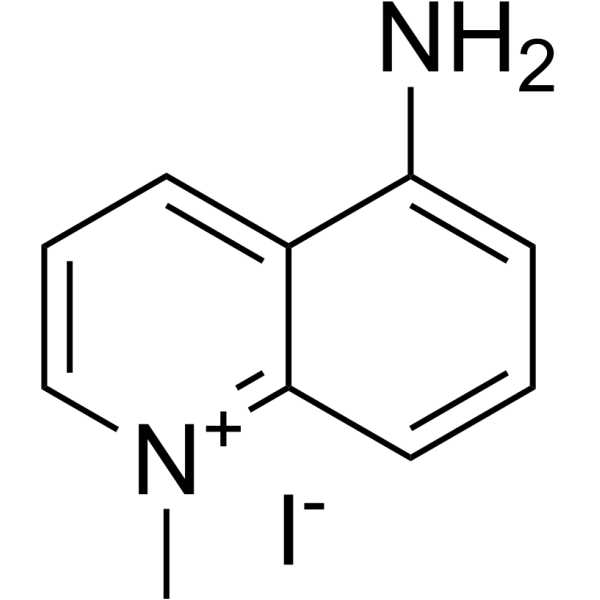
Physicochemical Properties
| Molecular Formula | C10H11IN2 |
| Molecular Weight | 286.1122 |
| Exact Mass | 285.996 |
| CAS # | 42464-96-0 |
| PubChem CID | 66522933 |
| Appearance | Brown to reddish brown solid powder |
| Hydrogen Bond Donor Count | 1 |
| Hydrogen Bond Acceptor Count | 2 |
| Rotatable Bond Count | 0 |
| Heavy Atom Count | 13 |
| Complexity | 158 |
| Defined Atom Stereocenter Count | 0 |
| SMILES | [I-].[N+]1(C)=CC=CC2=C(C=CC=C12)N |
| InChi Key | JPEZFBFIRRAFNR-UHFFFAOYSA-N |
| InChi Code | InChI=1S/C10H10N2.HI/c1-12-7-3-4-8-9(11)5-2-6-10(8)12;/h2-7,11H,1H3;1H |
| Chemical Name | 1-methylquinolin-1-ium-5-amine;iodide |
| HS Tariff Code | 2934.99.9001 |
| Storage |
Powder-20°C 3 years 4°C 2 years In solvent -80°C 6 months -20°C 1 month |
| Shipping Condition | Room temperature (This product is stable at ambient temperature for a few days during ordinary shipping and time spent in Customs) |
Biological Activity
| ln Vitro | In C2C12 myoblast differentiation, NNMTi (10-30 μM; 96 hours) causes a concentration-related increase in myoblast differentiation. Compared to untreated developed myoblasts (which produced 12% MHC-positive myotube nuclei), 30 μM NNMTi resulted in a 45% increase in myoblast differentiation, producing 18% MHC-positive myotube nuclei [1]. |
| ln Vivo | NNMTi (subcutaneous injection; 5 mg/kg and 10 mg/kg; 2 weeks, 1 week prior to and 1 week following injury) increases the proliferation of muscle cells during the process of recovering from injury. The percentage of active muSCs was 60% and 75%, respectively. Under NNMTi therapy, the proportion of fibers containing EdU+ myonuclei rose by 40% and 48% at 5 mg/kg and 10 mg/kg, respectively. Control fused myonuclei had odds ratios of 0.58 and 0.53 times, respectively, the NNMTi low and high doses [2]. Mice administered with NNMTi (subcutaneous injection; 10 mg/kg; 1 week) did not exhibit systemic toxicity, and there was no difference in glucose, cholesterol, plasma protein, or electrolyte levels between the control and NNMTi-treated groups. In aged rats, repeated daily injection of NNMTi for one week following injury did not result in any negative behavioral effects or systemic toxicity [2]. |
| References |
[1]. Small molecule nicotinamide N-methyltransferase inhibitor activates senescent muscle stem cells and improves regenerative capacity of aged skeletal muscle. Biochem Pharmacol. 2019 May;163:481-492. [2]. Structure-Activity Relationship for Small Molecule Inhibitors of Nicotinamide N-Methyltransferase. J Med Chem. |
Solubility Data
| Solubility (In Vitro) |
DMSO: 20.83 mg/mL (72.80 mM) H2O: 2.27 mg/mL (7.93 mM) |
| Solubility (In Vivo) |
Solubility in Formulation 1: ≥ 2.08 mg/mL (7.27 mM) (saturation unknown) in 10% DMSO + 40% PEG300 + 5% Tween80 + 45% Saline (add these co-solvents sequentially from left to right, and one by one), clear solution. For example, if 1 mL of working solution is to be prepared, you can add 100 μL of 20.8 mg/mL clear DMSO stock solution to 400 μL PEG300 and mix evenly; then add 50 μL Tween-80 to the above solution and mix evenly; then add 450 μL normal saline to adjust the volume to 1 mL. Preparation of saline: Dissolve 0.9 g of sodium chloride in 100 mL ddH₂ O to obtain a clear solution. Solubility in Formulation 2: ≥ 2.08 mg/mL (7.27 mM) (saturation unknown) in 10% DMSO + 90% (20% SBE-β-CD in Saline) (add these co-solvents sequentially from left to right, and one by one), clear solution. For example, if 1 mL of working solution is to be prepared, you can add 100 μL of 20.8 mg/mL clear DMSO stock solution to 900 μL of 20% SBE-β-CD physiological saline solution and mix evenly. Preparation of 20% SBE-β-CD in Saline (4°C,1 week): Dissolve 2 g SBE-β-CD in 10 mL saline to obtain a clear solution. (Please use freshly prepared in vivo formulations for optimal results.) |
| Preparing Stock Solutions | 1 mg | 5 mg | 10 mg | |
| 1 mM | 3.4952 mL | 17.4758 mL | 34.9516 mL | |
| 5 mM | 0.6990 mL | 3.4952 mL | 6.9903 mL | |
| 10 mM | 0.3495 mL | 1.7476 mL | 3.4952 mL |