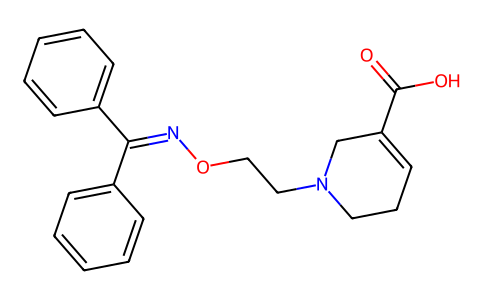
Physicochemical Properties
| Molecular Formula | C21H22N2O3 |
| Molecular Weight | 350.42 |
| Exact Mass | 350.163 |
| Elemental Analysis | C, 71.98; H, 6.33; N, 7.99; O, 13.70 |
| CAS # | 159094-94-7 |
| Related CAS # | 145645-62-1 |
| PubChem CID | 4515 |
| Appearance | White to off-white solid powder |
| LogP | 3.11 |
| Hydrogen Bond Donor Count | 1 |
| Hydrogen Bond Acceptor Count | 5 |
| Rotatable Bond Count | 7 |
| Heavy Atom Count | 26 |
| Complexity | 497 |
| Defined Atom Stereocenter Count | 0 |
| SMILES | C1(/C(=N/OCCN2CCC=C(C(O)=O)C2)/C2C=CC=CC=2)C=CC=CC=1 |
| InChi Key | NGNALWDRPKNJGR-UHFFFAOYSA-N |
| InChi Code | InChI=1S/C21H22N2O3/c24-21(25)19-12-7-13-23(16-19)14-15-26-22-20(17-8-3-1-4-9-17)18-10-5-2-6-11-18/h1-6,8-12H,7,13-16H2,(H,24,25) |
| Chemical Name | 1-[2-(benzhydrylideneamino)oxyethyl]-3,6-dihydro-2H-pyridine-5-carboxylic acid |
| Synonyms | NNC711; NNC 711; 159094-94-7; NO-711; BGU9MZ2G30; 3-Pyridinecarboxylic acid, 1-(2-(((diphenylmethylene)amino)oxy)ethyl)-1,2,5,6-tetrahydro-; CHEMBL473104; 1-[2-(benzhydrylideneamino)oxyethyl]-3,6-dihydro-2H-pyridine-5-carboxylic acid; 1-(2-(((Diphenylmethylene)amino)oxy)ethyl)-1,2,5,6-tetrahydropyridine-3-carboxylic acid; NNC-711 |
| HS Tariff Code | 2934.99.9001 |
| Storage |
Powder-20°C 3 years 4°C 2 years In solvent -80°C 6 months -20°C 1 month |
| Shipping Condition | Room temperature (This product is stable at ambient temperature for a few days during ordinary shipping and time spent in Customs) |
Biological Activity
| Targets | GAT-1 (GABA transporter 1) (IC50 = 40nM, 380 nM for human GAT-1 and rat GAT-1 respectively) |
| ln Vitro | gamma-Aminobutyric acid (GABA) is the major inhibitory neurotransmitter in the mammalian brain. The synaptic action of GABA is terminated by rapid uptake into presynaptic terminals and surrounding glial cells. Molecular cloning has revealed the existence of four distinct GABA transporters termed GAT-1, GAT-2, GAT-3, and BGT-1. Pharmacological inhibition of transport provides a mechanism for increasing GABA-ergic transmission, which may be useful in the treatment of various neuropsychiatric disorders. Recently, a number of lipophilic GABA transport inhibitors have been designed and synthesized, which are capable of crossing the blood brain barrier, and which display anticonvulsive activity. We have now determined the potency of four of these compounds, SK&F 89976-A (N-(4,4-diphenyl-3-butenyl)-3-piperidinecarboxylic acid), tiagabine ((R)-1-[4,4-bis(3-methyl-2-thienyl)-3-butenyl]-3- piperidencarboxylic acid), CI-966 ([1-[2-[bis 4-(trifluoromethyl)phenyl]methoxy]ethyl]-1,2,5,6-tetrahydro-3- pyridinecarboxylic acid), and NNC-711 (1-(2-(((diphenylmethylene)amino)oxy)ethyl)-1,2,4,6-tetrahydro-3- pyridinecarboxylic acid hydrochloride), at each of the four cloned GABA transporters, and find them to be highly selective for GAT-1. These data suggest that the anticonvulsant activity of these compounds is mediated via inhibition of uptake by GAT-1 [1]. |
| ln Vivo |
NNC-711 [1-(2-((diphenylmethylene)amino)oxy)ethyl)-1,2,4,6-tetrahydro-3-pyridinecarboxylic acid hydrochloride], a gamma-aminobutyric acid (GABA) reuptake inhibitor with anticonvulsant activity, was investigated with respect to its cognition-enhancing and neuroprotective potency. In the rat, administration of NNC-711 immediately prior to training prevented amnesia for a passive avoidance task induced by the acetylcholine receptor antagonist scopolamine. NNC-711 was also effective in protecting against ischemia-induced death of CA1 pyramidal neurons in a model of bilateral common carotid artery occlusion in the gerbil. In addition to a neuroprotective activity, NNC-711 exhibited significant cognition-enhancing actions. Daily administration of NNC-711, immediately prior to a spatial learning task, significantly reduced escape latencies in the water maze paradigm in both mature (postnatal day 80) and aged (28 months) rats. All of the above actions exhibited a bell-shaped response with an optimal dose of 0.5-1.0 mg/kg. These investigations with NNC-711 and previous clinical observations on the structurally related anticonvulsant tiagabine confirm the potential of GABA reuptake inhibitors as anti-amnesia and cognition-enhancing agents.[2] To investigate the analgesic effect of intrathecally administered γ-aminobutyric acid (GABA) transporter-1 inhibitor NNC-711/NO-711 on the sciatic nerve chronic constriction injury (CCI) rats. 5 days after intrathecal catheter placement, neuropathic pain model was established by CCI of sciatic nerve on rats. Withdrawal thresholds for mechanical allodynia and latency for thermal hyperalgesia were measured in all animals. All rats operated upon for CCI displayed decreased withdrawal thresholds for mechanical allodynia and latency for thermal hyperalgesia, which has significant difference compared with sham groups. After intrathecal NNC-711/NO-711 administration, withdrawal thresholds and latency were significantly increased on CCI rats compared with control group after 1 day. The results show that GABA transporter-1 inhibitor could effectively develop analgesic effect in sciatic nerve CCI rats' model [2]. In vivo, NNC-711 was a potent anticonvulsant compound against rodent seizures induced by methyl 6,7-dimethoxy-4-ethyl-beta-carboline-3-carboxylate (DMCM) (ED50 (clonic) = 1.2 mg/kg i.p.), pentylenetetrazole (PTZ) (ED50 (tonic) = 0.72 mg/kg i.p., mouse; and ED50 (tonic) = 1.7 mg/kg, rat), or audiogenic (ED50 (clonic and tonic) = 0.23 mg/kg i.p.). At higher doses NNC-711 produced behavioral side effects characterized by inhibition of traction (ED50 = 23 mg/kg i.p.), rotarod (ED50 = 10 mg/kg i.p.) and exploratory locomotor activity (ED50 = 45 mg/kg i.p.) in the mouse. Following acute (3-h) in vivo pretreatment with NNC-711, behavioral tolerance developed to its motor impairing side effects (inhibition of traction, rotarod or exploratory locomotor activity) without corresponding tolerance to the anticonvulsant effects [4]. |
| Enzyme Assay | NNC-711 (1-(2-(((diphenylmethylene)amino)oxy)ethyl)-1,2,5,6-tetrahydro-3- pyridinecarboxylic acid hydrochloride) is a novel, potent and selective gamma-aminobutyric acid (GABA) uptake inhibitor. NNC-711 inhibited synaptosomal (IC50 = 47 nM), neuronal (IC50 = 1238 nM) and glial (IC50 = 636 nM) GABA uptake in vitro NNC-711 lacked affinity for other neurotransmitter receptor binding sites, uptake sites and ion channels examined in vitro [4]. |
| Animal Protocol |
Drug administration [2] NNC-711 and scopolamine were administered by the intraperitoneal route in a final volume of saline that corresponded to 1 ml/kg for rats and 10 ml/kg for gerbils. For passive avoidance studies, NNC-711 was administered at the indicated dose at the 30-min pre-training time, while scopolamine (0.8 mg/kg) was administered at the 6-h post-training time, as has been described previously (Doyle and Regan, 1993). In water maze studies, NNC-711 was administered at the indicated dose 30 min prior to the first trial on each of the testing days but was not administered prior to the retention trial. To determine a neuroprotective effect on ischemia-induced CA1 cell death, NNC-711 was administered at the indicated dose just prior to carotid artery ligature. To evaluate inhibitory effects of NNC-711/NO-711, we intrathecally injected 50 μg, 100 μg, 200 μg on rats based on the previous experiments (data not published). The 24 Sprague–Dawley rats were equally randomized into four groups: CCI + saline group, CCI + NO-711(50 μg) group, CCI + NO-711(100 μg) group, and CCI + NO-711(200 μg). The 64 Sprague–Dawley rats were equally randomized into four groups: sham + saline group, sham + NNC-711/NO-711 group, CCI + saline group, and CCI + NO-711 group. Seven days after the successful establishment of models, rats in the sham + NO-711 group and the CCI + NO-711 group were intrathecally injected with NO-711(100 μg) dissolved in 10 μl saline over a period of 2 min followed by 10 μl of saline to clear the catheter drug. Rats in the sham + saline group and CCI + saline group were intrathecally injected with 10 μl of saline, while other two groups were intrathecally injected 20 μl of saline totally.[3] |
| References |
[1]. Tiagabine, SK&F 89976-A, CI-966, and NNC-711 are selective for the cloned GABA transporter GAT-1. Eur J Pharmacol. 1994 Oct 14;269(2):219-24. [2]. Anti-ischemic and cognition-enhancing properties of NNC-711, a gamma-aminobutyric acid reuptake inhibitor. Eur J Pharmacol. 2001 Jul 13;424(1):37-44. [3]. Analgesic effect of intrathecally γ-aminobutyric acid transporter-1 inhibitor NO-711 administrating on neuropathic pain in rats. Neurosci Lett. 2011 Apr 20;494(1):6-9. [4]. NNC-711, a novel potent and selective gamma-aminobutyric acid uptake inhibitor: pharmacological characterization. Eur J Pharmacol. 1992 Dec 2;224(2-3). |
| Additional Infomation |
1-[2-[(diphenylmethylene)amino]oxyethyl]-3,6-dihydro-2H-pyridine-5-carboxylic acid is a diarylmethane. See also: Nnc 711 (annotation moved to). Importantly, the dose range in which NNC-711 was most effective at enhancing cognition, 0.5–1.0 mg/kg, appears to be of clinical relevance as it concurs with the effective anticonvulsant doses of tiagabine (16–56 mg daily; reviewed in Leach and Brodie, 1998). This further supports the view that the cognition-enhancing potency of NNC-711 is directly related to a positive GABAergic function. Furthermore, the time-course for cognition enhancement by NNC-711 is in agreement with the elimination half-life of 7–9 h and peak plasma concentration time of 30–90 min observed for tiagabine. The neuroprotective and cognition-enhancing effects of NNC-711 exhibited bell-shaped dose–response effects. Higher doses of NNC-711 were less effective at protecting against ischemia-induced neuronal loss and scopolamine-induced amnesia. Moreover, in the absence of scopolamine, higher doses of NNC-711 impaired retention of the passive avoidance response. Although the bell-shaped dose response is a feature of many cognition-enhancing drugs, such as the nootropes Toide, 1989, Nabeshima, 1994, how this may relate to the mechanism of NNC-711 action is unclear. One possibility relates to observations that GAT transporters can operate in reverse, depending on which condition is most thermodynamically favourable (Cammack et al., 1994). This phenomenon is thought to account for Na+-dependent non-vesicular release of GABA that occurs during high frequency neuronal firing and during seizure activity (Taylor and Gordon-Weekes, 1991). Reverse operation of the GAT1 transporter can result in the release of sufficient amounts of GABA to mediate activation of GABAA receptors (Gaspary et al., 1998). Given these opposing activities, GAT inhibitors tend to exhibit contrary effects. For example, in audiogenic seizure-prone rats, NNC-711 exerts an anticonvulsant action at lower doses but a proconvulsant action at higher doses (Smith et al., 1995). Furthermore, in a plus maze task, NNC-711 exhibited anxiolytic properties at low doses but disrupted behaviour at higher doses (Dalvi and Rodgers, 1996).[2] It remains not clear whether GAT-1 expression is changed also in neuropathic state, however, functional role or quantitative change of GAT-1 in neuropathic state needs to be further studied. In summary, in this research, we found that GABA transporter-1 inhibitor by intrathecally NNC-711/NO-711 administration could develop analgesic effect on neuropathic animals.[3] |
Solubility Data
| Solubility (In Vitro) | May dissolve in DMSO (in most cases), if not, try other solvents such as H2O, Ethanol, or DMF with a minute amount of products to avoid loss of samples |
| Solubility (In Vivo) |
Note: Listed below are some common formulations that may be used to formulate products with low water solubility (e.g. < 1 mg/mL), you may test these formulations using a minute amount of products to avoid loss of samples. Injection Formulations (e.g. IP/IV/IM/SC) Injection Formulation 1: DMSO : Tween 80: Saline = 10 : 5 : 85 (i.e. 100 μL DMSO stock solution → 50 μL Tween 80 → 850 μL Saline) *Preparation of saline: Dissolve 0.9 g of sodium chloride in 100 mL ddH ₂ O to obtain a clear solution. Injection Formulation 2: DMSO : PEG300 :Tween 80 : Saline = 10 : 40 : 5 : 45 (i.e. 100 μL DMSO → 400 μLPEG300 → 50 μL Tween 80 → 450 μL Saline) Injection Formulation 3: DMSO : Corn oil = 10 : 90 (i.e. 100 μL DMSO → 900 μL Corn oil) Example: Take the Injection Formulation 3 (DMSO : Corn oil = 10 : 90) as an example, if 1 mL of 2.5 mg/mL working solution is to be prepared, you can take 100 μL 25 mg/mL DMSO stock solution and add to 900 μL corn oil, mix well to obtain a clear or suspension solution (2.5 mg/mL, ready for use in animals). Injection Formulation 4: DMSO : 20% SBE-β-CD in saline = 10 : 90 [i.e. 100 μL DMSO → 900 μL (20% SBE-β-CD in saline)] *Preparation of 20% SBE-β-CD in Saline (4°C,1 week): Dissolve 2 g SBE-β-CD in 10 mL saline to obtain a clear solution. Injection Formulation 5: 2-Hydroxypropyl-β-cyclodextrin : Saline = 50 : 50 (i.e. 500 μL 2-Hydroxypropyl-β-cyclodextrin → 500 μL Saline) Injection Formulation 6: DMSO : PEG300 : castor oil : Saline = 5 : 10 : 20 : 65 (i.e. 50 μL DMSO → 100 μLPEG300 → 200 μL castor oil → 650 μL Saline) Injection Formulation 7: Ethanol : Cremophor : Saline = 10: 10 : 80 (i.e. 100 μL Ethanol → 100 μL Cremophor → 800 μL Saline) Injection Formulation 8: Dissolve in Cremophor/Ethanol (50 : 50), then diluted by Saline Injection Formulation 9: EtOH : Corn oil = 10 : 90 (i.e. 100 μL EtOH → 900 μL Corn oil) Injection Formulation 10: EtOH : PEG300:Tween 80 : Saline = 10 : 40 : 5 : 45 (i.e. 100 μL EtOH → 400 μLPEG300 → 50 μL Tween 80 → 450 μL Saline) Oral Formulations Oral Formulation 1: Suspend in 0.5% CMC Na (carboxymethylcellulose sodium) Oral Formulation 2: Suspend in 0.5% Carboxymethyl cellulose Example: Take the Oral Formulation 1 (Suspend in 0.5% CMC Na) as an example, if 100 mL of 2.5 mg/mL working solution is to be prepared, you can first prepare 0.5% CMC Na solution by measuring 0.5 g CMC Na and dissolve it in 100 mL ddH2O to obtain a clear solution; then add 250 mg of the product to 100 mL 0.5% CMC Na solution, to make the suspension solution (2.5 mg/mL, ready for use in animals). Oral Formulation 3: Dissolved in PEG400 Oral Formulation 4: Suspend in 0.2% Carboxymethyl cellulose Oral Formulation 5: Dissolve in 0.25% Tween 80 and 0.5% Carboxymethyl cellulose Oral Formulation 6: Mixing with food powders Note: Please be aware that the above formulations are for reference only. InvivoChem strongly recommends customers to read literature methods/protocols carefully before determining which formulation you should use for in vivo studies, as different compounds have different solubility properties and have to be formulated differently. (Please use freshly prepared in vivo formulations for optimal results.) |
| Preparing Stock Solutions | 1 mg | 5 mg | 10 mg | |
| 1 mM | 2.8537 mL | 14.2686 mL | 28.5372 mL | |
| 5 mM | 0.5707 mL | 2.8537 mL | 5.7074 mL | |
| 10 mM | 0.2854 mL | 1.4269 mL | 2.8537 mL |