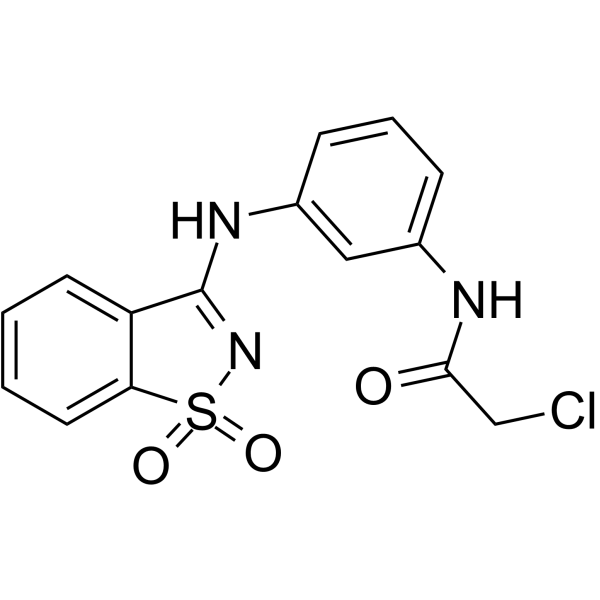
Physicochemical Properties
| Molecular Formula | C15H12CLN3O3S |
| Molecular Weight | 349.7921 |
| Exact Mass | 349.028 |
| CAS # | 1449236-96-7 |
| PubChem CID | 71607189 |
| Appearance | White to gray solid powder |
| Density | 1.5±0.1 g/cm3 |
| Boiling Point | 540.7±56.0 °C at 760 mmHg |
| Flash Point | 280.8±31.8 °C |
| Vapour Pressure | 0.0±1.4 mmHg at 25°C |
| Index of Refraction | 1.673 |
| LogP | 2.08 |
| Hydrogen Bond Donor Count | 2 |
| Hydrogen Bond Acceptor Count | 4 |
| Rotatable Bond Count | 4 |
| Heavy Atom Count | 23 |
| Complexity | 587 |
| Defined Atom Stereocenter Count | 0 |
| InChi Key | JWMFLBAPPIWNGG-UHFFFAOYSA-N |
| InChi Code | InChI=1S/C15H12ClN3O3S/c16-9-14(20)17-10-4-3-5-11(8-10)18-15-12-6-1-2-7-13(12)23(21,22)19-15/h1-8H,9H2,(H,17,20)(H,18,19) |
| Chemical Name | 2-chloro-N-[3-[(1,1-dioxo-1,2-benzothiazol-3-yl)amino]phenyl]acetamide |
| HS Tariff Code | 2934.99.9001 |
| Storage |
Powder-20°C 3 years 4°C 2 years In solvent -80°C 6 months -20°C 1 month |
| Shipping Condition | Room temperature (This product is stable at ambient temperature for a few days during ordinary shipping and time spent in Customs) |
Biological Activity
| Targets | NMS-859 is a strong VCP inhibitor having IC50 values of 0.37 and 0.36 μM for wild-type VCP in the presence of 60 μM and 1 mM ATP in cells, respectively. NMS-859 has extremely little inhibitory action against VCPC522T. NMS-859 also reduces cell proliferation with IC50s of 3.5 μM and 3.0 μM in HCT116 and HeLa cell lines, respectively [1]. |
| ln Vitro |
NMS-859 is a strong VCP inhibitor having IC50 values of 0.37 and 0.36 μM for wild-type VCP in the presence of 60 μM and 1 mM ATP in cells, respectively. NMS-859 has extremely little inhibitory action against VCPC522T. NMS-859 also reduces cell proliferation with IC50s of 3.5 μM and 3.0 μM in HCT116 and HeLa cell lines, respectively [1]. NMS-859 inhibited the proliferation of HCT116 and HeLa cancer cell lines with IC50 values of 3.5 µM and 3.0 µM, respectively. [1] Treatment of HCT116 cells with NMS-859 induced a dose-dependent accumulation of polyubiquitinated proteins, stabilization of the VCP client proteins cyclin E and Mcl-1, and induction of the unfolded protein response (UPR) markers GRP78 and CHOP. It also promoted the lipidation of the autophagy marker LC3B and activated apoptosis, as evidenced by cleavage of caspase-3 and its target PARP. This biomarker modulation pattern recapitulated the phenotype observed with VCP siRNA knockdown and occurred at doses consistent with its antiproliferative IC50. [1] Mass spectrometry analysis confirmed that NMS-859 covalently modified endogenous VCP at Cys522 in HCT116 cells. [1] Expression of a VCPC522T mutant in 293 T-Rex cells rescued the cellular sensitivity to NMS-859 (shifting IC50 from 3.2 µM to 9.8 µM) and abrogated caspase induction, confirming the on-target mechanism. Transient transfection of HeLa cells with V5-tagged VCPC522T, but not wild-type VCP or a control protein, enriched the transfected cell population after NMS-859 treatment, further validating specificity. [1] NMS-859 (10 µM) showed minimal inhibition of NSF and no significant inhibition against a panel of other AAA ATPases (VPS4B, RuvBL1, SPATAS), HSP90, or 53 kinases, indicating high selectivity for VCP. [1] |
| Enzyme Assay |
Biochemical ATPase Activity Assay: The ATPase activity of recombinant, hexameric VCP was measured using a modified NADH-coupled assay. In the first step, VCP hydrolyzes ATP in the presence of an ATP-regenerating system (pyruvate kinase and phosphoenolpyruvate) to accumulate pyruvate stoichiometrically with ADP production. The reaction is then quenched with EDTA. In the second step, lactate dehydrogenase and NADH are added to convert the accumulated pyruvate to lactate, oxidizing NADH to NAD+. The decrease in NADH absorbance at 340 nm is measured and correlates with VCP ATPase activity. Inhibitor potency (IC50) was determined under these conditions. [1] High-Throughput Screening (HTS) Assay: A miniaturized assay in 1,536-well format was used for primary screening. VCP was preincubated with compounds, and then ATP was added. ADP production was detected after 90 minutes using a Transcreener ADP fluorescence polarization (FP) assay. [1] |
| Cell Assay |
Cell Proliferation/Viability Assay: Cells (e.g., HCT116, HeLa) were seeded in 384-well plates. After 24 hours, cells were treated with serial dilutions of NMS-859 and incubated for 72 hours. Cell viability was then assessed by measuring intracellular ATP levels using a luciferase-based assay (CellTiter-Glo). IC50 values were calculated from dose-response curves. [1] Immunoblot Analysis for Biomarker Modulation: Exponentially growing cells (e.g., HCT116) were seeded in plates and treated with NMS-859 for specified durations (e.g., 8h or 24h). Cells were lysed, and proteins were separated by SDS-PAGE, transferred to membranes, and probed with specific antibodies against targets such as polyubiquitin, cyclin E, Mcl-1, GRP78, CHOP, LC3B, cleaved caspase-3, and cleaved PARP. Immunoreactive bands were visualized using chemiluminescence. [1] Mass Spectrometry Analysis of Cellular VCP Modification: HCT116 cells treated with NMS-859 were lysed, and proteins were separated by SDS-PAGE. The band corresponding to VCP (~90 kDa) was excised, subjected to in-gel digestion with trypsin, and the resulting peptides were analyzed by MALDI-TOF/TOF mass spectrometry. The peptide containing Cys522 was identified and sequenced to confirm the addition of the NMS-859 moiety (a 313 Da increase). [1] Rescue Experiment with VCPC522T Mutant: HeLa cells were transfected with plasmids expressing V5-tagged wild-type VCP, VCPC522T, or a control protein (survivin). After 48 hours, cells were treated with increasing doses of NMS-859 for another 48 hours. Cells were fixed, immunostained with an anti-V5 antibody and a fluorescent secondary antibody, and analyzed using a high-content imaging platform. The enrichment of V5-positive cells after treatment was quantified to assess specific rescue. [1] Inducible Rescue in 293 T-Rex Cells: A stable 293 T-Rex cell line with doxycycline-inducible expression of VCPC522T was generated. Cell viability upon NMS-859 treatment was compared between uninduced and induced states using a viability assay. Caspase induction was also assessed by immunoblotting. [1] |
| References |
[1]. Covalent and allosteric inhibitors of the ATPase VCP/p97 induce cancer cell death. Nat Chem Biol. 2013 Sep;9(9):548-56. |
| Additional Infomation |
NMS-859 is a covalent inhibitor of VCP/p97 identified through high-throughput screening. [1] It acts by covalently modifying cysteine 522 (Cys522) located in the Walker A motif of the D2 ATPase domain of VCP. This modification disrupts the local structure of the ATP-binding pocket, preventing ATP binding and hydrolysis, mimicking a regulatory oxidation mechanism. [1] The compound showed time-dependent inhibition in biochemical assays, consistent with a covalent mechanism. It did not affect the hexameric oligomeric state or general protein stability of VCP. [1] The consistent pattern of cancer cell biomarker modulation (accumulation of ubiquitinated proteins, UPR activation, apoptosis) by NMS-859, which mirrors VCP genetic knockdown, provides critical validation of VCP as a cancer drug target. [1] |
Solubility Data
| Solubility (In Vitro) | DMSO : ~50 mg/mL (~142.94 mM) |
| Solubility (In Vivo) |
Solubility in Formulation 1: ≥ 2.5 mg/mL (7.15 mM) (saturation unknown) in 10% DMSO + 40% PEG300 +5% Tween-80 + 45% Saline (add these co-solvents sequentially from left to right, and one by one), clear solution. For example, if 1 mL of working solution is to be prepared, you can add 100 μL of 25.0 mg/mL clear DMSO stock solution to 400 μL PEG300 and mix evenly; then add 50 μL Tween-80 + to the above solution and mix evenly; then add 450 μL normal saline to adjust the volume to 1 mL. Preparation of saline: Dissolve 0.9 g of sodium chloride in 100 mL ddH₂ O to obtain a clear solution. (Please use freshly prepared in vivo formulations for optimal results.) |
| Preparing Stock Solutions | 1 mg | 5 mg | 10 mg | |
| 1 mM | 2.8589 mL | 14.2943 mL | 28.5886 mL | |
| 5 mM | 0.5718 mL | 2.8589 mL | 5.7177 mL | |
| 10 mM | 0.2859 mL | 1.4294 mL | 2.8589 mL |