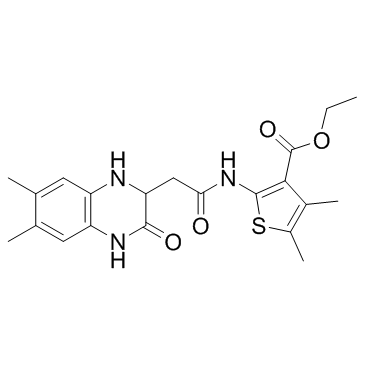
Physicochemical Properties
| Molecular Formula | C21H25N3O4S |
| Molecular Weight | 415.505903959274 |
| Exact Mass | 415.156 |
| CAS # | 307519-88-6 |
| PubChem CID | 2886617 |
| Appearance | Light yellow to yellow solid powder |
| Density | 1.3±0.1 g/cm3 |
| Boiling Point | 658.8±55.0 °C at 760 mmHg |
| Flash Point | 352.2±31.5 °C |
| Vapour Pressure | 0.0±2.0 mmHg at 25°C |
| Index of Refraction | 1.597 |
| LogP | 4.3 |
| Hydrogen Bond Donor Count | 3 |
| Hydrogen Bond Acceptor Count | 6 |
| Rotatable Bond Count | 6 |
| Heavy Atom Count | 29 |
| Complexity | 645 |
| Defined Atom Stereocenter Count | 0 |
| InChi Key | QRLPSNLBUMVXBL-UHFFFAOYSA-N |
| InChi Code | InChI=1S/C21H25N3O4S/c1-6-28-21(27)18-12(4)13(5)29-20(18)24-17(25)9-16-19(26)23-15-8-11(3)10(2)7-14(15)22-16/h7-8,16,22H,6,9H2,1-5H3,(H,23,26)(H,24,25) |
| Chemical Name | ethyl 2-[[2-(6,7-dimethyl-3-oxo-2,4-dihydro-1H-quinoxalin-2-yl)acetyl]amino]-4,5-dimethylthiophene-3-carboxylate |
| HS Tariff Code | 2934.99.9001 |
| Storage |
Powder-20°C 3 years 4°C 2 years In solvent -80°C 6 months -20°C 1 month |
| Shipping Condition | Room temperature (This product is stable at ambient temperature for a few days during ordinary shipping and time spent in Customs) |
Biological Activity
| Targets | NMDI14 targets nonsense-mediated RNA decay (NMD) pathway (IC₅₀ = 1.8 μM for NMD inhibition)[1] |
| ln Vitro |
NMDI14 is a nonsense-mediated RNA decay (NMD) inhibitor. If bioactive hemoglobin is produced, treating cells with NMDI14 for six hours can raise PTC 39 β-globin to 12%, a relative increase of four times, which is sufficient to improve the clinical symptoms of thalassemia. NMDI14 treatment for three days did not cause a decrease in cell counts, indicating that NMD can be pharmacologically inhibited without producing minor alterations in proliferation. 941 genes were elevated >1.5-fold by NMDI14. NMDI14 treatment for six hours caused steady-state p53 expression in N417 cells, which was comparable to that in U2OS cells. Without affecting the stability of wild-type p53 in NMDI-treated U2OS cells, NMDI14 dramatically raises the stability of PTC mutant p53 mRNA in N417 cells [1]. NMDI14 specifically inhibits the NMD pathway in human cancer cells, stabilizing mRNAs containing nonsense mutations (including p53 nonsense mutations such as R175X, R248X, R273X); it increases the levels of nonsense-containing p53 mRNA by 2-3 fold and restores functional p53 protein expression[1] NMDI14 inhibits proliferation of cancer cells harboring p53 nonsense mutations (H1299 cells transfected with p53-R175X, R248X, R273X) in a concentration-dependent manner (EC₅₀ ≈ 2.5 μM); it induces G1 cell cycle arrest and apoptosis by restoring p53-mediated transcriptional activation of downstream target genes (p21, Bax)[1] NMDI14 shows no significant inhibition of NMD in normal human fibroblasts, indicating selective activity against cancer cells with dysregulated NMD[1] |
| Cell Assay |
For NMD inhibition assay: Culture human cancer cells (H1299, HCT116) and normal fibroblasts in RPMI 1640 medium; treat cells with NMDI14 (0.1-10 μM) for 24 hours; transfect cells with a reporter plasmid containing a nonsense mutation to monitor NMD activity; measure luciferase activity to quantify NMD inhibition efficiency[1] For p53 nonsense mutation restoration assay: Transfect H1299 cells with p53 nonsense mutation plasmids (R175X, R248X, R273X); treat transfected cells with NMDI14 (1-5 μM) for 48 hours; detect p53 mRNA levels via quantitative real-time PCR (qPCR), and p53 protein levels via Western blot; analyze p53 downstream target genes (p21, Bax) expression via qPCR and Western blot[1] For cancer cell proliferation and apoptosis assay: Culture p53 nonsense mutation-harboring cancer cells in RPMI 1640 medium; treat cells with NMDI14 (0.5-10 μM) for 24-72 hours; evaluate cell proliferation via CCK-8 assay, cell cycle distribution via flow cytometry (PI staining), and apoptosis via Annexin V-FITC/PI double-staining flow cytometry[1] |
| References |
[1]. Identification and characterization of small molecules that inhibit nonsense-mediated RNA decay and suppress nonsense p53 mutations. Cancer Res. 2014 Jun 1;74(11):3104-1. [2]. Decreased mRNA and protein stability of W1282X limits response to modulator therapy. J Cyst Fibros. 2019;18(5):606-613. |
| Additional Infomation |
NMDI14 is a small-molecule inhibitor of the NMD pathway, developed for targeting cancer cells with nonsense mutations in tumor suppressor genes (e.g., p53)[1] The mechanism of action involves binding to key components of the NMD complex (UPF1), preventing the degradation of nonsense-containing mRNAs and enabling translation of functional proteins[1] NMDI14 exhibits potential as a targeted therapy for cancers with nonsense mutations that are unresponsive to conventional treatments, by restoring the function of inactive tumor suppressor proteins[1] |
Solubility Data
| Solubility (In Vitro) | DMSO : ≥ 25 mg/mL (~60.17 mM) |
| Solubility (In Vivo) |
Solubility in Formulation 1: 0.83 mg/mL (2.00 mM) in 10% DMSO + 40% PEG300 + 5% Tween80 + 45% Saline (add these co-solvents sequentially from left to right, and one by one), suspension solution; with sonication. For example, if 1 mL of working solution is to be prepared, you can add 100 μL of 8.3 mg/mL clear DMSO stock solution to 400 μL of PEG300 and mix evenly; then add 50 μL of Tween-80 to the above solution and mix evenly; then add 450 μL of normal saline to adjust the volume to 1 mL. Preparation of saline: Dissolve 0.9 g of sodium chloride in 100 mL ddH₂ O to obtain a clear solution. Solubility in Formulation 2: ≥ 0.83 mg/mL (2.00 mM) (saturation unknown) in 10% DMSO + 90% Corn Oil (add these co-solvents sequentially from left to right, and one by one), clear solution. For example, if 1 mL of working solution is to be prepared, you can add 100 μL of 8.3 mg/mL clear DMSO stock solution to 900 μL of corn oil and mix evenly. (Please use freshly prepared in vivo formulations for optimal results.) |
| Preparing Stock Solutions | 1 mg | 5 mg | 10 mg | |
| 1 mM | 2.4067 mL | 12.0334 mL | 24.0668 mL | |
| 5 mM | 0.4813 mL | 2.4067 mL | 4.8134 mL | |
| 10 mM | 0.2407 mL | 1.2033 mL | 2.4067 mL |