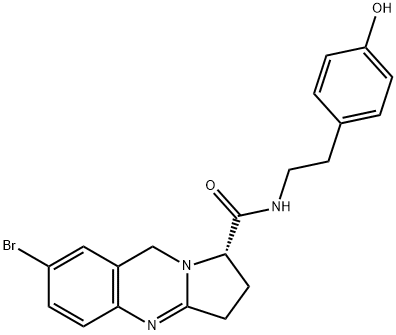
Physicochemical Properties
| Molecular Formula | C20H20BRN3O2 |
| Molecular Weight | 414.295703887939 |
| Exact Mass | 413.073 |
| CAS # | 2220162-06-9 |
| Related CAS # | (Rac)-NMDAR antagonist 1;2435557-99-4 |
| PubChem CID | 145710206 |
| Appearance | White to off-white solid powder |
| Density | 1.54±0.1 g/cm3(Predicted) |
| LogP | 2.7 |
| Hydrogen Bond Donor Count | 2 |
| Hydrogen Bond Acceptor Count | 3 |
| Rotatable Bond Count | 4 |
| Heavy Atom Count | 26 |
| Complexity | 547 |
| Defined Atom Stereocenter Count | 1 |
| SMILES | BrC1C=CC2=C(C=1)CN1C(CC[C@H]1C(NCCC1C=CC(=CC=1)O)=O)=N2 |
| InChi Key | NCHFPVRYYJGAJY-SFHVURJKSA-N |
| InChi Code | InChI=1S/C20H20BrN3O2/c21-15-3-6-17-14(11-15)12-24-18(7-8-19(24)23-17)20(26)22-10-9-13-1-4-16(25)5-2-13/h1-6,11,18,25H,7-10,12H2,(H,22,26)/t18-/m0/s1 |
| Chemical Name | (1S)-7-bromo-N-[2-(4-hydroxyphenyl)ethyl]-1,2,3,9-tetrahydropyrrolo[2,1-b]quinazoline-1-carboxamide |
| HS Tariff Code | 2934.99.9001 |
| Storage |
Powder-20°C 3 years 4°C 2 years In solvent -80°C 6 months -20°C 1 month |
| Shipping Condition | Room temperature (This product is stable at ambient temperature for a few days during ordinary shipping and time spent in Customs) |
Biological Activity
| Targets |
NMDAR antagonist 1 targets N-methyl-D-aspartate receptor (NMDAR), with an IC₅₀ value of 0.85 μM (glutamate-induced Ca²⁺ influx inhibition assay) and a Ki value of 0.62 μM ([³H]-MK-801 displacement assay) [1] |
| ln Vitro |
NMDAR antagonist 1 (compound 5q) demonstrates remarkable neuroprotective properties [1]. NMDA-induced Ca2+ influx can be reduced by NMDAR antagonist 1 [1]. NMDAR antagonist 1 has the ability to both upregulate p-ERK1/2 expression and inhibit NR2B upregulation [1]. At 0.1 µM, 1 µM, 10 µM, and 100 µM, respectively, NMDAR antagonist 1 inhibits SH-SY5Y cells, resulting in cell viability of 75.8%, 80.0%, 84.4%, and 78.6% [1]. In glutamate-induced PC12 cell excitotoxicity model: NMDAR antagonist 1 (0.1–10 μM) dose-dependently increased cell viability, with 5 μM concentration improving survival rate by 68% compared to glutamate-only group (MTT assay) [1] - The compound inhibited glutamate-induced intracellular Ca²⁺ overload in PC12 cells: 1 μM reduced Ca²⁺ fluorescence intensity by 52% (Fluo-3 AM staining, flow cytometry) [1] - NMDAR antagonist 1 (0.5–5 μM) suppressed glutamate-induced apoptosis in PC12 cells: 3 μM decreased apoptotic rate by 55% (Annexin V-FITC/PI staining), upregulated Bcl-2 expression by 2.3-fold, and downregulated Bax/caspase-3 (cleaved) expression by 48%/62% (Western blot) [1] - In primary cortical neurons: NMDAR antagonist 1 (1–10 μM) protected against NMDA-induced neuronal death, with 5 μM increasing neuron survival by 63% (lactate dehydrogenase (LDH) release assay) [1] - No significant cytotoxicity was observed in PC12 cells or primary cortical neurons at concentrations up to 20 μM [1] |
| Enzyme Assay |
[³H]-MK-801 displacement assay for NMDAR binding: Rat brain synaptic membranes enriched in NMDAR were incubated with [³H]-MK-801 (a selective NMDAR antagonist ligand) and serial dilutions of NMDAR antagonist 1 at 25°C for 90 minutes. Bound and free radioligands were separated by rapid filtration through glass fiber filters, and radioactivity was quantified by liquid scintillation counting to calculate the Ki value [1] - NMDAR-mediated Ca²⁺ influx inhibition assay: PC12 cells were loaded with Fluo-3 AM fluorescent probe, pretreated with NMDAR antagonist 1 for 30 minutes, then stimulated with glutamate (100 μM) + glycine (10 μM). Fluorescence intensity was measured in real-time to assess Ca²⁺ influx, and IC₅₀ was calculated based on inhibition efficiency [1] |
| Cell Assay |
PC12 cell excitotoxicity protection assay: PC12 cells were seeded in 96-well plates (5×10³ cells/well) and cultured for 24 hours. The cells were pretreated with NMDAR antagonist 1 (0.1–10 μM) for 1 hour, then exposed to glutamate (100 μM) + glycine (10 μM) for 24 hours. MTT reagent was added, and absorbance at 570 nm was measured to calculate cell viability [1] - Apoptosis detection assay: PC12 cells were treated as above, harvested, stained with Annexin V-FITC and PI for 15 minutes in the dark, and analyzed by flow cytometry to quantify apoptotic cells [1] - Western blot analysis: Treated PC12 cells were lysed, proteins separated by SDS-PAGE, transferred to membranes, and probed with antibodies against Bcl-2, Bax, cleaved caspase-3, and GAPDH. Band intensity was quantified by densitometry [1] - Primary cortical neuron protection assay: Cortical neurons were isolated from embryonic rats (E18), cultured for 7 days, pretreated with NMDAR antagonist 1 (1–10 μM) for 1 hour, then stimulated with NMDA (50 μM) + glycine (10 μM) for 24 hours. LDH release in culture supernatants was measured to assess neuronal damage [1] |
| References |
[1]. Design, synthesis and bioevaluation of 1,2,3,9-tetrahydropyrrolo[2,1-b]quinazoline-1-carboxylic acid derivatives as potent neuroprotective agents. Eur J Med Chem. 2018 May 10;151:27-38. |
| Additional Infomation |
NMDAR antagonist 1 is a synthetic derivative of 1,2,3,9-tetrahydropyrrolo[2,1-b]quinazoline-1-carboxylic acid, designed as a selective NMDAR antagonist [1] - Its neuroprotective mechanism involves blocking NMDAR-mediated excessive Ca²⁺ influx, suppressing the mitochondrial apoptotic pathway (regulating Bcl-2/Bax ratio, inhibiting caspase-3 activation) [1] - The compound exhibits high potency in protecting against excitotoxicity-induced neuronal damage in both PC12 cells and primary cortical neurons, with potential applications in neurodegenerative diseases (e.g., Alzheimer’s disease, stroke) [1] |
Solubility Data
| Solubility (In Vitro) | May dissolve in DMSO (in most cases), if not, try other solvents such as H2O, Ethanol, or DMF with a minute amount of products to avoid loss of samples |
| Solubility (In Vivo) |
Note: Listed below are some common formulations that may be used to formulate products with low water solubility (e.g. < 1 mg/mL), you may test these formulations using a minute amount of products to avoid loss of samples. Injection Formulations (e.g. IP/IV/IM/SC) Injection Formulation 1: DMSO : Tween 80: Saline = 10 : 5 : 85 (i.e. 100 μL DMSO stock solution → 50 μL Tween 80 → 850 μL Saline) *Preparation of saline: Dissolve 0.9 g of sodium chloride in 100 mL ddH ₂ O to obtain a clear solution. Injection Formulation 2: DMSO : PEG300 :Tween 80 : Saline = 10 : 40 : 5 : 45 (i.e. 100 μL DMSO → 400 μLPEG300 → 50 μL Tween 80 → 450 μL Saline) Injection Formulation 3: DMSO : Corn oil = 10 : 90 (i.e. 100 μL DMSO → 900 μL Corn oil) Example: Take the Injection Formulation 3 (DMSO : Corn oil = 10 : 90) as an example, if 1 mL of 2.5 mg/mL working solution is to be prepared, you can take 100 μL 25 mg/mL DMSO stock solution and add to 900 μL corn oil, mix well to obtain a clear or suspension solution (2.5 mg/mL, ready for use in animals). Injection Formulation 4: DMSO : 20% SBE-β-CD in saline = 10 : 90 [i.e. 100 μL DMSO → 900 μL (20% SBE-β-CD in saline)] *Preparation of 20% SBE-β-CD in Saline (4°C,1 week): Dissolve 2 g SBE-β-CD in 10 mL saline to obtain a clear solution. Injection Formulation 5: 2-Hydroxypropyl-β-cyclodextrin : Saline = 50 : 50 (i.e. 500 μL 2-Hydroxypropyl-β-cyclodextrin → 500 μL Saline) Injection Formulation 6: DMSO : PEG300 : castor oil : Saline = 5 : 10 : 20 : 65 (i.e. 50 μL DMSO → 100 μLPEG300 → 200 μL castor oil → 650 μL Saline) Injection Formulation 7: Ethanol : Cremophor : Saline = 10: 10 : 80 (i.e. 100 μL Ethanol → 100 μL Cremophor → 800 μL Saline) Injection Formulation 8: Dissolve in Cremophor/Ethanol (50 : 50), then diluted by Saline Injection Formulation 9: EtOH : Corn oil = 10 : 90 (i.e. 100 μL EtOH → 900 μL Corn oil) Injection Formulation 10: EtOH : PEG300:Tween 80 : Saline = 10 : 40 : 5 : 45 (i.e. 100 μL EtOH → 400 μLPEG300 → 50 μL Tween 80 → 450 μL Saline) Oral Formulations Oral Formulation 1: Suspend in 0.5% CMC Na (carboxymethylcellulose sodium) Oral Formulation 2: Suspend in 0.5% Carboxymethyl cellulose Example: Take the Oral Formulation 1 (Suspend in 0.5% CMC Na) as an example, if 100 mL of 2.5 mg/mL working solution is to be prepared, you can first prepare 0.5% CMC Na solution by measuring 0.5 g CMC Na and dissolve it in 100 mL ddH2O to obtain a clear solution; then add 250 mg of the product to 100 mL 0.5% CMC Na solution, to make the suspension solution (2.5 mg/mL, ready for use in animals). Oral Formulation 3: Dissolved in PEG400 Oral Formulation 4: Suspend in 0.2% Carboxymethyl cellulose Oral Formulation 5: Dissolve in 0.25% Tween 80 and 0.5% Carboxymethyl cellulose Oral Formulation 6: Mixing with food powders Note: Please be aware that the above formulations are for reference only. InvivoChem strongly recommends customers to read literature methods/protocols carefully before determining which formulation you should use for in vivo studies, as different compounds have different solubility properties and have to be formulated differently. (Please use freshly prepared in vivo formulations for optimal results.) |
| Preparing Stock Solutions | 1 mg | 5 mg | 10 mg | |
| 1 mM | 2.4137 mL | 12.0685 mL | 24.1371 mL | |
| 5 mM | 0.4827 mL | 2.4137 mL | 4.8274 mL | |
| 10 mM | 0.2414 mL | 1.2069 mL | 2.4137 mL |