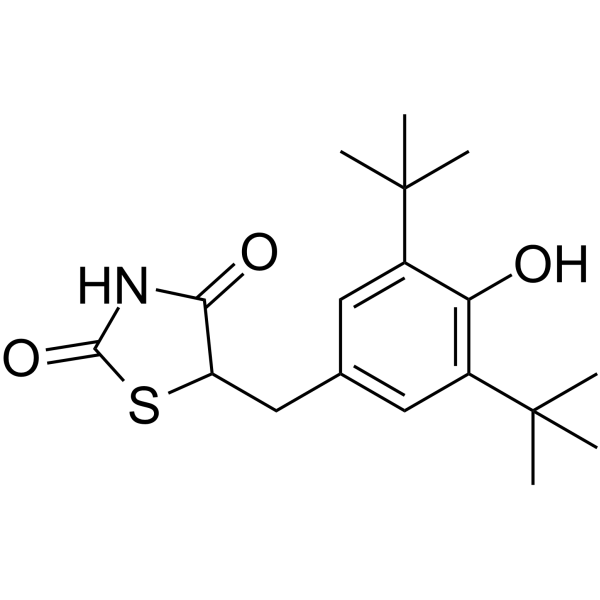
Physicochemical Properties
| Molecular Formula | C₁₈H₂₅NO₃S |
| Molecular Weight | 335.46 |
| Exact Mass | 335.156 |
| CAS # | 188532-26-5 |
| PubChem CID | 9819104 |
| Appearance | White to off-white solid powder |
| LogP | 4.21 |
| Hydrogen Bond Donor Count | 2 |
| Hydrogen Bond Acceptor Count | 4 |
| Rotatable Bond Count | 4 |
| Heavy Atom Count | 23 |
| Complexity | 454 |
| Defined Atom Stereocenter Count | 0 |
| InChi Key | QDYYSPGKYXWGSL-UHFFFAOYSA-N |
| InChi Code | InChI=1S/C18H25NO3S/c1-17(2,3)11-7-10(8-12(14(11)20)18(4,5)6)9-13-15(21)19-16(22)23-13/h7-8,13,20H,9H2,1-6H3,(H,19,21,22) |
| Chemical Name | 5-[(3,5-ditert-butyl-4-hydroxyphenyl)methyl]-1,3-thiazolidine-2,4-dione |
| Synonyms | NL1; NL 1 |
| HS Tariff Code | 2934.99.9001 |
| Storage |
Powder-20°C 3 years 4°C 2 years In solvent -80°C 6 months -20°C 1 month |
| Shipping Condition | Room temperature (This product is stable at ambient temperature for a few days during ordinary shipping and time spent in Customs) |
Biological Activity
| ln Vitro | Treatment of REH, REH/Ara-C, and ALL (SUP-B15, TOM-1, JM1, NALM-1, NALM-6, BV-173) cell lines with NL-1 (10-100 μM; 72 hours) results in concentration-dependent reductions of these cell lines. SUPB15 and NALM6 are inhibited by NL-1, with IC50 values of 29.48 µM and 94.26 µM, respectively. The IC50 values for NL-1, TOM1, BV173, NALM1, and JM1 are comparable, hovering about 60 µM [1]. Autophagy can be mediated by NL-1 treatment (60 μM; 6 hours; REH, REH/Ara-C cell lines), and NL-1-induced tumor cell death can be somewhat mitigated by autophagy inhibition [1]. The chemotactic capacity of REH and REH/Ara-C cells to move toward different chemoattractants is inhibited by NL-1 pretreatment. Chemotaxis in both REH and REH/AraC cells decreased in a dose-dependent manner in cells treated with NL1 [1]. |
| ln Vivo | NL-1 (10 mg/kg; i.p.; daily; for 5 days; female NSG mice) therapy revealed antileukemic action in an in vivo mouse ALL model [1]. |
| Cell Assay |
Cell Proliferation Assay[1] Cell Types: REH, REH/Ara-C and ALL (SUP-B15, TOM-1, JM1, NALM-1, NALM-6, BV-173) Cell Line Tested Concentrations: 10 μM, 20 μM , 30 μM, 40 μM, 50 μM, 60 μM, 70 μM, 80 μM, 100 μM Incubation Duration: 72 hrs (hours) Experimental Results: diminished number of viable cells in REH, REH/Ara-C and ALL (SUP-B15, TOM) - 1. JM1, NALM-1, NALM-6, BV-173) cell lines, in a concentration-dependent manner. Autophagy assay[1] Cell Types: REH, REH/Ara-C Cell line Tested Concentrations: 60 μM Incubation Duration: 6 hrs (hours) Experimental Results: Induction of autophagy. |
| Animal Protocol |
Animal/Disease Models: 10 female NOD.Cg-Prkdcscid Il2rgtm1Wjl/SzJ (NSG) mice (6-8 months old) were injected with TOM-1 ALL cells [1] Doses: 10 mg/kg Route of Administration: intraperitoneal (ip) injection; daily ; Lasts 5 days Experimental Results: Demonstrates anti-leukemic activity in an in vivo mouse ALL model. |
| References |
[1]. The MitoNEET Ligand NL-1 Mediates Antileukemic Activity in Drug-Resistant B-Cell Acute Lymphoblastic Leukemia. J Pharmacol Exp Ther. 2019 Jul;370(1):25-34. |
Solubility Data
| Solubility (In Vitro) | DMSO : ~250 mg/mL (~745.25 mM) |
| Solubility (In Vivo) |
Solubility in Formulation 1: ≥ 2.08 mg/mL (6.20 mM) (saturation unknown) in 10% DMSO + 40% PEG300 + 5% Tween80 + 45% Saline (add these co-solvents sequentially from left to right, and one by one), clear solution. For example, if 1 mL of working solution is to be prepared, you can add 100 μL of 20.8 mg/mL clear DMSO stock solution to 400 μL PEG300 and mix evenly; then add 50 μL Tween-80 to the above solution and mix evenly; then add 450 μL normal saline to adjust the volume to 1 mL. Preparation of saline: Dissolve 0.9 g of sodium chloride in 100 mL ddH₂ O to obtain a clear solution. Solubility in Formulation 2: ≥ 2.08 mg/mL (6.20 mM) (saturation unknown) in 10% DMSO + 90% (20% SBE-β-CD in Saline) (add these co-solvents sequentially from left to right, and one by one), clear solution. For example, if 1 mL of working solution is to be prepared, you can add 100 μL of 20.8 mg/mL clear DMSO stock solution to 900 μL of 20% SBE-β-CD physiological saline solution and mix evenly. Preparation of 20% SBE-β-CD in Saline (4°C,1 week): Dissolve 2 g SBE-β-CD in 10 mL saline to obtain a clear solution. Solubility in Formulation 3: ≥ 2.08 mg/mL (6.20 mM) (saturation unknown) in 10% DMSO + 90% Corn Oil (add these co-solvents sequentially from left to right, and one by one), clear solution. For example, if 1 mL of working solution is to be prepared, you can add 100 μL of 20.8 mg/mL clear DMSO stock solution to 900 μL of corn oil and mix evenly. (Please use freshly prepared in vivo formulations for optimal results.) |
| Preparing Stock Solutions | 1 mg | 5 mg | 10 mg | |
| 1 mM | 2.9810 mL | 14.9049 mL | 29.8098 mL | |
| 5 mM | 0.5962 mL | 2.9810 mL | 5.9620 mL | |
| 10 mM | 0.2981 mL | 1.4905 mL | 2.9810 mL |