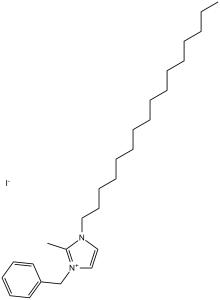
NH125 (NH-125; NH 125) is a potent and selective eEF-2 (eukaryotic elongation factor 2) kinase inhibitor with antibacterial activity against various Gram-positive and -negative bacteria. It inhibits eEF-2 with an IC50 of 60 nM, and showed >125-fold selectivity over PKC, PKA, and CaMKI. NH125 is also a potent histidine kinase inhibitor. When tested with a panel of 10 cancer cell lines (C6, T98-G, U-138 MG, and so forth), NH125 treatment inhibited cell viability with IC50 value ranges from 0.7 to 4.8 μM. NH125 decreased the cellular content of p-eEF-2 without affecting total content eEF-2 and arrested cell in G0-G1 phase in C6 glioma cells. When tested with a panel of human cancer cell lines (glioblastoma, breast cancer, and so on), NH125 sensitized cells at the dose of 0.25 μM which thus reinforced the efficacy of ER stress-inducing drug by inhibiting eEF-2.
Physicochemical Properties
| Molecular Formula | C27H45IN2 | |
| Molecular Weight | 524.56 | |
| Exact Mass | 524.262 | |
| CAS # | 278603-08-0 | |
| Related CAS # |
|
|
| PubChem CID | 10436839 | |
| Appearance | White to off-white solid powder | |
| Melting Point | 88.2-94.9ºC | |
| LogP | 4.617 | |
| Hydrogen Bond Donor Count | 0 | |
| Hydrogen Bond Acceptor Count | 1 | |
| Rotatable Bond Count | 17 | |
| Heavy Atom Count | 30 | |
| Complexity | 364 | |
| Defined Atom Stereocenter Count | 0 | |
| InChi Key | RVWOHCBHAGBLLT-UHFFFAOYSA-M | |
| InChi Code | InChI=1S/C27H45N2.HI/c1-3-4-5-6-7-8-9-10-11-12-13-14-15-19-22-28-23-24-29(26(28)2)25-27-20-17-16-18-21-27;/h16-18,20-21,23-24H,3-15,19,22,25H2,1-2H3;1H/q+1;/p-1 | |
| Chemical Name | 1-Hexadecyl-2-methyl-3-(phenylmethyl)-1H-imidazolium iodide | |
| Synonyms |
|
|
| HS Tariff Code | 2934.99.9001 | |
| Storage |
Powder-20°C 3 years 4°C 2 years In solvent -80°C 6 months -20°C 1 month Note: Please store this product in a sealed and protected environment, avoid exposure to moisture. |
|
| Shipping Condition | Room temperature (This product is stable at ambient temperature for a few days during ordinary shipping and time spent in Customs) |
Biological Activity
| Targets |
Eukaryotic elongation factor 2 kinase (eEF2K) (IC50 = 0.4 μM in in vitro kinase assay) [1] |
| ln Vitro |
NH125 exhibits relative selectivity over other protein kinases, including protein kinase C (IC50 = 7.5 μM), protein kinase A (IC50 = 80 μM), and calmodulin-dependent kinase II (IC50 > 100 μM). It also inhibits eEF-2 kinase activity (IC50 = 60 nM) in vitro and prevents eEF-2 from being phosphorylated in intact cells. Ten cancer cell lines with IC50s ranging from 0.7 to 4.7 μM are less viable when exposed to NH125. In a glioma cell line, forced overexpression of eEF-2 kinase results in 10-fold resistance to NH125. In conclusion, these results suggest that identification of potent inhibitors of eEF-2 kinase may lead to the development of new types of anticancer drugs[1]. Anticancer effect of NH125 is not mediated through inhibition of eEF2K. Inhibition of cell growth correlates with induction of peEF2[2]. Kinase activity inhibition: NH125 potently inhibited the activity of purified recombinant eEF2K with an IC50 value of 0.4 μM, and showed no significant inhibition against a panel of 20 other kinases at 10 μM [1] - Antiproliferative activity: The compound exhibited dose-dependent antiproliferative effects on various human cancer cell lines, including HeLa (cervical cancer), A549 (lung cancer), MCF-7 (breast cancer), and HT-29 (colon cancer), with IC50 values of 1.2 μM, 1.5 μM, 1.8 μM, and 2.1 μM respectively [1] - eEF2 phosphorylation induction: Treatment of HeLa and A549 cells with NH125 (0.5-5 μM) for 1-4 hours resulted in a dose- and time-dependent increase in the phosphorylation of eukaryotic elongation factor 2 (eEF2) at threonine 56, as detected by western blot [2] - Protein synthesis inhibition: NH125 (2-10 μM) inhibited protein synthesis in HeLa cells in a dose-dependent manner, with maximum inhibition of 65% at 10 μM after 4 hours of treatment [2] - Cell cycle arrest: Exposure of HeLa cells to NH125 (2 μM) for 24 hours induced G1 phase cell cycle arrest, as analyzed by flow cytometry [1] - Apoptosis induction: NH125 (3-5 μM) triggered apoptosis in MCF-7 cells, as evidenced by increased caspase-3 activity and annexin V-FITC staining positive cells (28% and 42% at 3 μM and 5 μM respectively after 48 hours) [1] |
| ln Vivo | NH125 reduces blood pressure in SHR and ROS production, induction of inflammatory molecules, and hypertrophy in SHR superior mesenteric artery. |
| Enzyme Assay |
Recombinant eEF2K activity assay: Purified recombinant eEF2K was incubated with reaction buffer containing ATP, MgCl2, and a specific peptide substrate (derived from eEF2) in the presence of serial dilutions of NH125. The reaction was carried out at 30°C for 30 minutes and terminated by adding stop solution. The phosphorylation of the peptide substrate was measured using a kinase assay detection system, and IC50 value was calculated from the dose-response curve [1] - Kinase selectivity assay: NH125 was tested at 10 μM concentration against a panel of 20 purified recombinant kinases (including CDK2, ERK1, JNK1, etc.). Each kinase was incubated with its respective substrate, ATP, and NH125 under optimal reaction conditions. Kinase activity was measured using substrate phosphorylation detection, and inhibition rate was calculated relative to vehicle-treated controls [1] |
| Cell Assay |
Antiproliferation assay: Human cancer cell lines (HeLa, A549, MCF-7, HT-29) were seeded in 96-well plates at a density of 5×10³ cells/well and incubated overnight. Serial dilutions of NH125 were added, and cells were cultured for 72 hours. Cell viability was determined using a colorimetric assay based on metabolic activity, and IC50 values were calculated [1] - Western blot analysis for eEF2 phosphorylation: HeLa and A549 cells were seeded in 6-well plates and grown to 70-80% confluence. Cells were treated with different concentrations of NH125 for various time periods, then lysed in ice-cold lysis buffer. Cell lysates were subjected to SDS-PAGE, transferred to a membrane, and probed with specific antibodies against phosphorylated eEF2 (Thr56) and total eEF2. Immunoreactive bands were detected using a chemiluminescence system [2] - Protein synthesis assay: HeLa cells were seeded in 24-well plates and treated with NH125 for the indicated times. During the last 30 minutes of treatment, cells were incubated with a radiolabeled amino acid. Cells were then lysed, and radiolabeled proteins were precipitated with trichloroacetic acid. The radioactivity was measured using a scintillation counter, and protein synthesis rate was expressed as a percentage of vehicle-treated controls [2] - Cell cycle analysis: HeLa cells were treated with NH125 (2 μM) for 24 hours, harvested, fixed with ethanol, and stained with propidium iodide. Cell cycle distribution was analyzed by flow cytometry, and the percentage of cells in G1, S, and G2/M phases was calculated [1] - Apoptosis assay: MCF-7 cells were treated with NH125 (3-5 μM) for 48 hours. Caspase-3 activity was measured using a fluorometric assay kit, and annexin V-FITC/propidium iodide double staining was performed to detect apoptotic cells, which were then analyzed by flow cytometry [1] |
| Animal Protocol |
Dissolved in DMSO; ~500 μg/kg/day; s.c. Spontaneously hypertensive rats (SHR) |
| References |
[1]. Identification and characterization of an inhibitor of eukaryotic elongation factor 2 kinase against human cancer cell lines. Cancer Res. 2003 Oct 15;63(20):6894-9. [2]. 1-Benzyl-3-cetyl-2-methylimidazolium iodide (NH125) induces phosphorylation of eukaryotic elongation factor-2 (eEF2): a cautionary note on the anticancer mechanism of an eEF2 kinase inhibitor. J Biol Chem. 2011 Dec 23;286(51):43951-8. |
| Additional Infomation |
NH125 is an imidazolium derivative identified as a selective inhibitor of eukaryotic elongation factor 2 kinase (eEF2K) [1] - Initially proposed to exert anticancer effects by inhibiting eEF2K, subsequent studies revealed that NH125 induces eEF2 phosphorylation, which may contribute to its protein synthesis inhibition and antiproliferative activity [2] - The mechanism of NH125-induced eEF2 phosphorylation is independent of eEF2K inhibition, as phosphorylation was still observed in eEF2K-knockdown cells [2] - NH125 shows high selectivity for eEF2K over other kinases, making it a valuable tool compound for studying eEF2K function and eEF2 phosphorylation-related cellular processes [1] |
Solubility Data
| Solubility (In Vitro) |
|
|||
| Solubility (In Vivo) |
Solubility in Formulation 1: ≥ 2.67 mg/mL (5.09 mM) (saturation unknown) in 10% DMSO + 40% PEG300 + 5% Tween80 + 45% Saline (add these co-solvents sequentially from left to right, and one by one), clear solution. For example, if 1 mL of working solution is to be prepared, you can add 100 μL of 26.7 mg/mL clear DMSO stock solution to 400 μL PEG300 and mix evenly; then add 50 μL Tween-80 to the above solution and mix evenly; then add 450 μL normal saline to adjust the volume to 1 mL. Preparation of saline: Dissolve 0.9 g of sodium chloride in 100 mL ddH₂ O to obtain a clear solution. Solubility in Formulation 2: ≥ 2.67 mg/mL (5.09 mM) (saturation unknown) in 10% DMSO + 90% (20% SBE-β-CD in Saline) (add these co-solvents sequentially from left to right, and one by one), clear solution. For example, if 1 mL of working solution is to be prepared, you can add 100 μL of 26.7 mg/mL clear DMSO stock solution to 900 μL of 20% SBE-β-CD physiological saline solution and mix evenly. Preparation of 20% SBE-β-CD in Saline (4°C,1 week): Dissolve 2 g SBE-β-CD in 10 mL saline to obtain a clear solution. Solubility in Formulation 3: ≥ 2.67 mg/mL (5.09 mM) (saturation unknown) in 10% DMSO + 90% Corn Oil (add these co-solvents sequentially from left to right, and one by one), clear solution. For example, if 1 mL of working solution is to be prepared, you can add 100 μL of 26.7 mg/mL clear DMSO stock solution to 900 μL of corn oil and mix evenly. (Please use freshly prepared in vivo formulations for optimal results.) |
| Preparing Stock Solutions | 1 mg | 5 mg | 10 mg | |
| 1 mM | 1.9064 mL | 9.5318 mL | 19.0636 mL | |
| 5 mM | 0.3813 mL | 1.9064 mL | 3.8127 mL | |
| 10 mM | 0.1906 mL | 0.9532 mL | 1.9064 mL |