Physicochemical Properties
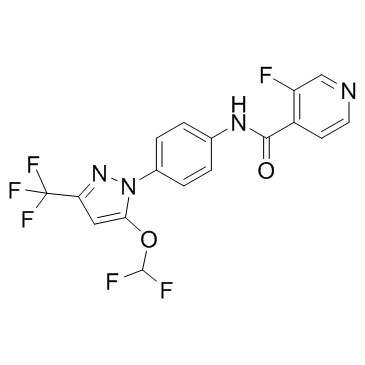
| Molecular Formula | C17H10F6N4O2 |
| Molecular Weight | 416.277324199677 |
| Exact Mass | 416.07 |
| CAS # | 245747-71-1 |
| PubChem CID | 9931706 |
| Appearance | Light yellow to yellow solid powder |
| LogP | 3.9 |
| Hydrogen Bond Donor Count | 1 |
| Hydrogen Bond Acceptor Count | 10 |
| Rotatable Bond Count | 5 |
| Heavy Atom Count | 29 |
| Complexity | 559 |
| Defined Atom Stereocenter Count | 0 |
| SMILES | FC(C1C=C(N(C2C=CC(=CC=2)NC(C2C=CN=CC=2F)=O)N=1)OC(F)F)(F)F |
| InChi Key | XGCRLPUGFWHAGJ-UHFFFAOYSA-N |
| InChi Code | InChI=1S/C17H10F6N4O2/c18-12-8-24-6-5-11(12)15(28)25-9-1-3-10(4-2-9)27-14(29-16(19)20)7-13(26-27)17(21,22)23/h1-8,16H,(H,25,28) |
| Chemical Name | N-[4-[5-(difluoromethoxy)-3-(trifluoromethyl)pyrazol-1-yl]phenyl]-3-fluoropyridine-4-carboxamide |
| HS Tariff Code | 2934.99.9001 |
| Storage |
Powder-20°C 3 years 4°C 2 years In solvent -80°C 6 months -20°C 1 month |
| Shipping Condition | Room temperature (This product is stable at ambient temperature for a few days during ordinary shipping and time spent in Customs) |
Biological Activity
| Targets | NFAT (Nuclear Factor of Activated T-cells) transcription factor (IC50 = 0.8 μM for NFAT-mediated transcriptional activity) [1] |
| ln Vitro |
Compound example 19, NFAT Transcription Factor Regulator-1, has an IC50 of 182 nM, which suppresses IL-2 production. NFAT Transcription Factor Regulator-1 has an IC50 of 146 nM for rat PBMC proliferation and 82 nM for human PBMC proliferation. NFAT Transcription Factor Regulator-1 has comparable potency to its effects on IL-2 release when it comes to inhibiting the synthesis of IL-4 and IL-5 in human T-cell lines[1]. In Jurkat T cells transfected with NFAT-luciferase reporter plasmid, NFAT Transcription Factor Regulator-1 (0.1-10 μM) dose-dependently inhibited NFAT-mediated transcriptional activity. At 0.8 μM (IC50), luciferase activity was reduced by 50%; at 10 μM, inhibition reached 89%, as measured by dual-luciferase assay [1] In PMA/ionomycin-stimulated Jurkat T cells, the compound (0.5-5 μM) suppressed interleukin-2 (IL-2) secretion. At 5 μM, IL-2 production was reduced by 76% compared to the vehicle control, detected by sandwich ELISA [1] It did not affect AP-1 or NF-κB-mediated transcriptional activity at concentrations up to 10 μM, indicating selectivity for NFAT [1] |
| ln Vivo | It is discovered that the inhibitory effectiveness of NFAT Transcription Factor Regulator-1 is almost ten times more than that of cyclosporine. At dosages of 3.0 and 30 mg/kg, po, respectively, NFAT Transcription Factor Regulator-1 and cyclosporine have comparable inhibitory effects on T-cell IL-2 production. The results of the in vivo suppression of T-cell cytokine production in monkeys indicate that NFAT Transcription Factor Regulator-1 may be used in transplantation with potential comparable to that of cyclosporine[1]. |
| Enzyme Assay | Jurkat T cells were co-transfected with NFAT-responsive luciferase reporter plasmid and renilla luciferase control plasmid. After 24 hours of transfection, cells were seeded in 96-well plates (1×10⁵ cells/well) and pretreated with NFAT Transcription Factor Regulator-1 (0.1-10 μM) for 1 hour. Cells were then stimulated with PMA (10 ng/mL) plus ionomycin (1 μM) for 6 hours to activate NFAT. Luciferase activity was measured using a dual-luciferase detection system, with renilla luciferase activity as internal control. IC50 was calculated from concentration-response curves of relative luciferase activity [1] |
| Cell Assay | Jurkat T cells were cultured in RPMI 1640 medium supplemented with fetal bovine serum. Cells were seeded in 24-well plates (5×10⁵ cells/well) and pretreated with NFAT Transcription Factor Regulator-1 (0.5-5 μM) for 1 hour, followed by stimulation with PMA (10 ng/mL) and ionomycin (1 μM) for 24 hours. Cell culture supernatants were collected, and IL-2 secretion was quantified by sandwich ELISA. Cell viability was assessed by MTT assay, showing >90% viability at concentrations up to 10 μM [1] |
| Animal Protocol | Monkey[1] Cynomolgus monkeys are bled to obtain heparinized baseline samples for measuring predrug cytokine production and then briefly intubated for intragastric dosing. Cyclosporine is administered in the Neoral formulation. Compound 19 is given. Postdrug blood samples are similarly obtained 2 h later. The samples are stimulated by spiking undiluted blood with PMA (50 ng/mL) and ionomycin (1μg/mL) and incubating for 24 h. Plasma samples are collected by centrifugation, and IL-2 concentrations are determined by ELISA using recombinant human IL-2 as standard[1]. |
| References |
[1]. 3,5-Bis(trifluoromethyl)pyrazoles: a novel class of NFAT transcription factor regulator. J Med Chem. 2000 Aug 10;43(16):2975-81. |
| Additional Infomation |
NFAT Transcription Factor Regulator-1 is a synthetic small-molecule compound belonging to the 3,5-bis(trifluoromethyl)pyrazole class [1] Its mechanism of action involves selective inhibition of NFAT transcription factor activity, blocking NFAT-dependent gene expression (e.g., IL-2) without interfering with other transcription factors (AP-1, NF-κB) [1] It acts downstream of calcineurin (the upstream activator of NFAT) by directly targeting the NFAT transcription factor, preventing its binding to DNA response elements and subsequent transcriptional activation [1] The compound exhibits high selectivity for NFAT and good in vitro cellular tolerance, supporting its potential as a lead compound for developing treatments for NFAT-mediated inflammatory or immune disorders [1] |
Solubility Data
| Solubility (In Vitro) | DMSO : ~100 mg/mL (~240.22 mM) |
| Solubility (In Vivo) |
Solubility in Formulation 1: ≥ 5 mg/mL (12.01 mM) (saturation unknown) in 10% DMSO + 40% PEG300 + 5% Tween80 + 45% Saline (add these co-solvents sequentially from left to right, and one by one), clear solution. For example, if 1 mL of working solution is to be prepared, you can add 100 μL of 50.0 mg/mL clear DMSO stock solution to 400 μL PEG300 and mix evenly; then add 50 μL Tween-80 to the above solution and mix evenly; then add 450 μL normal saline to adjust the volume to 1 mL. Preparation of saline: Dissolve 0.9 g of sodium chloride in 100 mL ddH₂ O to obtain a clear solution. Solubility in Formulation 2: ≥ 5 mg/mL (12.01 mM) (saturation unknown) in 10% DMSO + 90% Corn Oil (add these co-solvents sequentially from left to right, and one by one), clear solution. For example, if 1 mL of working solution is to be prepared, you can add 100 μL of 50.0 mg/mL clear DMSO stock solution to 900 μL of corn oil and mix evenly. (Please use freshly prepared in vivo formulations for optimal results.) |
| Preparing Stock Solutions | 1 mg | 5 mg | 10 mg | |
| 1 mM | 2.4022 mL | 12.0111 mL | 24.0223 mL | |
| 5 mM | 0.4804 mL | 2.4022 mL | 4.8045 mL | |
| 10 mM | 0.2402 mL | 1.2011 mL | 2.4022 mL |