Physicochemical Properties
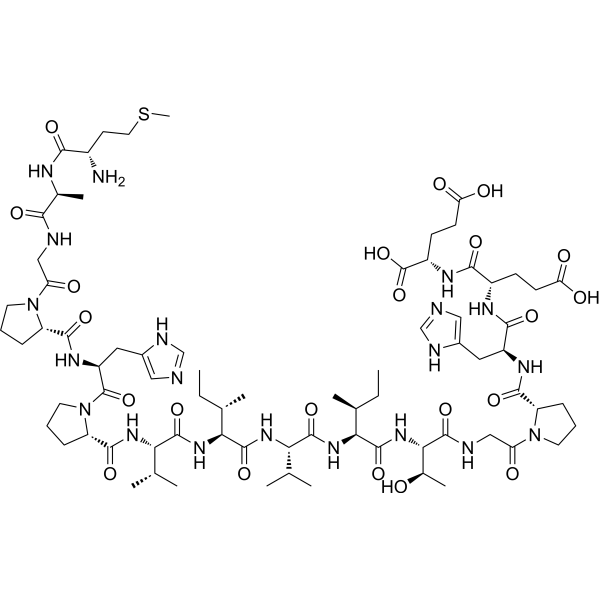
| Molecular Formula | C75H118N20O22S |
| Molecular Weight | 1683.92523622513 |
| Exact Mass | 1682.845 |
| CAS # | 249537-73-3 |
| PubChem CID | 16135717 |
| Appearance | White to off-white solid powder |
| Density | 1.3±0.1 g/cm3 |
| Boiling Point | 1982.4±65.0 °C at 760 mmHg |
| Flash Point | 1152.7±34.3 °C |
| Vapour Pressure | 0.0±0.3 mmHg at 25°C |
| Index of Refraction | 1.580 |
| LogP | -0.76 |
| Hydrogen Bond Donor Count | 19 |
| Hydrogen Bond Acceptor Count | 26 |
| Rotatable Bond Count | 48 |
| Heavy Atom Count | 118 |
| Complexity | 3550 |
| Defined Atom Stereocenter Count | 17 |
| SMILES | CC[C@H](C)[C@@H](C(=O)N[C@@H]([C@@H](C)O)C(=O)NCC(=O)N1CCC[C@H]1C(=O)N[C@@H](CC2=CN=CN2)C(=O)N[C@@H](CCC(=O)O)C(=O)N[C@@H](CCC(=O)O)C(=O)O)NC(=O)[C@H](C(C)C)NC(=O)[C@H]([C@@H](C)CC)NC(=O)[C@H](C(C)C)NC(=O)[C@@H]3CCCN3C(=O)[C@H](CC4=CN=CN4)NC(=O)[C@@H]5CCCN5C(=O)CNC(=O)[C@H](C)NC(=O)[C@H](CCSC)N |
| InChi Key | QPMHUXBSHGAVGD-MCDIZDEASA-N |
| InChi Code | InChI=1S/C75H118N20O22S/c1-12-39(7)59(90-70(111)57(37(3)4)88-68(109)52-19-16-27-95(52)74(115)49(30-44-32-78-36-82-44)87-67(108)51-18-15-26-94(51)53(97)33-79-62(103)41(9)83-63(104)45(76)24-28-118-11)72(113)89-58(38(5)6)71(112)91-60(40(8)13-2)73(114)92-61(42(10)96)69(110)80-34-54(98)93-25-14-17-50(93)66(107)86-48(29-43-31-77-35-81-43)65(106)84-46(20-22-55(99)100)64(105)85-47(75(116)117)21-23-56(101)102/h31-32,35-42,45-52,57-61,96H,12-30,33-34,76H2,1-11H3,(H,77,81)(H,78,82)(H,79,103)(H,80,110)(H,83,104)(H,84,106)(H,85,105)(H,86,107)(H,87,108)(H,88,109)(H,89,113)(H,90,111)(H,91,112)(H,92,114)(H,99,100)(H,101,102)(H,116,117)/t39-,40-,41-,42+,45-,46-,47-,48-,49-,50-,51-,52-,57-,58-,59-,60-,61-/m0/s1 |
| Chemical Name | (2S)-2-[[(2S)-2-[[(2S)-2-[[(2S)-1-[2-[[(2S,3R)-2-[[(2S,3S)-2-[[(2S)-2-[[(2S,3S)-2-[[(2S)-2-[[(2S)-1-[(2S)-2-[[(2S)-1-[2-[[(2S)-2-[[(2S)-2-amino-4-methylsulfanylbutanoyl]amino]propanoyl]amino]acetyl]pyrrolidine-2-carbonyl]amino]-3-(1H-imidazol-5-yl)propanoyl]pyrrolidine-2-carbonyl]amino]-3-methylbutanoyl]amino]-3-methylpentanoyl]amino]-3-methylbutanoyl]amino]-3-methylpentanoyl]amino]-3-hydroxybutanoyl]amino]acetyl]pyrrolidine-2-carbonyl]amino]-3-(1H-imidazol-5-yl)propanoyl]amino]-4-carboxybutanoyl]amino]pentanedioic acid |
| HS Tariff Code | 2934.99.9001 |
| Storage |
Powder-20°C 3 years 4°C 2 years In solvent -80°C 6 months -20°C 1 month Note: Please store this product in a sealed and protected environment, avoid exposure to moisture. |
| Shipping Condition | Room temperature (This product is stable at ambient temperature for a few days during ordinary shipping and time spent in Customs) |
Biological Activity
| Targets | Nuclear Factor of Activated T-cells (NFAT) [1] |
| ln Vitro |
For a whole day, NFAT Inhibitor-1 therapy dramatically reduced NFATc1's nuclear translocation. The levels of cathepsin K, TRAP, and MMP-9 in the cytoplasm are markedly inhibited by long-term VIVIT therapy [2]. In Jurkat T cells stimulated with phorbol 12-myristate 13-acetate (PMA) plus ionomycin, NFAT Inhibitor (a 10-amino acid peptide) dose-dependently inhibited NFAT-mediated transcriptional activity. At 10 μM, it suppressed NFAT-dependent luciferase reporter gene expression by 85%, with an IC50 of 2.3 μM. This inhibition was more selective than cyclosporin A (CsA), as the compound did not affect AP-1, NF-κB, or CREB transcriptional activity at concentrations up to 50 μM [1] In primary human T cells, NFAT Inhibitor (5-20 μM) reduced interleukin-2 (IL-2) and interferon-γ (IFN-γ) production induced by CD3/CD28 stimulation. At 20 μM, IL-2 secretion was decreased by 78% and IFN-γ by 72%, without affecting T cell viability (MTT assay showed >90% viability at 50 μM) [1] |
| Enzyme Assay |
NFAT binding assay: Recombinant NFATc1 protein was incubated with biotin-labeled NFAT response element (RE) oligonucleotide and NFAT Inhibitor (0.1-50 μM) for 30 minutes at 25°C. Streptavidin-agarose beads were used to pull down protein-DNA complexes, and bound NFATc1 was detected by western blot. The assay showed dose-dependent inhibition of NFATc1-DNA binding, with 50% inhibition at 1.8 μM [1] Luciferase reporter assay: Jurkat T cells were transfected with NFAT-luciferase reporter plasmid and a renilla luciferase control plasmid. After 24 hours, cells were pretreated with NFAT Inhibitor (0.1-50 μM) for 1 hour, then stimulated with PMA (10 ng/mL) plus ionomycin (1 μM) for 6 hours. Luciferase activity was measured using a dual-luciferase assay system, and relative light units were normalized to renilla activity to calculate inhibition rates [1]. |
| Cell Assay |
Western Blot analysis [2] Cell Types: Human peripheral blood CD14+ monocytes Tested Concentrations: 10 μM Incubation Duration: 24 hrs (hours) or 21 days Experimental Results: Short-term treatment with 10 μM Dramatically inhibited the nuclear translocation of NFATc1. Long-term treatment Dramatically inhibited the levels of cytoplasmic cathepsin K, TRAP and MMP-9. Jurkat T cells were cultured in RPMI 1640 medium supplemented with fetal bovine serum. Cells were seeded in 96-well plates (1×10⁵ cells/well) and pretreated with NFAT Inhibitor (0.1-50 μM) for 1 hour, followed by stimulation with PMA (10 ng/mL) and ionomycin (1 μM) for 24 hours. Cell culture supernatants were collected to quantify IL-2 and IFN-γ levels by sandwich ELISA [1] Primary human T cells were isolated from peripheral blood and cultured in T cell growth medium. Cells were activated with anti-CD3/anti-CD28 antibodies in the presence of NFAT Inhibitor (5-20 μM) for 48 hours. T cell viability was assessed by MTT assay, and cytokine production was measured by ELISA [1] |
| References |
[1]. Affinity-driven peptide selection of an NFAT inhibitor more selective than cyclosporin A. Science. 1999 Sep 24;285(5436):2129-33. [2]. Activation of the Peroxisome Proliferator-Activated Receptor γ Coactivator 1β/NFATc1 Pathway in Circulating Osteoclast Precursors Associated With Bone Destruction in Rheumatoid Arthritis. Arthritis Rheumatol. 2019 Aug;71(8):1252-1264. |
| Additional Infomation |
NFAT Inhibitor is a synthetic 10-amino acid peptide identified via affinity-driven peptide selection, designed to target the DNA-binding domain of NFAT [1] Its mechanism of action involves blocking the interaction between NFAT and its cognate DNA response elements, thereby inhibiting NFAT-dependent gene transcription. Unlike cyclosporin A (which inhibits calcineurin, a upstream regulator of NFAT), it acts directly on NFAT, conferring higher selectivity for NFAT-mediated pathways [1] Literature [2] focuses on the role of the PGC-1β/NFATc1 pathway in osteoclast precursors from rheumatoid arthritis patients and does not contain data related to NFAT Inhibitor [2]. |
Solubility Data
| Solubility (In Vitro) | H2O : ~100 mg/mL (~59.38 mM) |
| Solubility (In Vivo) |
Solubility in Formulation 1: 50 mg/mL (29.69 mM) in PBS (add these co-solvents sequentially from left to right, and one by one), clear solution; with sonication. (Please use freshly prepared in vivo formulations for optimal results.) |
| Preparing Stock Solutions | 1 mg | 5 mg | 10 mg | |
| 1 mM | 0.5938 mL | 2.9692 mL | 5.9385 mL | |
| 5 mM | 0.1188 mL | 0.5938 mL | 1.1877 mL | |
| 10 mM | 0.0594 mL | 0.2969 mL | 0.5938 mL |