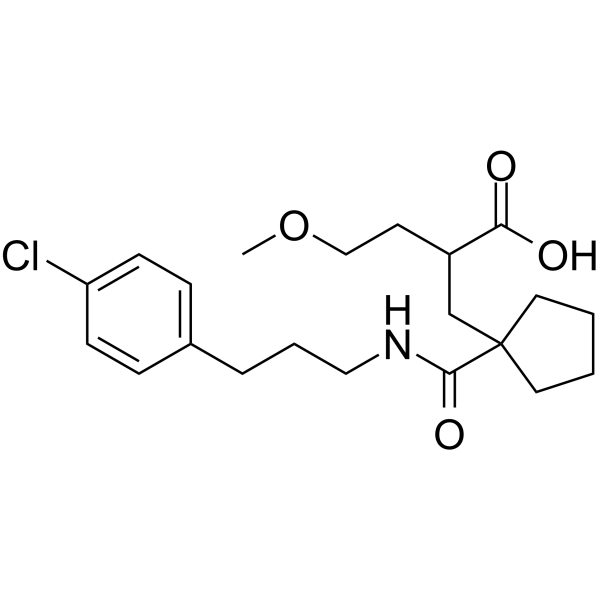
Physicochemical Properties
| Molecular Formula | C21H30CLNO4 |
| Molecular Weight | 395.920205593109 |
| Exact Mass | 395.186 |
| CAS # | 465527-94-0 |
| PubChem CID | 10272048 |
| Appearance | Typically exists as solid at room temperature |
| LogP | 3.9 |
| Hydrogen Bond Donor Count | 2 |
| Hydrogen Bond Acceptor Count | 4 |
| Rotatable Bond Count | 11 |
| Heavy Atom Count | 27 |
| Complexity | 471 |
| Defined Atom Stereocenter Count | 0 |
| InChi Key | UOGBJRPKRSUJRU-UHFFFAOYSA-N |
| InChi Code | InChI=1S/C21H30ClNO4/c1-27-14-10-17(19(24)25)15-21(11-2-3-12-21)20(26)23-13-4-5-16-6-8-18(22)9-7-16/h6-9,17H,2-5,10-15H2,1H3,(H,23,26)(H,24,25) |
| Chemical Name | 2-[[1-[3-(4-chlorophenyl)propylcarbamoyl]cyclopentyl]methyl]-4-methoxybutanoic acid |
| HS Tariff Code | 2934.99.9001 |
| Storage |
Powder-20°C 3 years 4°C 2 years In solvent -80°C 6 months -20°C 1 month |
| Shipping Condition | Room temperature (This product is stable at ambient temperature for a few days during ordinary shipping and time spent in Customs) |
Biological Activity
| Targets |
- NEP-In-1 targets neutral endopeptidase (NEP, EC 3.4.24.11) (Ki value for NEP inhibition: 1.2 nM); it shows high selectivity, with no significant inhibition on angiotensin-converting enzyme (ACE, IC50 > 10,000 nM) and aminopeptidase N (APN, IC50 > 10,000 nM) [1] |
| ln Vitro |
NEP-IN-1 (compound 30) is a selective neutral endopeptidase blocker that is prescribed to treat female sexual arousal problem [1]. - NEP inhibitory activity: NEP-In-1 inhibited recombinant human NEP enzyme activity in a dose-dependent manner. At concentrations ranging from 0.1 to 100 nM, it showed increasing inhibitory effects, with a Ki value of 1.2 nM (determined via nonlinear regression of the concentration-inhibition curve). The maximum inhibition rate reached ~98% at 100 nM [1] - Selectivity for NEP: NEP-In-1 exhibited no significant inhibitory activity against other related peptidases. At a concentration of 10,000 nM, it inhibited ACE by <5% and APN by <3%, confirming high selectivity for NEP [1] |
| Enzyme Assay |
- NEP enzyme activity assay: Recombinant human NEP was mixed with reaction buffer (pH 7.4) containing the fluorescent substrate MCA-D-Ala-Gly-Phe(NO2)-Gly (final concentration 25 μM) and NEP-In-1 (concentrations: 0.1, 0.3, 1, 3, 10, 30, 100 nM). The mixture was incubated at 37°C for 30 minutes. The fluorescence intensity of the product (MCA) was measured using a microplate reader (excitation wavelength: 320 nm; emission wavelength: 405 nm). The inhibition rate was calculated by comparing with the vehicle control group, and the Ki value was determined using the Dixon plot method [1] - Selectivity assay for other peptidases: For ACE activity detection, recombinant human ACE and substrate Hippuryl-His-Leu were used; the reaction was incubated at 37°C for 60 minutes, and the released hippuric acid was measured via spectrophotometry (228 nm). For APN activity detection, recombinant human APN and substrate L-alanine-p-nitroanilide were used; the reaction was incubated at 37°C for 45 minutes, and the absorbance of p-nitroaniline was measured at 405 nm. NEP-In-1 was tested at 10,000 nM in both assays, and inhibition rates were calculated [1] |
| References |
[1]. Novel selective inhibitors of neutral endopeptidase for the treatment of female sexual arousal disorder. Bioorg Med Chem. 2007 Jan 1;15(1):142-59. |
| Additional Infomation |
- NEP-In-1 is a novel small-molecule selective inhibitor of neutral endopeptidase (NEP) [1] - It was designed for the potential treatment of female sexual arousal disorder (FSAD). Its mechanism of action is proposed to involve inhibiting NEP-mediated degradation of neuropeptides (e.g., substance P, vasoactive intestinal peptide) that regulate vascular relaxation and sensory signaling, thereby enhancing sexual arousal-related physiological responses [1] |
Solubility Data
| Solubility (In Vitro) | May dissolve in DMSO (in most cases), if not, try other solvents such as H2O, Ethanol, or DMF with a minute amount of products to avoid loss of samples |
| Solubility (In Vivo) |
Note: Listed below are some common formulations that may be used to formulate products with low water solubility (e.g. < 1 mg/mL), you may test these formulations using a minute amount of products to avoid loss of samples. Injection Formulations (e.g. IP/IV/IM/SC) Injection Formulation 1: DMSO : Tween 80: Saline = 10 : 5 : 85 (i.e. 100 μL DMSO stock solution → 50 μL Tween 80 → 850 μL Saline) *Preparation of saline: Dissolve 0.9 g of sodium chloride in 100 mL ddH ₂ O to obtain a clear solution. Injection Formulation 2: DMSO : PEG300 :Tween 80 : Saline = 10 : 40 : 5 : 45 (i.e. 100 μL DMSO → 400 μLPEG300 → 50 μL Tween 80 → 450 μL Saline) Injection Formulation 3: DMSO : Corn oil = 10 : 90 (i.e. 100 μL DMSO → 900 μL Corn oil) Example: Take the Injection Formulation 3 (DMSO : Corn oil = 10 : 90) as an example, if 1 mL of 2.5 mg/mL working solution is to be prepared, you can take 100 μL 25 mg/mL DMSO stock solution and add to 900 μL corn oil, mix well to obtain a clear or suspension solution (2.5 mg/mL, ready for use in animals). Injection Formulation 4: DMSO : 20% SBE-β-CD in saline = 10 : 90 [i.e. 100 μL DMSO → 900 μL (20% SBE-β-CD in saline)] *Preparation of 20% SBE-β-CD in Saline (4°C,1 week): Dissolve 2 g SBE-β-CD in 10 mL saline to obtain a clear solution. Injection Formulation 5: 2-Hydroxypropyl-β-cyclodextrin : Saline = 50 : 50 (i.e. 500 μL 2-Hydroxypropyl-β-cyclodextrin → 500 μL Saline) Injection Formulation 6: DMSO : PEG300 : castor oil : Saline = 5 : 10 : 20 : 65 (i.e. 50 μL DMSO → 100 μLPEG300 → 200 μL castor oil → 650 μL Saline) Injection Formulation 7: Ethanol : Cremophor : Saline = 10: 10 : 80 (i.e. 100 μL Ethanol → 100 μL Cremophor → 800 μL Saline) Injection Formulation 8: Dissolve in Cremophor/Ethanol (50 : 50), then diluted by Saline Injection Formulation 9: EtOH : Corn oil = 10 : 90 (i.e. 100 μL EtOH → 900 μL Corn oil) Injection Formulation 10: EtOH : PEG300:Tween 80 : Saline = 10 : 40 : 5 : 45 (i.e. 100 μL EtOH → 400 μLPEG300 → 50 μL Tween 80 → 450 μL Saline) Oral Formulations Oral Formulation 1: Suspend in 0.5% CMC Na (carboxymethylcellulose sodium) Oral Formulation 2: Suspend in 0.5% Carboxymethyl cellulose Example: Take the Oral Formulation 1 (Suspend in 0.5% CMC Na) as an example, if 100 mL of 2.5 mg/mL working solution is to be prepared, you can first prepare 0.5% CMC Na solution by measuring 0.5 g CMC Na and dissolve it in 100 mL ddH2O to obtain a clear solution; then add 250 mg of the product to 100 mL 0.5% CMC Na solution, to make the suspension solution (2.5 mg/mL, ready for use in animals). Oral Formulation 3: Dissolved in PEG400 Oral Formulation 4: Suspend in 0.2% Carboxymethyl cellulose Oral Formulation 5: Dissolve in 0.25% Tween 80 and 0.5% Carboxymethyl cellulose Oral Formulation 6: Mixing with food powders Note: Please be aware that the above formulations are for reference only. InvivoChem strongly recommends customers to read literature methods/protocols carefully before determining which formulation you should use for in vivo studies, as different compounds have different solubility properties and have to be formulated differently. (Please use freshly prepared in vivo formulations for optimal results.) |
| Preparing Stock Solutions | 1 mg | 5 mg | 10 mg | |
| 1 mM | 2.5258 mL | 12.6288 mL | 25.2576 mL | |
| 5 mM | 0.5052 mL | 2.5258 mL | 5.0515 mL | |
| 10 mM | 0.2526 mL | 1.2629 mL | 2.5258 mL |