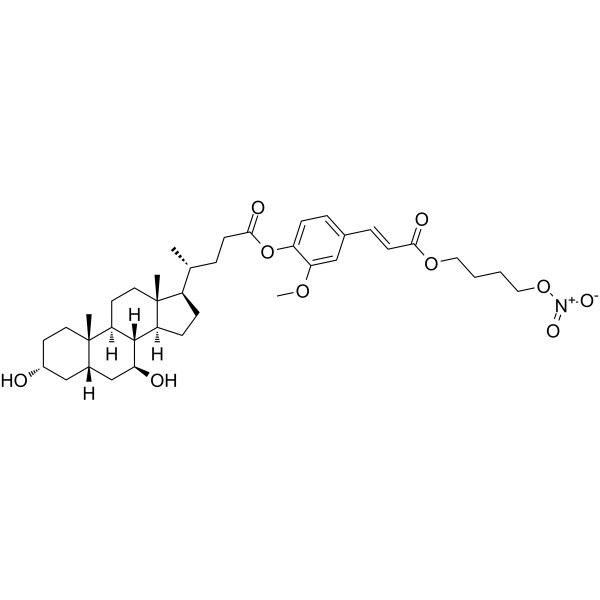
Physicochemical Properties
| Molecular Formula | C38H55NO10 |
| Molecular Weight | 685.84 |
| Exact Mass | 685.382 |
| CAS # | 401519-96-8 |
| PubChem CID | 129628949 |
| Appearance | White to off-white solid powder |
| Density | 1.2±0.1 g/cm3 |
| Boiling Point | 758.3±60.0 °C at 760 mmHg |
| Flash Point | 412.4±32.9 °C |
| Vapour Pressure | 0.0±2.7 mmHg at 25°C |
| Index of Refraction | 1.560 |
| LogP | 7.64 |
| Hydrogen Bond Donor Count | 2 |
| Hydrogen Bond Acceptor Count | 10 |
| Rotatable Bond Count | 15 |
| Heavy Atom Count | 49 |
| Complexity | 1170 |
| Defined Atom Stereocenter Count | 10 |
| SMILES | C[C@H](CCC(=O)OC1=C(C=C(C=C1)/C=C/C(=O)OCCCCO[N+](=O)[O-])OC)[C@H]2CC[C@@H]3[C@@]2(CC[C@H]4[C@H]3[C@H](C[C@H]5[C@@]4(CC[C@H](C5)O)C)O)C |
| InChi Key | WTAVOESJEWSDJC-OBOLPPCUSA-N |
| InChi Code | InChI=1S/C38H55NO10/c1-24(28-10-11-29-36-30(16-18-38(28,29)3)37(2)17-15-27(40)22-26(37)23-31(36)41)7-13-35(43)49-32-12-8-25(21-33(32)46-4)9-14-34(42)47-19-5-6-20-48-39(44)45/h8-9,12,14,21,24,26-31,36,40-41H,5-7,10-11,13,15-20,22-23H2,1-4H3/b14-9+/t24-,26+,27-,28-,29+,30+,31+,36+,37+,38-/m1/s1 |
| Chemical Name | [2-methoxy-4-[(E)-3-(4-nitrooxybutoxy)-3-oxoprop-1-enyl]phenyl] (4R)-4-[(3R,5S,7S,8R,9S,10S,13R,14S,17R)-3,7-dihydroxy-10,13-dimethyl-2,3,4,5,6,7,8,9,11,12,14,15,16,17-tetradecahydro-1H-cyclopenta[a]phenanthren-17-yl]pentanoate |
| HS Tariff Code | 2934.99.9001 |
| Storage |
Powder-20°C 3 years 4°C 2 years In solvent -80°C 6 months -20°C 1 month |
| Shipping Condition | Room temperature (This product is stable at ambient temperature for a few days during ordinary shipping and time spent in Customs) |
Biological Activity
| ln Vivo | In rats treated with CCl4, NCX-1000 (15 mg/kg) decreases collagen deposition and prevents the formation of ascites. In cirrhotic rats, treatment of NCX-1000 decreased portal pressure and nearly entirely corrected CCl4-induced portal hypertension. NCX-1000 suppresses TNF-α and IFN-γ-stimulated HSC production of MCP-1 while restoring FCS-induced HSC contraction [1]. Rats' portal venous pressure is lowered by NCX-1000 (28 mg/kg, orally) without changing their heart rate or mean arterial pressure. Moreover, NCX-1000 60% lessens the vasoconstriction that 30 μM NE causes in rats. The liver concentrations of nitrite/nitrate and cGMP rise similarly in BDL and sham-operated animals when NCX-1000 is administered [2]. |
| References |
[1]. NCX-1000, a NO-releasing derivative of ursodeoxycholic acid, selectively delivers NO to the liver and protects against development of portal hypertension. Proc Natl Acad Sci U S A. 2001 Jul 17;98(15):8897-902. Epub 2001 Jul 10. [2]. NCX-1000, a nitric oxide-releasing derivative of ursodeoxycholic acid, ameliorates portal hypertension and lowers norepinephrine-induced intrahepatic resistance in the isolated and perfused rat liver. J Hepatol. 2003 Dec;39(6):932-9. |
| Additional Infomation | NCX-1000 is under investigation in clinical trial NCT00414869 (Preliminary Efficacy and Tolerability of NCX-1000 After Repeated Oral Doses in Patients With Elevated Portal Pressure). |
Solubility Data
| Solubility (In Vitro) | May dissolve in DMSO (in most cases), if not, try other solvents such as H2O, Ethanol, or DMF with a minute amount of products to avoid loss of samples |
| Solubility (In Vivo) |
Note: Listed below are some common formulations that may be used to formulate products with low water solubility (e.g. < 1 mg/mL), you may test these formulations using a minute amount of products to avoid loss of samples. Injection Formulations (e.g. IP/IV/IM/SC) Injection Formulation 1: DMSO : Tween 80: Saline = 10 : 5 : 85 (i.e. 100 μL DMSO stock solution → 50 μL Tween 80 → 850 μL Saline) *Preparation of saline: Dissolve 0.9 g of sodium chloride in 100 mL ddH ₂ O to obtain a clear solution. Injection Formulation 2: DMSO : PEG300 :Tween 80 : Saline = 10 : 40 : 5 : 45 (i.e. 100 μL DMSO → 400 μLPEG300 → 50 μL Tween 80 → 450 μL Saline) Injection Formulation 3: DMSO : Corn oil = 10 : 90 (i.e. 100 μL DMSO → 900 μL Corn oil) Example: Take the Injection Formulation 3 (DMSO : Corn oil = 10 : 90) as an example, if 1 mL of 2.5 mg/mL working solution is to be prepared, you can take 100 μL 25 mg/mL DMSO stock solution and add to 900 μL corn oil, mix well to obtain a clear or suspension solution (2.5 mg/mL, ready for use in animals). Injection Formulation 4: DMSO : 20% SBE-β-CD in saline = 10 : 90 [i.e. 100 μL DMSO → 900 μL (20% SBE-β-CD in saline)] *Preparation of 20% SBE-β-CD in Saline (4°C,1 week): Dissolve 2 g SBE-β-CD in 10 mL saline to obtain a clear solution. Injection Formulation 5: 2-Hydroxypropyl-β-cyclodextrin : Saline = 50 : 50 (i.e. 500 μL 2-Hydroxypropyl-β-cyclodextrin → 500 μL Saline) Injection Formulation 6: DMSO : PEG300 : castor oil : Saline = 5 : 10 : 20 : 65 (i.e. 50 μL DMSO → 100 μLPEG300 → 200 μL castor oil → 650 μL Saline) Injection Formulation 7: Ethanol : Cremophor : Saline = 10: 10 : 80 (i.e. 100 μL Ethanol → 100 μL Cremophor → 800 μL Saline) Injection Formulation 8: Dissolve in Cremophor/Ethanol (50 : 50), then diluted by Saline Injection Formulation 9: EtOH : Corn oil = 10 : 90 (i.e. 100 μL EtOH → 900 μL Corn oil) Injection Formulation 10: EtOH : PEG300:Tween 80 : Saline = 10 : 40 : 5 : 45 (i.e. 100 μL EtOH → 400 μLPEG300 → 50 μL Tween 80 → 450 μL Saline) Oral Formulations Oral Formulation 1: Suspend in 0.5% CMC Na (carboxymethylcellulose sodium) Oral Formulation 2: Suspend in 0.5% Carboxymethyl cellulose Example: Take the Oral Formulation 1 (Suspend in 0.5% CMC Na) as an example, if 100 mL of 2.5 mg/mL working solution is to be prepared, you can first prepare 0.5% CMC Na solution by measuring 0.5 g CMC Na and dissolve it in 100 mL ddH2O to obtain a clear solution; then add 250 mg of the product to 100 mL 0.5% CMC Na solution, to make the suspension solution (2.5 mg/mL, ready for use in animals). Oral Formulation 3: Dissolved in PEG400 Oral Formulation 4: Suspend in 0.2% Carboxymethyl cellulose Oral Formulation 5: Dissolve in 0.25% Tween 80 and 0.5% Carboxymethyl cellulose Oral Formulation 6: Mixing with food powders Note: Please be aware that the above formulations are for reference only. InvivoChem strongly recommends customers to read literature methods/protocols carefully before determining which formulation you should use for in vivo studies, as different compounds have different solubility properties and have to be formulated differently. (Please use freshly prepared in vivo formulations for optimal results.) |
| Preparing Stock Solutions | 1 mg | 5 mg | 10 mg | |
| 1 mM | 1.4581 mL | 7.2903 mL | 14.5807 mL | |
| 5 mM | 0.2916 mL | 1.4581 mL | 2.9161 mL | |
| 10 mM | 0.1458 mL | 0.7290 mL | 1.4581 mL |