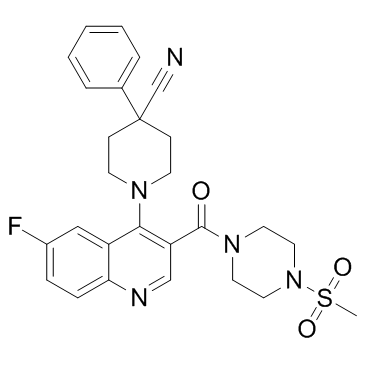
NCT-505 (NCT 505; NCT505) is a novel and potent aldehyde dehydrogenase 1A1 (ALDH1A1) inhibitor with potential anticancer activity. Overexpression of certain ALDHs (e.g., ALDH1A1) is an important biomarker in cancers and cancer stem cells (CSCs). NCT-505 inhibited the formation of 3D spheroid cultures of OV-90 cancer cells, and potentiated the cytotoxicity of paclitaxel in SKOV-3-TR, a paclitaxel resistant ovarian cancer cell line.
Physicochemical Properties
| Molecular Formula | C27H28FN5O3S |
| Molecular Weight | 521.606328010559 |
| Exact Mass | 521.189 |
| CAS # | 2231079-74-4 |
| Related CAS # | 2231079-74-4;2231079-75-5 (TFA); |
| PubChem CID | 134821685 |
| Appearance | White to off-white solid powder |
| LogP | 2.6 |
| Hydrogen Bond Donor Count | 0 |
| Hydrogen Bond Acceptor Count | 8 |
| Rotatable Bond Count | 4 |
| Heavy Atom Count | 37 |
| Complexity | 972 |
| Defined Atom Stereocenter Count | 0 |
| SMILES | S(C)(N1CCN(C(C2=CN=C3C=CC(=CC3=C2N2CCC(C#N)(C3C=CC=CC=3)CC2)F)=O)CC1)(=O)=O |
| InChi Key | XMNLWOQHMQRHDV-UHFFFAOYSA-N |
| InChi Code | InChI=1S/C27H28FN5O3S/c1-37(35,36)33-15-13-32(14-16-33)26(34)23-18-30-24-8-7-21(28)17-22(24)25(23)31-11-9-27(19-29,10-12-31)20-5-3-2-4-6-20/h2-8,17-18H,9-16H2,1H3 |
| Chemical Name | 1-(6-Fluoro-3-(4-(methylsulfonyl)piperazine-1-carbonyl)-quinolin-4-yl)-4-phenylpiperidine-4-carbonitrile |
| Synonyms | NCT 505 NCT-505NCT505 |
| HS Tariff Code | 2934.99.9001 |
| Storage |
Powder-20°C 3 years 4°C 2 years In solvent -80°C 6 months -20°C 1 month |
| Shipping Condition | Room temperature (This product is stable at ambient temperature for a few days during ordinary shipping and time spent in Customs) |
Biological Activity
| Targets |
|
|
| ln Vitro | Compound 86, also known as NCT-505, exhibits robust and selective activity against aldehyde dehydrogenase (ALDH1A1), with an IC50 of 7 nM. It also exhibits modest inhibition against hALDH1A2, hALDH1A3, hALDH2, and hALDH3A1 (IC50s, >57, 22.8, 20.1, >57 μM). NCT-505 does not appear to have any discernible inhibitory effects on type-4 hydroxysteroid dehydrogenase (HSD17β4) and 5-hydroxyprostaglandin dehydrogenase (HPGD) (IC50, >57 μM). Furthermore, NCT-505 exhibits strong cellular activities that lower OV-90 cell viability at an EC50 of 2.10-3.92 μM. Moreover, NCT-505 is cytotoxic to SKOV-3-TR cells, as demonstrated by IC50 values in the titration assay of 1, 3, 10, 20, and 30 μM, respectively[1]. | |
| Cell Assay |
|
|
| References |
[1]. Discovery of Orally Bioavailable, Quinoline-Based Aldehyde Dehydrogenase 1A1 (ALDH1A1) Inhibitors with Potent Cellular Activity. J Med Chem. 2018 Jun 14;61(11):4883-4903. |
Solubility Data
| Solubility (In Vitro) | DMSO : ~100 mg/mL (~191.71 mM) |
| Solubility (In Vivo) |
Solubility in Formulation 1: ≥ 2.5 mg/mL (4.79 mM) (saturation unknown) in 10% DMSO + 40% PEG300 + 5% Tween80 + 45% Saline (add these co-solvents sequentially from left to right, and one by one), clear solution. For example, if 1 mL of working solution is to be prepared, you can add 100 μL of 25.0 mg/mL clear DMSO stock solution to 400 μL PEG300 and mix evenly; then add 50 μL Tween-80 to the above solution and mix evenly; then add 450 μL normal saline to adjust the volume to 1 mL. Preparation of saline: Dissolve 0.9 g of sodium chloride in 100 mL ddH₂ O to obtain a clear solution. Solubility in Formulation 2: ≥ 2.5 mg/mL (4.79 mM) (saturation unknown) in 10% DMSO + 90% Corn Oil (add these co-solvents sequentially from left to right, and one by one), clear solution. For example, if 1 mL of working solution is to be prepared, you can add 100 μL of 25.0 mg/mL clear DMSO stock solution to 900 μL of corn oil and mix evenly. (Please use freshly prepared in vivo formulations for optimal results.) |
| Preparing Stock Solutions | 1 mg | 5 mg | 10 mg | |
| 1 mM | 1.9171 mL | 9.5857 mL | 19.1714 mL | |
| 5 mM | 0.3834 mL | 1.9171 mL | 3.8343 mL | |
| 10 mM | 0.1917 mL | 0.9586 mL | 1.9171 mL |