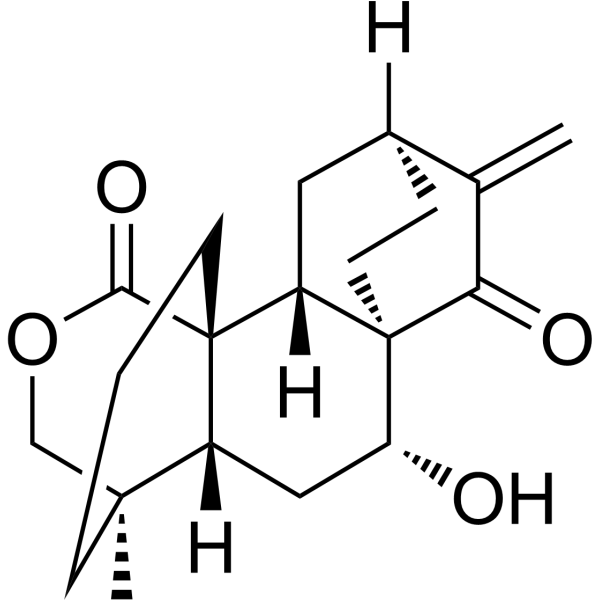
Physicochemical Properties
| Molecular Formula | C22H30O4 |
| Molecular Weight | 358.478 |
| Exact Mass | 330.183 |
| Elemental Analysis | C, 73.71; H, 8.44; O, 17.85 |
| CAS # | 1053172-87-4 |
| PubChem CID | 90671718 |
| Appearance | Typically exists as solid at room temperature |
| Density | 1.3±0.1 g/cm3 |
| Boiling Point | 549.2±50.0 °C at 760 mmHg |
| Flash Point | 198.5±23.6 °C |
| Vapour Pressure | 0.0±3.4 mmHg at 25°C |
| Index of Refraction | 1.588 |
| LogP | 1.41 |
| Hydrogen Bond Donor Count | 1 |
| Hydrogen Bond Acceptor Count | 4 |
| Rotatable Bond Count | 0 |
| Heavy Atom Count | 24 |
| Complexity | 669 |
| Defined Atom Stereocenter Count | 7 |
| SMILES | O[C@@H]1C[C@@H]2[C@]3(C)CCOCC([C@]2(CCC3)[C@@H]2C[C@H]3C(=C)C([C@]21CC3)=O)=O |
| InChi Key | XZYYWKVDXANEHM-WFIVFVBGSA-N |
| InChi Code | InChI=1S/C20H26O4/c1-11-12-4-7-20(16(11)22)14(8-12)19-6-3-5-18(2,10-24-17(19)23)13(19)9-15(20)21/h12-15,21H,1,3-10H2,2H3/t12-,13+,14-,15+,18-,19-,20+/m0/s1 |
| Chemical Name | (1S,2R,4S,7R,8R,10R,11R)-8-hydroxy-11-methyl-5-methylidene-13-oxapentacyclo[9.3.3.24,7.01,10.02,7]nonadecane-6,14-dione |
| Synonyms | NC 043; NC-043; 15-oxospiramilactone; 1053172-87-4; NC-043; (1S,2R,4S,7R,8R,10R,11R)-8-hydroxy-11-methyl-5-methylidene-13-oxapentacyclo[9.3.3.24,7.01,10.02,7]nonadecane-6,14-dione; (3S,4aR,4bS,8R,8aR,10R,10aR)-10-Hydroxy-8-methyl-12-methylenedodecahydro-3,10a-ethano-4b,8-(methanooxymethano)phenanthrene-11,15-dione; NC043; CHEMBL3238170; NC043 |
| HS Tariff Code | 2934.99.9001 |
| Storage |
Powder-20°C 3 years 4°C 2 years In solvent -80°C 6 months -20°C 1 month |
| Shipping Condition | Room temperature (This product is stable at ambient temperature for a few days during ordinary shipping and time spent in Customs) |
Biological Activity
| Targets | Wnt/β-catenin |
| ln Vitro | The Wnt/β-catenin signaling pathway is a highly conserved pathway in organism evolution and regulates many biological processes. Aberrant activation of the Wnt/β-catenin signaling pathway is closely related to tumorigenesis. In order to identify potent small molecules to treat the over-activated Wnt signaling-mediated cancer, such as colon cancer, we established a mammalian cell line-based reporter gene screening system. The screen revealed a diterpenoid derivative, 15-oxospiramilactone (NC043) that inhibits Wnt3a or LiCl-stimulated Top-flash reporter activity in HEK293T cells and growth of colon cancer cells, SW480 and Caco-2. Treatment of SW480 cells with NC043 led to decreases in the mRNA and/or protein expression of Wnt target genes Axin2, Cyclin D1 and Survivin , as well as decreases in the protein levels of Cdc25c and Cdc2. NC043 did not affect the cytosol-nuclear distribution and protein level of soluble β-catenin, but decreased β-catenin/TCF4 association in SW480 cells. Moreover, NC043 inhibited anchorage-independent growth and xenograft tumorigenesis of SW480 cells. Collectively these results demonstrate that NC043 is a novel small molecule that inhibits canonical Wnt signaling downstream of β-catenin stability and may be a potential compound for treating colorectal cancer.[1] |
| ln Vivo | In this study, researchers investigated its inhibitory effect on SW480 cell tumorigenesis in vivo using a mouse xenograft model. SW480 cells were injected subcutaneously into the flanks of nude mice to initiate tumor formation. Seven days after SW480 cell injection, tumor size reached around 80 mm3. Tumor-bearing mice were randomly separated into three groups and intraperitoneally injected with vehicle or two dosages of NC043 (45 and 90 μg/kg) daily for 17 days. NC043 treatment did not have any effect on body weight as no difference in weight was observed between control and NC043-treated animals (Figure 5C). However, treatment with 90 μg/kg of NC043 resulted in a significant reduction in both tumor volume (Figure 5D and 5E) and tumor weight (Figure 5F) compared to the vehicle-treated group. These data demonstrate that NC043 inhibits tumor growth in vivo. Collectively our in vitro and in vivo results indicate that NC043 has the potential to inhibit tumorigenesis.[1] |
| Cell Assay |
SW480 cell anchorage-independent growth assay[1] 2.5 ml of 0.6% agar in DMEM supplemented with 10% FBS was layered onto each well of 6-well tissue culture plates. SW480 cells (4 × 10³) were added to 0.3% agar-basal DMEM supplemented with 10% FBS and the mixture was added to the top of the 0.6% agar layer. To analyze the inhibitory effect of NC043 and its derivatives on SW480 cell anchorage-independent growth, both layers of agar were supplemented with small molecules. Cells were incubated at 37 °C in 5% CO2 for 18 days, and the number of colonies was scored by crystal violet staining. MTT cell viability assay[1] SW480 (1 × 10⁴), Caco-2 (5 × 10³) and CCD-841-CoN (5 × 10³) cells were seeded into each well of 96-well plates. After being cultured for 24 h in a CO2 incubator, the cells were treated with the dose rang from 0.47 to 10 μM of NC043 and its derivatives or DMSO control for 72 h. The medium was then changed and replaced with 200 μl of fresh growth medium with 10% FBS and 20 μl of MTT solution. Cells were incubated for another 4 hrs and the medium replaced by with 200 μl of DMSO. After 10 min of incubation at 37 °C the optical absorbance was measured using a micro-plate reader at a 570 nm. The results are presented as percentage of cell viability. Data of 0 hour was set to 1 in each panel. |
| Animal Protocol |
Xenograft studies[1] Fifteen male athymic nude mice (4 weeks old) were acclimated for 4 days. 3.3 × 10~6 SW480 cells in 80 μl of growth medium with 10% FBS were implanted into the flanks of each nude mouse. Tumor size was measured every three days in two dimensions with calipers and calculated using the formula (L × W2)/2, where L is length and W is width. After the tumor size reached around 80 mm3, which occurred 7 days after cell injection, the mice were randomly assigned into two NC043treatment groups with dose of 45 and 90 μg/kg and a vehicle control group. NC043 in 60 μl PBS (with 3% DMSO) was injected intraperitoneally into each mouse daily for 17 days. Control mice were intraperitoneally injected with 60 μl PBS (with 3% DMSO) as a vehicle control daily for 17 days. Tumors were removed from mice 24 days after SW480 cell injection and flash-frozen in liquid Nitrogen. |
| References |
[1]. A diterpenoid derivative 15-oxospiramilactone inhibits Wnt/β-catenin signaling and colon cancer cell tumorigenesis. Cell Res. 2011 May;21(5):730-40. |
| Additional Infomation |
The differences in the observed effects on Top-flash activity, β-catenin/TCF4 association and SW480 cell growth between NC043 and its derivatives provide information regarding the relationship between NC043's biological functions and its structure. S1 and S2, which lack the 15-acetonyl group, did not inhibit Top-flash activity, β-catenin/TCF4 association and carcinoma cell growth (Figures 1D, 3B and 4A), indicating that the 15-acetonyl group is responsible for the inhibitory effects of NC043. SR-37, a derivative which loses the spatial configuration formed by the lactone bond, did not specifically inhibit Wnt signaling activity as measured by Top/Fop ratio and β-catenin/TCF4 association but did slightly inhibit cancer cell growth (Figures 1D, 3B and 4A), suggesting that the spatial configuration formed by the lactone bond may be essential for NC043 to bind its target molecule, resulting in specific inhibition of Wnt signaling. Collectively, these results demonstrate that NC043 is a potent and selective Wnt/β-catenin signaling inhibitor.[1] NC043 comes from spiramines through chemical reactions in vitro. Spiramines, separated from the extract of the roots of a Chinese herbal medicine Spiraea japonica (Rosaceae) , inhibit platelet aggregation, increase antioxidant enzymatic activity and inhibit nitric oxide production 39, 40. The anti-tumor activity shown in this report ascribes new anti-cancer properties to diterpene alkaloids including NC043.[1] |
Solubility Data
| Solubility (In Vitro) | May dissolve in DMSO (in most cases), if not, try other solvents such as H2O, Ethanol, or DMF with a minute amount of products to avoid loss of samples |
| Solubility (In Vivo) |
Note: Listed below are some common formulations that may be used to formulate products with low water solubility (e.g. < 1 mg/mL), you may test these formulations using a minute amount of products to avoid loss of samples. Injection Formulations (e.g. IP/IV/IM/SC) Injection Formulation 1: DMSO : Tween 80: Saline = 10 : 5 : 85 (i.e. 100 μL DMSO stock solution → 50 μL Tween 80 → 850 μL Saline) *Preparation of saline: Dissolve 0.9 g of sodium chloride in 100 mL ddH ₂ O to obtain a clear solution. Injection Formulation 2: DMSO : PEG300 :Tween 80 : Saline = 10 : 40 : 5 : 45 (i.e. 100 μL DMSO → 400 μLPEG300 → 50 μL Tween 80 → 450 μL Saline) Injection Formulation 3: DMSO : Corn oil = 10 : 90 (i.e. 100 μL DMSO → 900 μL Corn oil) Example: Take the Injection Formulation 3 (DMSO : Corn oil = 10 : 90) as an example, if 1 mL of 2.5 mg/mL working solution is to be prepared, you can take 100 μL 25 mg/mL DMSO stock solution and add to 900 μL corn oil, mix well to obtain a clear or suspension solution (2.5 mg/mL, ready for use in animals). Injection Formulation 4: DMSO : 20% SBE-β-CD in saline = 10 : 90 [i.e. 100 μL DMSO → 900 μL (20% SBE-β-CD in saline)] *Preparation of 20% SBE-β-CD in Saline (4°C,1 week): Dissolve 2 g SBE-β-CD in 10 mL saline to obtain a clear solution. Injection Formulation 5: 2-Hydroxypropyl-β-cyclodextrin : Saline = 50 : 50 (i.e. 500 μL 2-Hydroxypropyl-β-cyclodextrin → 500 μL Saline) Injection Formulation 6: DMSO : PEG300 : castor oil : Saline = 5 : 10 : 20 : 65 (i.e. 50 μL DMSO → 100 μLPEG300 → 200 μL castor oil → 650 μL Saline) Injection Formulation 7: Ethanol : Cremophor : Saline = 10: 10 : 80 (i.e. 100 μL Ethanol → 100 μL Cremophor → 800 μL Saline) Injection Formulation 8: Dissolve in Cremophor/Ethanol (50 : 50), then diluted by Saline Injection Formulation 9: EtOH : Corn oil = 10 : 90 (i.e. 100 μL EtOH → 900 μL Corn oil) Injection Formulation 10: EtOH : PEG300:Tween 80 : Saline = 10 : 40 : 5 : 45 (i.e. 100 μL EtOH → 400 μLPEG300 → 50 μL Tween 80 → 450 μL Saline) Oral Formulations Oral Formulation 1: Suspend in 0.5% CMC Na (carboxymethylcellulose sodium) Oral Formulation 2: Suspend in 0.5% Carboxymethyl cellulose Example: Take the Oral Formulation 1 (Suspend in 0.5% CMC Na) as an example, if 100 mL of 2.5 mg/mL working solution is to be prepared, you can first prepare 0.5% CMC Na solution by measuring 0.5 g CMC Na and dissolve it in 100 mL ddH2O to obtain a clear solution; then add 250 mg of the product to 100 mL 0.5% CMC Na solution, to make the suspension solution (2.5 mg/mL, ready for use in animals). Oral Formulation 3: Dissolved in PEG400 Oral Formulation 4: Suspend in 0.2% Carboxymethyl cellulose Oral Formulation 5: Dissolve in 0.25% Tween 80 and 0.5% Carboxymethyl cellulose Oral Formulation 6: Mixing with food powders Note: Please be aware that the above formulations are for reference only. InvivoChem strongly recommends customers to read literature methods/protocols carefully before determining which formulation you should use for in vivo studies, as different compounds have different solubility properties and have to be formulated differently. (Please use freshly prepared in vivo formulations for optimal results.) |
| Preparing Stock Solutions | 1 mg | 5 mg | 10 mg | |
| 1 mM | 2.7896 mL | 13.9478 mL | 27.8956 mL | |
| 5 mM | 0.5579 mL | 2.7896 mL | 5.5791 mL | |
| 10 mM | 0.2790 mL | 1.3948 mL | 2.7896 mL |