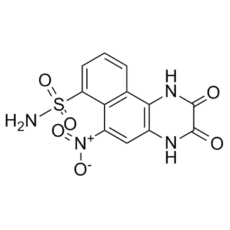
NBQX (also known as FG9202) is a novel and potent antagonist of aminomethylphosphonic acid receptor (AMPAR) with IC50 of 0.7 ± 0.1 μM. It has the potential to treat seizure. Brief NBQX administration during the 48 h postseizure in P10 Long-Evans rats suppresses transient mTOR pathway activation and attenuates spontaneous recurrent seizures, social preference deficits, and mossy fiber sprouting observed in vehicle-treated adult rats after early life seizures. These results suggest that acute AMPAR antagonist treatment during the latent period immediately following neonatal HS can modify seizure-induced activation of mTOR, reduce the frequency of later-life seizures, and protect against CA3 mossy fiber sprouting and autistic-like social deficits.
Physicochemical Properties
| Molecular Formula | C12H8N4O6S | |
| Molecular Weight | 336.28 | |
| Exact Mass | 336.016 | |
| Elemental Analysis | C, 42.86; H, 2.40; N, 16.66; O, 28.55; S, 9.53 | |
| CAS # | 118876-58-7 | |
| Related CAS # | NBQX disodium;479347-86-9 | |
| PubChem CID | 3272524 | |
| Appearance | Light yellow to yellow solid powder | |
| Density | 2.005g/cm3 | |
| Boiling Point | 613.386ºC at 760 mmHg | |
| Melting Point | 361ºC | |
| Flash Point | 324.764ºC | |
| Vapour Pressure | 0mmHg at 25°C | |
| Index of Refraction | 1.864 | |
| LogP | 2.229 | |
| Hydrogen Bond Donor Count | 3 | |
| Hydrogen Bond Acceptor Count | 7 | |
| Rotatable Bond Count | 1 | |
| Heavy Atom Count | 23 | |
| Complexity | 653 | |
| Defined Atom Stereocenter Count | 0 | |
| InChi Key | UQNAFPHGVPVTAL-UHFFFAOYSA-N | |
| InChi Code | InChI=1S/C12H8N4O6S/c13-23(21,22)8-3-1-2-5-9(8)7(16(19)20)4-6-10(5)15-12(18)11(17)14-6/h1-4H,(H,14,17)(H,15,18)(H2,13,21,22) | |
| Chemical Name |
|
|
| Synonyms |
|
|
| HS Tariff Code | 2934.99.9001 | |
| Storage |
Powder-20°C 3 years 4°C 2 years In solvent -80°C 6 months -20°C 1 month |
|
| Shipping Condition | Room temperature (This product is stable at ambient temperature for a few days during ordinary shipping and time spent in Customs) |
Biological Activity
| Targets |
AMPA receptor
AMPA receptors (IC50=0.7 ± 0.1 µM); Kainic acid (KA) receptors (IC50=0.7 ± 0.03 µM) [1] AMPA receptors [2] |
| ln Vitro |
NBQX (FG9202) exhibits strong affinity for AMPA and kainate binding sites and little or no affinity for the glutamate recognition site on the NMDA receptor complex [1]. The hippocampus is an important brain region that is involved in neurological disorders such as Alzheimer disease, schizophrenia, and epilepsy. Ionotropic glutamate receptors-namely,N-methyl-D-aspartate (NMDA) receptors (NMDARs), α-amino-3-hydroxy-5-methyl-4-isoxazolepropionate (AMPA) receptors (AMPARs), and kainic acid (KA) receptors (KARs)-are well known to be involved in these diseases by mediating long-term potentiation, excitotoxicity, or both. To predict the therapeutic efficacy and neuronal toxicity of drug candidates acting on these receptors, physiologically relevant systems for assaying brain region-specific human neural cells are necessary. Here, we characterized the functional differentiation of human fetal hippocampus-derived neural stem/progenitor cells-namely, HIP-009 cells. Calcium rise assay demonstrated that, after a 4-week differentiation, the cells responded to NMDA (EC50= 7.5 ± 0.4 µM; n= 4), AMPA (EC50= 2.5 ± 0.1 µM; n= 3), or KA (EC50= 33.5 ± 1.1 µM; n= 3) in a concentration-dependent manner. An AMPA-evoked calcium rise was observed in the absence of the desensitization inhibitor cyclothiazide. In addition, the calcium rise induced by these agonists was inhibited by antagonists for each receptor-namely, MK-801 for NMDA stimulation (IC50= 0.6 ± 0.1 µM; n= 4) and NBQX for AMPA and KA stimulation (IC50= 0.7 ± 0.1 and 0.7 ± 0.03 µM, respectively; n= 3). The gene expression profile of differentiated HIP-009 cells was distinct from that of undifferentiated cells and closely resembled that of the human adult hippocampus. Our results show that HIP-009 cells are a unique tool for obtaining human hippocampal neural cells and are applicable to systems for assay of ionotropic glutamate receptors as a physiologically relevant in vitro model.[1] Inhibited AMPA and KA-induced calcium rise in differentiated HIP-009 cells: Human fetal hippocampus-derived neural stem/progenitor cells (HIP-009) were differentiated for 4 weeks. The cells were pre-treated with different concentrations of NBQX, then stimulated with AMPA or KA. Calcium rise assay showed that NBQX concentration-dependently inhibited the calcium elevation induced by both agonists, with IC50 values of 0.7 ± 0.1 µM (AMPA) and 0.7 ± 0.03 µM (KA) (n=3 for each) [1] |
| ln Vivo |
For three days, NBQX (FG9202; 20 mg/kg, i.p.) lessens PTZ-induced seizures[2]. In an intravenous bolus dose of 30 mg/kg at the time of MCA blockage and again an hour later, NBQX proved neuroprotective in a rat focal ischemia model [1]. Epilepsy is a serious brain disorder with diverse seizure types and epileptic syndromes. AMPA receptor antagonist 2,3-dihydroxy-6-nitro-7-sulfamoyl-benzoquinoxaline-2,3-dione (NBQX) attenuates spontaneous recurrent seizures in rats. However, the anti-epileptic effect of NBQX in chronic epilepsy model is poorly understood. Perineuronal nets (PNNs), specialized extracellular matrix structures, surround parvalbumin-positive inhibitory interneurons, and play a critical role in neuronal cell development and synaptic plasticity. Here, we focused on the potential involvement of PNNs in the treatment of epilepsy by NBQX. Rats were intraperitoneally (i.p.) injected with pentylenetetrazole (PTZ, 50 mg/kg) for 28 consecutive days to establish chronic epilepsy models. Subsequently, NBQX (20 mg/kg, i.p.) was injected for 3 days for the observation of behavioral measurements of epilepsy. The Wisteria floribundi agglutinin (WFA)-labeled PNNs were measured by immunohistochemical staining to evaluate the PNNs. The levels of three components of PNNs such as tenascin-R, aggrecan and neurocan were assayed by Western blot assay. The results showed that there are reduction of PNNs and decrease of tenascin-R, aggrecan and neurocan in the medial prefrontal cortex (mPFC) in the rats injected with PTZ. However, NBQX treatment normalized PNNs, tenascin-R, aggrecan and neurocan levels. NBQX was sufficient to decrease seizures through increasing the latency to seizures, decrease the duration of seizure onset, and reduce the scores for the severity of seizures. Furthermore, the degradation of mPFC PNNs by chondroitinase ABC (ChABC) exacerbated seizures in PTZ-treated rats. Finally, the anti-epileptic effect of NBQX was reversed by pretreatment with ChABC into mPFC. These findings revealed that PNNs degradation in mPFC is involved in the pathophysiology of epilepsy and enhancement of PNNs may be effective for the treatment of epilepsy.[2] Reduced seizures in PTZ-induced chronic epilepsy rats: Wistar rats were intraperitoneally injected with pentylenetetrazole (PTZ, 50 mg/kg) for 28 consecutive days to establish chronic epilepsy models. Subsequently, NBQX (20 mg/kg, i.p.) was administered for 3 days. Behavioral assessments showed that NBQX significantly increased the latency to seizures, decreased the duration of seizure onset, and reduced the severity scores of seizures (n=6 per group, p<0.01 compared with PTZ group) [2] - Normalized perineuronal nets (PNNs) and their components in the medial prefrontal cortex (mPFC): Immunohistochemical staining with Wisteria floribundi agglutinin (WFA) showed that PTZ treatment reduced the number of WFA-labeled PNNs in mPFC. NBQX treatment restored the number of PNNs to normal levels. Western blot assay demonstrated that PTZ-induced decreases in tenascin-R, aggrecan, and neurocan (components of PNNs) in mPFC were reversed by NBQX administration (n=6 per group, p<0.01 compared with PTZ group) [2] - Anti-epileptic effect reversed by ChABC pretreatment: Microinjection of chondroitinase ABC (ChABC) into mPFC degraded PNNs and exacerbated seizures in PTZ-treated rats. Pretreatment with ChABC reversed the anti-epileptic effect of NBQX, indicating that the therapeutic effect of NBQX is dependent on PNNs [2] |
| Enzyme Assay |
Fluorescence-Based Calcium Rise Assay[1] For the assays of differentiated HIP-009 cells, HIP-009 cells cultured in Neural Transition Medium for 3 days were plated on black-walled, clear-bottomed, PDL-coated 96-well plates at 3.7 × 10⁴ cells/well in Neural Differentiation Medium and then allowed to differentiate into neural cells for 4 weeks. Undifferentiated HIP-009 cells were seeded on the same types of 96-well plates (which also had been coated manually with laminin) at 6.4 × 10³ cells/well in StemCell Growth Medium and were cultured until they reached 80% to 100% confluence. On the day of the assays, the media were removed and the cells were loaded with calcium 4 dye (for glutamate concentration–dependent assays) or calcium 5 dye (for the other assays) and probenecid (2.5 mM) reconstituted in an assay buffer for 1 h at 37 °C. The compositions of the assay buffers were as follows: 20 mM HEPES and Hank’s balanced salt solution with calcium and magnesium without phenol red (pH adjusted to 7.4 with NaOH) for glutamate concentration–dependent assays; 137 mM NaCl, 4 mM KCl, 1.8 mM CaCl2, 10 mM HEPES, and 10 mM D-glucose (pH adjusted to 7.4 with NaOH) for NMDARs and co-treatment assays of MK-801 and NBQX; and 140 mM NaCl, 5 mM KCl, 3 mM CaCl2, 2 mM MgCl2, 10 mM HEPES, 24 mM D-glucose, and 10 µM MK-801 (pH adjusted to 7.4 with NaOH) for AMPARs and KARs. Compounds were diluted in the assay buffer and transferred to compound plates. After the 1-h incubation, except in the case of the glutamate concentration–dependent assays, the cells were washed twice and replaced with the assay buffer. In the case of the glutamate concentration–dependent assays, the washing step was skipped. Calcium rise was measured with a Functional Drug Screening System 6000 that simultaneously monitored changes in fluorescence in each well of the plate. A baseline was recorded for 12 s before the addition of the compound solution, and recordings were taken at 0.3-s intervals for 1.75 min in total (excitation wavelength, 480 nm; emission, 540 nm). |
| Cell Assay |
Electrophysiology[1] For electrophysiological recordings, HIP-009 cells were seeded on glass coverslips coated with laminin and PDL. After 4 weeks of differentiation, the cells were characterized by using whole-cell patch-clamp recording techniques. Signals were low pass filtered at 3 kHz and sampled at 20 kHz by using a Digidata 1322A interface. Data recording and analysis were performed with pCLAMP 10.2 software. The extracellular solution contained 140 mM NaCl, 5 mM KCl, 1 mM CaCl2, 1 mM MgCl2, 10 mM HEPES, and 24 mM D-glucose (pH adjusted to 7.4 with NaOH). The intracellular solution contained 130 mM KCl, 1 mM EGTA, 1 mM MgCl2, 5 mM HEPES, and 5 mM Na2-ATP (pH adjusted to 7.2 with KOH). Patch micropipettes were made from borosilicate glass capillaries by using a PB-7 pipette puller. Current-clamp and voltage-clamp recordings were performed with an Axopatch 200B amplifier. For the current-clamp recordings, current pulses were injected through the patch electrode into differentiated HIP-009 cells with a 10-pA step increment from −10 pA to +100 pA. For the voltage-clamp recordings, cells were subjected to 20-mV step depolarizations from −80 mV to +80 mV at a −100-mV holding potential. Calcium rise assay for ionotropic glutamate receptor inhibition: Human HIP-009 neural stem/progenitor cells were cultured and differentiated for 4 weeks. The differentiated cells were seeded in appropriate culture plates and loaded with a calcium-sensitive fluorescent dye. Different concentrations of NBQX were added to the cells, followed by the addition of AMPA (2.5 ± 0.1 µM, EC50) or KA (33.5 ± 1.1 µM, EC50). The fluorescence intensity was measured to assess calcium elevation, and the IC50 values of NBQX for inhibiting AMPA and KA-induced calcium rise were calculated (n=3 for each agonist) [1] |
| Animal Protocol |
Animal/Disease Models: Male Wistar rats that weighed 220-240 g with pentylenetetrazole (PTZ)[2] Doses: 20 mg/kg Route of Administration: IP; for 3 days Experimental Results: Effectively reversed the behavioral abnormality of epileptic seizures of chronic PTZ administration (50mg/ kg; ip; for 28 days) in rats. NBQX was freshly dissolved in saline as sodium salt. ChABC were dissolved in 0.1 m PBS (vehicle) for microinjection into the medial prefrontal cortex and prepared in stock solutions of 0.02 U/μl.To observe anti-epileptic effects of NBQX in PTZ induced epilepsy, we divided rats into four groups: rats in saline + saline group were treated with saline only; rats in PTZ + saline group were treated with 50 mg/kg of PTZ (i.p.) and saline for 28 days; rats in saline + NBQX group were treated with saline for 28 days, and 20 mg/kg of NBQX (i.p.) for next 3 days; rats in PTZ + NBQX group were treated with 50 mg/kg of PTZ (i.p.) for 28 days and were treated with 20 mg/kg of NBQX (i.p.) for next 3 days. Behavioral tests and neurochemical analysis were performed on the following 2 days (Fig 2A). The doses for PTZ and NBQX were selected regarding to previous studies.[2] To determine whether PNNs degradation by ChABC can reverse the anti-epileptic effect of NBQX, we injected rats with PTZ for 28 days and separated them into four groups: rats in vehicle group were treated with vehicle without NBQX, and were microinjected with penicillinase into mPFC on d 24; rats in vehicle + ChABC group were treated with vehicle plus microinjection of ChABC into mPFC on d24; rats in NBQX + penicillinase group were treated with penicillinase on d24 and were treated with NBQX injection on d 29 to d31; rats in NBQX + ChABC group were treated with microinjection of ChABC into mPFC on d24 plus NBQX (20 mg/kg, i.p.) on d 29 to d31. Behavioral tests were performed on day 32.[2] PTZ-induced chronic epilepsy model establishment and NBQX treatment: Male Wistar rats were randomly divided into control and model groups. The model group received daily intraperitoneal injections of PTZ (50 mg/kg) for 28 consecutive days to induce chronic epilepsy. After model establishment, the rats were further divided into PTZ group and NBQX treatment group. The NBQX group was given intraperitoneal injections of NBQX (20 mg/kg) once daily for 3 days, while the control and PTZ groups received equal volumes of saline. Seizure-related behaviors were observed and recorded during the treatment period [2] - ChABC pretreatment experiment: Rats were anesthetized and placed in a stereotaxic frame. Chondroitinase ABC (ChABC) was microinjected into the mPFC. After ChABC pretreatment, the rats were subjected to PTZ-induced epilepsy modeling followed by NBQX treatment (20 mg/kg, i.p., 3 days). Seizure behaviors were evaluated, and mPFC tissues were collected for WFA staining and Western blot analysis [2] |
| References |
[1]. Characterization of Human Hippocampal Neural Stem/Progenitor Cells and Their Application to Physiologically Relevant Assays for Multiple Ionotropic Glutamate Receptors. J Biomol Screen. 2014 Sep; 19(8):1174-84. [2]. AMPA Receptor Antagonist NBQX Decreased Seizures by Normalization of Perineuronal Nets. PLoS One. 2016 Nov 23;11(11):e0166672. |
| Additional Infomation |
2,3-Dioxo-6-nitro-7-sulfamoylbenzo(f)quinoxaline is a member of naphthalenes and a sulfonic acid derivative. A recent investigation suggested that chondroitin sulfate-degrading enzyme ChABC enhanced the lateral mobility of the AMPA receptor, and consequently promote short-term synaptic plasticity. ChABC may degrade various PNNs components, and consequently destroy the PNNs structure. In the current study, pretreatment with ChABC blocked the anti-epileptic effects of NBQX in PTZ-induced seizures, suggesting that normalization of PNNs in mPFC might underlie the therapeutic action of AMPA receptor antagonist NBQX. Further study is needed to evaluate the effect of upregulation of PNNs in the mPFC on the epilepsy induced by PTZ and on the treatment benefits of NBQX. The finding that the fast movements of AMPA receptors are involved in the modulation of synaptic transmission suggests that AMPAR mobility regulates the availability of naive receptors for synapses. Previous studies showed that removal of the PNNs leads to an increase of AMPAR exchange between extrasynaptic and synaptic sites, and may modulate synaptic properties. Our results revealed that chronic epilepsy induced a reduction of components of PNNs, tenascin-R, aggrecan and neurocan in mPFC, while AMPA receptor antagonist NBQX increased the levels of these proteins, suggesting that PNNs might be essential for the functionality of synaptic transmission. Thus, future studies targeting at PNNs can shed light on development of novel antiepileptic drugs with good efficacy and acceptable tolerability for therapy in epilepsy.[2] In addition, we investigated the contribution of each receptor to the calcium rise upon glutamate stimulation by co-treatment with MK-801 and NBQX. We estimated that ~45% of the total glutamate-evoked calcium rise was through NMDARs, and ~34% of the rise was through AMPARs and KARs. The remaining activity level of about 20% implied that there was a contribution from other glutamate receptors—that is, metabotropic glutamate receptors—although there would also be a contribution from residual KARs that were not inhibited completely by 30 µM NBQX.[1] NBQX is a selective antagonist of ionotropic glutamate receptors, specifically targeting AMPA receptors and KA receptors [1][2] NBQX is a valuable tool for predicting the therapeutic efficacy and neuronal toxicity of drug candidates acting on ionotropic glutamate receptors, using physiologically relevant human hippocampal neural cell models [1] The anti-epileptic mechanism of NBQX involves the normalization of PNNs in the mPFC, which are critical for neuronal development and synaptic plasticity. Degradation of PNNs abrogates the therapeutic effect of NBQX [2] NBQX attenuates spontaneous recurrent seizures and improves seizure-related behavioral outcomes in chronic epilepsy models, highlighting its potential as a therapeutic agent for epilepsy [2] |
Solubility Data
| Solubility (In Vitro) |
|
|||
| Solubility (In Vivo) |
Solubility in Formulation 1: ≥ 2.5 mg/mL (7.43 mM) (saturation unknown) in 10% DMSO + 40% PEG300 + 5% Tween80 + 45% Saline (add these co-solvents sequentially from left to right, and one by one), clear solution. For example, if 1 mL of working solution is to be prepared, you can add 100 μL of 25.0 mg/mL clear DMSO stock solution to 400 μL PEG300 and mix evenly; then add 50 μL Tween-80 to the above solution and mix evenly; then add 450 μL normal saline to adjust the volume to 1 mL. Preparation of saline: Dissolve 0.9 g of sodium chloride in 100 mL ddH₂ O to obtain a clear solution. Solubility in Formulation 2: ≥ 2.5 mg/mL (7.43 mM) (saturation unknown) in 10% DMSO + 90% (20% SBE-β-CD in Saline) (add these co-solvents sequentially from left to right, and one by one), clear solution. For example, if 1 mL of working solution is to be prepared, you can add 100 μL of 25.0 mg/mL clear DMSO stock solution to 900 μL of 20% SBE-β-CD physiological saline solution and mix evenly. Preparation of 20% SBE-β-CD in Saline (4°C,1 week): Dissolve 2 g SBE-β-CD in 10 mL saline to obtain a clear solution. Solubility in Formulation 3: ≥ 2.5 mg/mL (7.43 mM) (saturation unknown) in 10% DMSO + 90% Corn Oil (add these co-solvents sequentially from left to right, and one by one), clear solution. For example, if 1 mL of working solution is to be prepared, you can add 100 μL of 25.0 mg/mL clear DMSO stock solution to 900 μL of corn oil and mix evenly. (Please use freshly prepared in vivo formulations for optimal results.) |
| Preparing Stock Solutions | 1 mg | 5 mg | 10 mg | |
| 1 mM | 2.9737 mL | 14.8686 mL | 29.7371 mL | |
| 5 mM | 0.5947 mL | 2.9737 mL | 5.9474 mL | |
| 10 mM | 0.2974 mL | 1.4869 mL | 2.9737 mL |