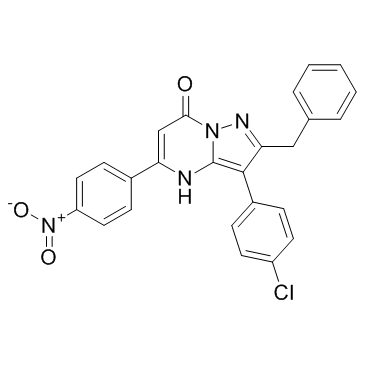
Grassofermata (NAV-2729) is a selective ARF6 inhibitor (IC50 = 1.0 μM), or a dual inhibitor of Arf1/Arf6 activation, with anticancer effects. In a mouse model, uveal melanoma cell proliferation and tumorigenesis are reduced when ARF6 is blocked with a small-molecule inhibitor. This suggests a potential therapeutic approach for Gα-mediated diseases and validates the functional significance of this pathway.
Physicochemical Properties
| Molecular Formula | C25H17CLN4O3 |
| Molecular Weight | 456.880484342575 |
| Exact Mass | 456.098 |
| Elemental Analysis | C, 65.72; H, 3.75; Cl, 7.76; N, 12.26; O, 10.51 |
| CAS # | 419547-11-8 |
| Related CAS # | 419547-11-8; |
| PubChem CID | 2257249 |
| Appearance | Light yellow to yellow solid powder |
| LogP | 5.3 |
| Hydrogen Bond Donor Count | 1 |
| Hydrogen Bond Acceptor Count | 5 |
| Rotatable Bond Count | 4 |
| Heavy Atom Count | 33 |
| Complexity | 871 |
| Defined Atom Stereocenter Count | 0 |
| InChi Key | WHYGBVWGARJOCS-UHFFFAOYSA-N |
| InChi Code | InChI=1S/C25H17ClN4O3/c26-19-10-6-18(7-11-19)24-22(14-16-4-2-1-3-5-16)28-29-23(31)15-21(27-25(24)29)17-8-12-20(13-9-17)30(32)33/h1-13,15,28H,14H2 |
| Chemical Name | 2-benzyl-3-(4-chlorophenyl)-5-(4-nitrophenyl)-1H-pyrazolo[1,5-a]pyrimidin-7-one |
| Synonyms | Grassofermata; NAV 2729; NAV-2729; NAV2729 |
| HS Tariff Code | 2934.99.9001 |
| Storage |
Powder-20°C 3 years 4°C 2 years In solvent -80°C 6 months -20°C 1 month |
| Shipping Condition | Room temperature (This product is stable at ambient temperature for a few days during ordinary shipping and time spent in Customs) |
Biological Activity
| Targets | Arf6; Arf |
| ln Vitro | NAV-2729 binds to Arf6 directly. In contrast to Arf6's guanine nucleotide-binding pocket, NAV-2729 is thought to bind to Arf6 at the Arf6 GEF-binding area, according to a structural homology model of the Arf6/Arf6-GEF complex. On Arf6, NAV-2729 prevents guanine nucleotide exchange mediated by GEP100 and ARNO. The application of NAV-2729 to uveal melanoma cells inhibits the cells' ability to grow without anchorage[1]. NAV-2729 is a dual inhibitor of Arf1/Arf6, with a greater affinity for Arf1 than for Arf6. NAV-2729 inhibits both the cytohesin and BRAG-induced and spontaneous activation of Arf6. NAV-2729 is an inhibitor of Arf6's spontaneous activation and of Arf6's GEFs, BRAG2 and ARNO, activating it in solution. At a concentration of 25 μM, which is reported to produce nearly complete inhibition of both spontaneous and GEF-stimulated Arf6 activation in vitro, the inhibitory profile of NAV-2729 is examined. NAV-2729 impedes Δ13Arf6's spontaneous nucleotide exchange by about 15% under the assay conditions. A quarter of the activation of Δ13Arf6 by BRAG2Sec7PH is inhibited by NAV-2729. There is no detectable spontaneous nucleotide exchange in Δ17Arf1. NAV-2729 inhibits Δ17Arf1 activation by BRAG2Sec7PH with a significantly higher efficiency than Arf6 (50%). Nucleotide exchange rates are lowered by 50% in a dose-response experiment when using 10 μM NAV-2729 for Δ17Arf1, but not by 50% when using 25 μM NAV-2729 for Δ13Arf6. |
| ln Vivo | In an orthotopic xenograft mouse model of uveal melanoma, systemic treatment of the mice with NAV-2729 inhibits tumorigenesis and tumor growth[1]. |
| References |
[1]. Machineries regulating the activity of the small GTPase Arf6 in cancer cells are potential targets for developing innovative anti-cancer drugs. Adv Biol Regul. 2017 Jan;63:115-121. [2]. Family-wide Analysis of the Inhibition of Arf Guanine Nucleotide Exchange Factors with Small Molecules: Evidence of Unique Inhibitory Profiles. Biochemistry. 2017 Sep 26;56(38):5125-5133. |
| Additional Infomation | NAV2729 is a pyrazolopyrimidine that is 4H-pyrazolo[1,5-a]pyrimidin-7-one which is substituted at positions 2, 3, and 5 by benzyl, p-chlorophenyl, and p-nitrophenyl groups, respectively. It is an inhibitor of ADP-ribosylation factor 6 (ARF6), a member of the ADP ribosylation factor family of GTP-binding proteins. It has a role as an inhibitor. It is a pyrazolopyrimidine, a C-nitro compound and a member of monochlorobenzenes. |
Solubility Data
| Solubility (In Vitro) | DMSO: ~50 mg/mL (~109.4 mM) |
| Solubility (In Vivo) |
Solubility in Formulation 1: 2.08 mg/mL (4.55 mM) in 10% DMSO + 90% (20% SBE-β-CD in Saline) (add these co-solvents sequentially from left to right, and one by one), suspension solution; with sonication. For example, if 1 mL of working solution is to be prepared, you can add 100 μL of 20.8 mg/mL clear DMSO stock solution to 900 μL of 20% SBE-β-CD physiological saline solution and mix evenly. Preparation of 20% SBE-β-CD in Saline (4°C,1 week): Dissolve 2 g SBE-β-CD in 10 mL saline to obtain a clear solution. (Please use freshly prepared in vivo formulations for optimal results.) |
| Preparing Stock Solutions | 1 mg | 5 mg | 10 mg | |
| 1 mM | 2.1888 mL | 10.9438 mL | 21.8876 mL | |
| 5 mM | 0.4378 mL | 2.1888 mL | 4.3775 mL | |
| 10 mM | 0.2189 mL | 1.0944 mL | 2.1888 mL |