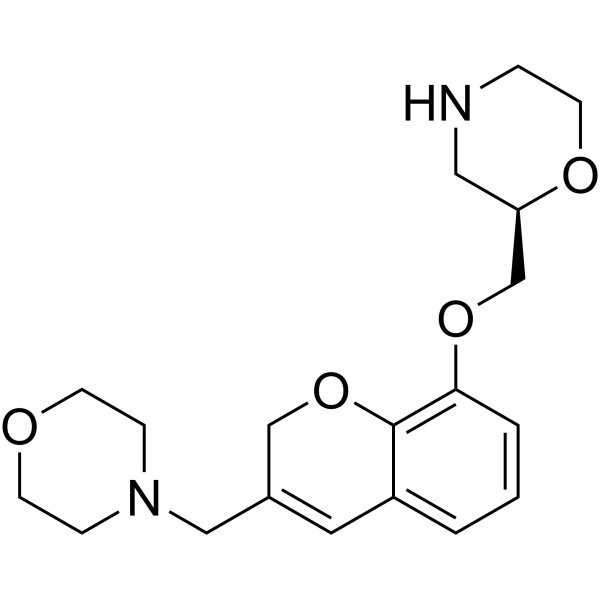
Physicochemical Properties
| Molecular Formula | C19H26N2O4 |
| Molecular Weight | 346.42 |
| CAS # | 205242-61-1 |
| Appearance | Typically exists as solids at room temperature |
| HS Tariff Code | 2934.99.9001 |
| Storage |
Powder-20°C 3 years 4°C 2 years In solvent -80°C 6 months -20°C 1 month |
| Shipping Condition | Room temperature (This product is stable at ambient temperature for a few days during ordinary shipping and time spent in Customs) |
Biological Activity
| ln Vitro | NAS181 has very low affinities (Ki>3000 nM) for all other receptors examined, including 5-HT2A, 5-HT2C, 5-HT6, and 5-HT7, α1-, α2-, and β-adrenoceptors, and dopamine D1 and D2[1]. NAS181 (10-1000 nM) dose-dependently potentiates the K+-stimulated [3H]-5-HT release in preloaded rat occipital cortical slices[1]. |
| ln Vivo | NAS181 (1-10 mg/kg; sc) dose-dependently increases acetylcholine (ACh) release in the frontal, ventral hippocampus cortex and VHipp[1]. NAS181 (20 mg/kg; sc) enhances the 5-HT turnover in four rat brain regions (hypothalamus, hippocampus, striatum, and frontal cortex) with about 40%[1]. NAS181 (3 mg/kg; sc) produces a significant increase in the number of wet dog shakes in rats[1]. |
| Animal Protocol |
Animal/Disease Models: Adult male Sprague-Dawley rats (250-300 g) Doses: 1, 5, 10 mg/kg Route of Administration: S.c. in the scruff of the neck Experimental Results: Increased the ACh release in the frontal cortex, reaching the maximal value of 500% of the control group within 80 min after the injection of the highest dose. Increased the ACh releases in VHipp with a maximum of 230% of the control values at 80 min after the injection of the highest dose. |
| References |
[1]. (R)-(+)-2-[[[3-(Morpholinomethyl)-2H-chromen-8-yl]oxy]methyl] morpholine methanesulfonate: a new selective rat 5-hydroxytryptamine1B receptor antagonist. J Med Chem. 1998 May 21;41(11):1934-42. [2]. Hu XJ, et, al. Effects of the 5-HT1B receptor antagonist NAS-181 on extracellular levels of acetylcholine, glutamate and GABA in the frontal cortex and ventral hippocampus of awake rats: a microdialysis study. Eur Neuropsychopharmacol. 2007 Sep;17(9):580-6. |
Solubility Data
| Solubility (In Vitro) | May dissolve in DMSO (in most cases), if not, try other solvents such as H2O, Ethanol, or DMF with a minute amount of products to avoid loss of samples |
| Solubility (In Vivo) |
Note: Listed below are some common formulations that may be used to formulate products with low water solubility (e.g. < 1 mg/mL), you may test these formulations using a minute amount of products to avoid loss of samples. Injection Formulations (e.g. IP/IV/IM/SC) Injection Formulation 1: DMSO : Tween 80: Saline = 10 : 5 : 85 (i.e. 100 μL DMSO stock solution → 50 μL Tween 80 → 850 μL Saline) *Preparation of saline: Dissolve 0.9 g of sodium chloride in 100 mL ddH ₂ O to obtain a clear solution. Injection Formulation 2: DMSO : PEG300 :Tween 80 : Saline = 10 : 40 : 5 : 45 (i.e. 100 μL DMSO → 400 μLPEG300 → 50 μL Tween 80 → 450 μL Saline) Injection Formulation 3: DMSO : Corn oil = 10 : 90 (i.e. 100 μL DMSO → 900 μL Corn oil) Example: Take the Injection Formulation 3 (DMSO : Corn oil = 10 : 90) as an example, if 1 mL of 2.5 mg/mL working solution is to be prepared, you can take 100 μL 25 mg/mL DMSO stock solution and add to 900 μL corn oil, mix well to obtain a clear or suspension solution (2.5 mg/mL, ready for use in animals). Injection Formulation 4: DMSO : 20% SBE-β-CD in saline = 10 : 90 [i.e. 100 μL DMSO → 900 μL (20% SBE-β-CD in saline)] *Preparation of 20% SBE-β-CD in Saline (4°C,1 week): Dissolve 2 g SBE-β-CD in 10 mL saline to obtain a clear solution. Injection Formulation 5: 2-Hydroxypropyl-β-cyclodextrin : Saline = 50 : 50 (i.e. 500 μL 2-Hydroxypropyl-β-cyclodextrin → 500 μL Saline) Injection Formulation 6: DMSO : PEG300 : castor oil : Saline = 5 : 10 : 20 : 65 (i.e. 50 μL DMSO → 100 μLPEG300 → 200 μL castor oil → 650 μL Saline) Injection Formulation 7: Ethanol : Cremophor : Saline = 10: 10 : 80 (i.e. 100 μL Ethanol → 100 μL Cremophor → 800 μL Saline) Injection Formulation 8: Dissolve in Cremophor/Ethanol (50 : 50), then diluted by Saline Injection Formulation 9: EtOH : Corn oil = 10 : 90 (i.e. 100 μL EtOH → 900 μL Corn oil) Injection Formulation 10: EtOH : PEG300:Tween 80 : Saline = 10 : 40 : 5 : 45 (i.e. 100 μL EtOH → 400 μLPEG300 → 50 μL Tween 80 → 450 μL Saline) Oral Formulations Oral Formulation 1: Suspend in 0.5% CMC Na (carboxymethylcellulose sodium) Oral Formulation 2: Suspend in 0.5% Carboxymethyl cellulose Example: Take the Oral Formulation 1 (Suspend in 0.5% CMC Na) as an example, if 100 mL of 2.5 mg/mL working solution is to be prepared, you can first prepare 0.5% CMC Na solution by measuring 0.5 g CMC Na and dissolve it in 100 mL ddH2O to obtain a clear solution; then add 250 mg of the product to 100 mL 0.5% CMC Na solution, to make the suspension solution (2.5 mg/mL, ready for use in animals). Oral Formulation 3: Dissolved in PEG400 Oral Formulation 4: Suspend in 0.2% Carboxymethyl cellulose Oral Formulation 5: Dissolve in 0.25% Tween 80 and 0.5% Carboxymethyl cellulose Oral Formulation 6: Mixing with food powders Note: Please be aware that the above formulations are for reference only. InvivoChem strongly recommends customers to read literature methods/protocols carefully before determining which formulation you should use for in vivo studies, as different compounds have different solubility properties and have to be formulated differently. (Please use freshly prepared in vivo formulations for optimal results.) |
| Preparing Stock Solutions | 1 mg | 5 mg | 10 mg | |
| 1 mM | 2.8867 mL | 14.4333 mL | 28.8667 mL | |
| 5 mM | 0.5773 mL | 2.8867 mL | 5.7733 mL | |
| 10 mM | 0.2887 mL | 1.4433 mL | 2.8867 mL |