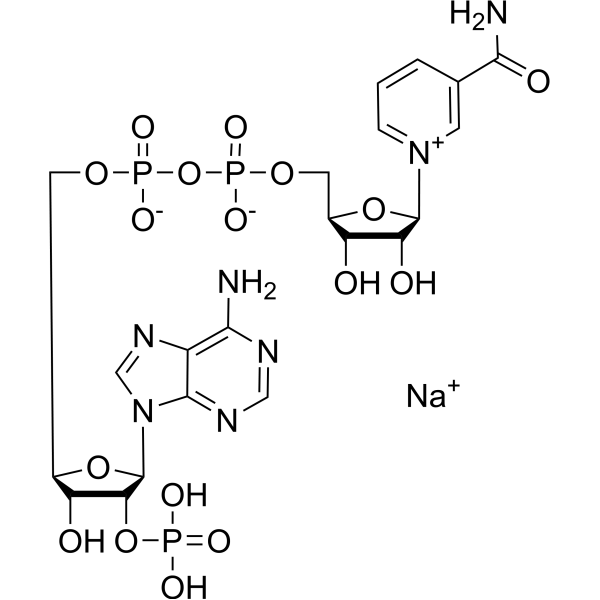
Physicochemical Properties
| Molecular Formula | C21H27N7NAO17P3 |
| Molecular Weight | 765.3868 |
| Exact Mass | 765.057 |
| CAS # | 1184-16-3 |
| Related CAS # | 53-57-6 (reduced);604-79-5 (oxidized);53-59-8 (free);1184-16-3 (Na); 100929-71-3 (ammonium); 24294-60-2 (disodium); |
| PubChem CID | 2724369 |
| Appearance | White to off-white solid powder |
| Melting Point | 175-178ºC |
| Hydrogen Bond Donor Count | 7 |
| Hydrogen Bond Acceptor Count | 21 |
| Rotatable Bond Count | 13 |
| Heavy Atom Count | 49 |
| Complexity | 1290 |
| Defined Atom Stereocenter Count | 8 |
| InChi Key | JNUMDLCHLVUHFS-UHFFFAOYSA-M |
| InChi Code | InChI=1S/C21H28N7O17P3.Na/c22-17-12-19(25-7-24-17)28(8-26-12)21-16(44-46(33,34)35)14(30)11(43-21)6-41-48(38,39)45-47(36,37)40-5-10-13(29)15(31)20(42-10)27-3-1-2-9(4-27)18(23)32;/h1-4,7-8,10-11,13-16,20-21,29-31H,5-6H2,(H7-,22,23,24,25,32,33,34,35,36,37,38,39);/q;+1/p-1 |
| Chemical Name | sodium;[[5-(6-aminopurin-9-yl)-3-hydroxy-4-phosphonooxyoxolan-2-yl]methoxy-oxidophosphoryl] [5-(3-carbamoylpyridin-1-ium-1-yl)-3,4-dihydroxyoxolan-2-yl]methyl phosphate |
| HS Tariff Code | 2934.99.9001 |
| Storage |
Powder-20°C 3 years 4°C 2 years In solvent -80°C 6 months -20°C 1 month Note: Please store this product in a sealed and protected environment, avoid exposure to moisture. |
| Shipping Condition | Room temperature (This product is stable at ambient temperature for a few days during ordinary shipping and time spent in Customs) |
Biological Activity
| Targets |
NADP⁺ serves as a precursor for potent intracellular calcium-releasing second messengers, including nicotinic acid adenine dinucleotide phosphate (NAADP) and cyclic ADP-ribose phosphate (cADPRP), which are involved in Ca²⁺ signaling. [1] NADP⁺ is also a substrate for NAD kinase (NADK) for the generation of NADP⁺/NADPH, and it is the oxidized form of NADPH, which acts as an essential electron donor in multiple redox reactions. [1] NADP sodium salt (NADP⁺) is the oxidized form of NADPH and serves as a substrate for NADPH-producing enzymes including glucose-6-phosphate dehydrogenase (G6PD), isocitrate dehydrogenase 1 (IDH1), and malic enzyme 1 (ME1) in the cytosol. [2] NADP⁺ is also a product inhibitor of human dihydrofolate reductase (DHFR), and its accumulation impairs DHFR activity and folate metabolism. [2] |
| ln Vitro |
NADP⁺ can be transformed into NAADP by a base-exchange reaction catalyzed by NAD⁺ glycohydrolase (NADase) at acidic pH. [1] NADP⁺ can also be converted into cyclic ADP-ribose phosphate (cADPRP) by NAD glycohydrolase, which is a potent inducer of Ca²⁺ release from intracellular stores. [1] In human engineered cells, changes in NADK expression did not significantly alter cellular NADP⁺ concentration but strongly affected NADPH levels. Overexpression of human NADK led to a 4–5 fold increase in NADPH concentration, improving cell viability in response to oxidative damage. [1] In HCT116 colon cancer cells, knockout of G6PD (the committed enzyme of the oxidative pentose phosphate pathway, oxPPP) resulted in increased cellular NADP⁺ levels, decreased NADPH/NADP⁺ ratio, and impaired folate metabolism, evidenced by accumulation of dihydrofolate (DHF) and deoxyuridine monophosphate (dUMP). [2] Re-expression of wild-type G6PD in knockout cells restored NADPH/NADP⁺ ratio and normalized dUMP levels, while catalytically dead G6PD mutants (K171Q) had no effect. [2] Expression of Escherichia coli DHFR, but not human DHFR, in G6PD knockout cells reversed dUMP accumulation, indicating that human DHFR is inhibited by high NADP⁺. [2] Knockout of G6PD in multiple cancer cell lines (HEK293T, MDA-MB-468, 8988T, A549, HepG2) consistently led to increased NADP⁺, accumulation of DHF and dUMP, and decreased malate and citrate levels. [2] |
| Enzyme Assay |
NAD kinase (NADK) catalyzes the transfer of a phosphate group from ATP to the 2′-hydroxyl group of the adenosine ribose moiety of NAD⁺ to generate NADP⁺. The enzyme is essential for cell survival, and its activity is dependent on NAD⁺ availability. [1] NAD⁺ glycohydrolase (NADase, also known as ADP-ribosyl cyclase) catalyzes the conversion of NADP⁺ to NAADP via a base-exchange reaction, replacing nicotinamide with nicotinic acid, and also catalyzes the cyclization to form cADPRP. [1] G6PD, IDH1, and ME1 enzyme activities were measured in cytosolic fractions of cell lysates using a diaphorase-resazurin coupled assay. The assay buffer contained Tris pH 7.4, MgCl₂, resazurin, NADP⁺, diaphorase, and bovine serum albumin. Reactions were initiated by adding respective substrates: glucose-6-phosphate for G6PD, isocitrate for IDH1, and malate for ME1. Activity was measured by fluorescence. [2] DHFR enzyme activity was measured in whole cell lysates. Lysates were mixed with phosphate buffer, β-mercaptoethanol, dihydrofolate (DHF), and methotrexate or NADP⁺ as indicated. Reactions were initiated by adding NADPH, and activity was measured as the rate of NADPH decrease by absorption at 340 nm. [2] |
| Cell Assay |
In engineered human cells, NADK expression was modulated using small interfering RNA (shRNA) to reduce expression to about 30%, resulting in a significant (~70%) decrease in cellular NADPH concentration and increased sensitivity to hydrogen peroxide. [1] Overexpression of NADK in human cells increased NADPH levels 4–5 fold and improved cell viability under oxidative stress, though not to the extent expected from the NADPH increase. [1] Clonal CRISPR knockout cell lines for G6PD, IDH1, ME1, and combinations were generated in HCT116 cells. Cells were transfected with Cas9 nickase and guide RNA plasmids, selected with puromycin, and single-cell cloned. Functional deletion was confirmed by sequencing and immunoblotting. [2] Cell growth was assessed using a CyQUANT proliferation assay. Cells were plated in 96-well plates, and fluorescence intensity proportional to DNA content was measured over consecutive days. For hypoxic growth, oxygen level was maintained at 0.5%. For oxidative stress assays, diamide or H₂O₂ was added during plating. [2] Metabolite profiling was performed by extracting cells with cold acetonitrile:methanol:water containing formic acid, followed by LC-MS analysis using a quadrupole orbitrap mass spectrometer in negative ion mode with hydrophilic interaction chromatography. [2] NADP⁺ and NADPH levels were measured via LC-MS. Cells were fed deuterated tracers ([3-²H]glucose, [2,3,3,4,4-²H]glutamine) or cultured in D₂O medium for 2 hours, followed by metabolite extraction and LC-MS analysis with an additional scan window for NADP(H) species. [2] Fatty acid synthesis was measured by culturing cells in [U-¹³C]glucose medium for several generations, followed by saponification, hexane extraction, and LC-MS analysis of fatty acids. [2] Folate species were measured by extracting cells with methanol/water containing sodium ascorbate and ammonium acetate, followed by incubation with rat serum, solid-phase extraction, and LC-MS analysis. [2] |
| References |
[1]. The phosphate makes a difference: cellular functions of NADP. Redox Rep. 2010;15(1):2-10. [2]. NADPH production by the oxidative pentose-phosphate pathway supports folate metabolism. Nat Metab. 2019 Mar;1:404-415. Epub 2019 Mar 11. PMID: 31058257; PMCID: PMC6489125. [3]. Interleukin-8 drives CD38 to form NAADP from NADP+ and NAAD in the endolysosomes to mobilize Ca2+ and effect cell migration. FASEB J. 2020 Sep;34(9):12565-12576. [4]. NADK-mediated de novo NADP(H) synthesis is a metabolic adaptation essential for breast cancer metastasis. Redox Biol. 2023 May;61:102627. [5]. Upregulation of cytosolic NADP+-dependent isocitrate dehydrogenase by hyperglycemia protects renal cells against oxidative stress. Mol Cells. 2010 Feb 28;29(2):203-8. |
| Additional Infomation |
Nicotinamide adenine dinucleotide phosphate. A coenzyme composed of ribosylnicotinamide 5'-phosphate (NMN) coupled by pyrophosphate linkage to the 5'-phosphate adenosine 2',5'-bisphosphate. It serves as an electron carrier in a number of reactions, being alternately oxidized (NADP+) and reduced (NADPH). (Dorland, 27th ed) NADP⁺ is the oxidized form of NADPH and plays critical roles in cellular redox balance, calcium signaling, and as a precursor for second messengers. [1] NADP⁺ is maintained at low levels in cells due to rapid reduction to NADPH, which is essential for antioxidant defense, detoxification, and reductive biosynthesis. [1] NADP⁺-derived signaling molecules (NAADP, cADPRP) are involved in Ca²⁺ mobilization and may link oxidative stress with intracellular calcium release. [1] NADP⁺ can be degraded by NADP phosphatase (NADPase). [1] NADP sodium salt (NADP⁺) is a key metabolite whose cellular concentration is regulated by NADPH-producing pathways. The oxidative pentose phosphate pathway (oxPPP) is required to maintain low NADP⁺ levels and a high NADPH/NADP⁺ ratio in mammalian cells. [2] Accumulation of NADP⁺ due to loss of G6PD inhibits human dihydrofolate reductase (DHFR), leading to impaired folate metabolism, accumulation of DHF and dUMP, and disruption of purine and thymidine synthesis. [2] This mechanism highlights a critical link between cytosolic NADPH metabolism and folate-dependent one-carbon metabolism, with implications for cancer cell proliferation and oxidative stress response. [2] |
Solubility Data
| Solubility (In Vitro) |
H2O : ~100 mg/mL (~130.65 mM) DMSO : ~3.57 mg/mL (~4.66 mM) |
| Solubility (In Vivo) |
Solubility in Formulation 1: 100 mg/mL (130.65 mM) in PBS (add these co-solvents sequentially from left to right, and one by one), clear solution; with sonication. (Please use freshly prepared in vivo formulations for optimal results.) |
| Preparing Stock Solutions | 1 mg | 5 mg | 10 mg | |
| 1 mM | 1.3065 mL | 6.5326 mL | 13.0652 mL | |
| 5 mM | 0.2613 mL | 1.3065 mL | 2.6130 mL | |
| 10 mM | 0.1307 mL | 0.6533 mL | 1.3065 mL |