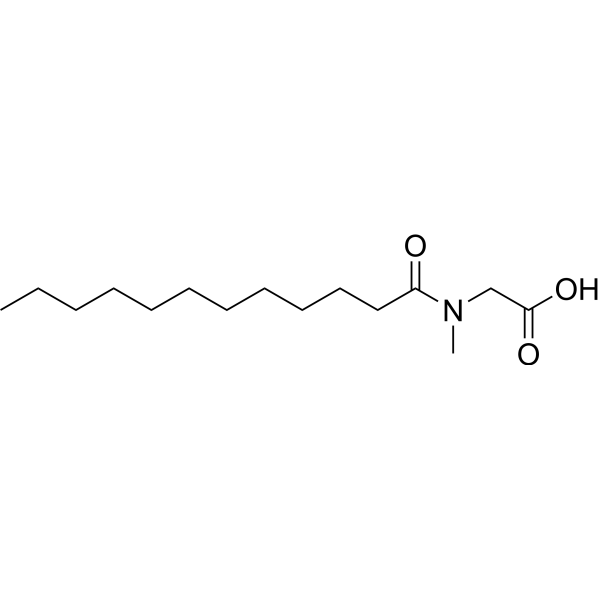
Physicochemical Properties
| Molecular Formula | C15H29NO3 |
| Molecular Weight | 271.3957 |
| Exact Mass | 271.215 |
| CAS # | 97-78-9 |
| Related CAS # | 68003-46-3 (ammonium salt) |
| PubChem CID | 7348 |
| Appearance | White to off-white solid powder |
| Density | 0.986g/cm3 |
| Boiling Point | 413.2ºC at 760mmHg |
| Melting Point | 45-49 °C |
| LogP | 3.45 |
| Hydrogen Bond Donor Count | 1 |
| Hydrogen Bond Acceptor Count | 3 |
| Rotatable Bond Count | 12 |
| Heavy Atom Count | 19 |
| Complexity | 254 |
| Defined Atom Stereocenter Count | 0 |
| InChi Key | BACYUWVYYTXETD-UHFFFAOYSA-N |
| InChi Code | InChI=1S/C15H29NO3/c1-3-4-5-6-7-8-9-10-11-12-14(17)16(2)13-15(18)19/h3-13H2,1-2H3,(H,18,19) |
| Chemical Name | 2-[dodecanoyl(methyl)amino]acetic acid |
| HS Tariff Code | 2934.99.9001 |
| Storage |
Powder-20°C 3 years 4°C 2 years In solvent -80°C 6 months -20°C 1 month Note: Please store this product in a sealed and protected environment, avoid exposure to moisture. |
| Shipping Condition | Room temperature (This product is stable at ambient temperature for a few days during ordinary shipping and time spent in Customs) |
Biological Activity
| ADME/Pharmacokinetics |
Metabolism / Metabolites Acyl sarcosines can be absorbed following oral or dermal contact, while nitrosamines can enter the body via ingestion, inhalation, or dermal contact. Once in the body, nitrosamines are metabolized by cytochrome P-450 enzymes, which essentially activates them into carcinogens. Sarcosine is metabolized to glycine by the enzyme sarcosine dehydrogenase. (A2878, A2879, L1892) |
| Toxicity/Toxicokinetics |
Toxicity Summary While acyl sarcosines themselves are not toxic, they are nitrosating agents. Nitrosating agents may decompose and/or react to cause nitrosamine contamination. Nitrosamines are produced from secondary amines and amides in the presence of nitrite ions and are believed to be carcinogenic. The particular nitrosamine produced by acyl sarcosines is N-nitrososarcosine. Once in the body, nitrosamines are activated by cytochrome P-450 enzymes. They are then believed to induce their carcinogenic effects by forming DNA adducts at the N- and O-atoms. (L1889, L1890, A2878, A2879, A2880, A2881) |
| References |
[1]. Synergistic enhancement of skin permeability by N-lauroylsarcosine and ethanol. Int J Pharm. 2008 Mar 20;352(1-2):129-38. |
| Additional Infomation |
N-Lauroylsarcosine is a N-acyl-amino acid. Lauroyl sarcosine is a condensation product of natural fatty acids with sarcosine, which is a natural amino acid found in muscles and other body tissues. Acyl sarcosines are considered modifiŽed fatty acids in which the hydrocarbon chains are interrupted by an amidomethyl group in the alpha position. They are used as hair-conditioning agents and surfactant-cleansing agents in cosmetics, as well as to improve wetting and penetration of topical pharmaceutical products. Acyl sarcosines and their sodium salts are also used in the metal finishing and processing industries for their crystal modifying, anti-rust, and anti-corrosion properties. (L1892, A2881) See also: Sodium Lauroyl Sarcosinate (annotation moved to). |
Solubility Data
| Solubility (In Vitro) |
DMSO : ~250 mg/mL (~921.15 mM) H2O : < 0.1 mg/mL |
| Solubility (In Vivo) |
Solubility in Formulation 1: ≥ 2.08 mg/mL (7.66 mM) (saturation unknown) in 10% DMSO + 40% PEG300 + 5% Tween80 + 45% Saline (add these co-solvents sequentially from left to right, and one by one), clear solution. For example, if 1 mL of working solution is to be prepared, you can add 100 μL of 20.8 mg/mL clear DMSO stock solution to 400 μL PEG300 and mix evenly; then add 50 μL Tween-80 to the above solution and mix evenly; then add 450 μL normal saline to adjust the volume to 1 mL. Preparation of saline: Dissolve 0.9 g of sodium chloride in 100 mL ddH₂ O to obtain a clear solution. Solubility in Formulation 2: ≥ 2.08 mg/mL (7.66 mM) (saturation unknown) in 10% DMSO + 90% (20% SBE-β-CD in Saline) (add these co-solvents sequentially from left to right, and one by one), clear solution. For example, if 1 mL of working solution is to be prepared, you can add 100 μL of 20.8 mg/mL clear DMSO stock solution to 900 μL of 20% SBE-β-CD physiological saline solution and mix evenly. Preparation of 20% SBE-β-CD in Saline (4°C,1 week): Dissolve 2 g SBE-β-CD in 10 mL saline to obtain a clear solution. Solubility in Formulation 3: ≥ 2.08 mg/mL (7.66 mM) (saturation unknown) in 10% DMSO + 90% Corn Oil (add these co-solvents sequentially from left to right, and one by one), clear solution. For example, if 1 mL of working solution is to be prepared, you can add 100 μL of 20.8 mg/mL clear DMSO stock solution to 900 μL of corn oil and mix evenly. (Please use freshly prepared in vivo formulations for optimal results.) |
| Preparing Stock Solutions | 1 mg | 5 mg | 10 mg | |
| 1 mM | 3.6846 mL | 18.4230 mL | 36.8460 mL | |
| 5 mM | 0.7369 mL | 3.6846 mL | 7.3692 mL | |
| 10 mM | 0.3685 mL | 1.8423 mL | 3.6846 mL |