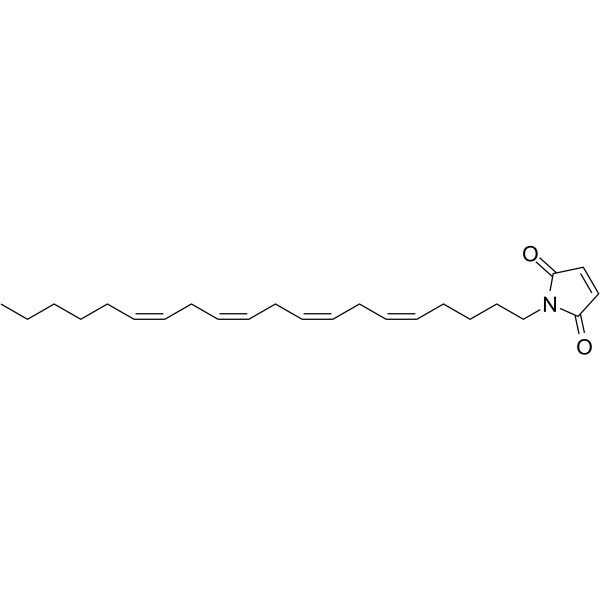
Physicochemical Properties
| Molecular Formula | C24H35NO2 |
| Molecular Weight | 369.54 |
| Exact Mass | 369.266 |
| CAS # | 876305-42-9 |
| PubChem CID | 25021164 |
| Appearance | Colorless to light yellow liquid |
| Density | 1.0±0.1 g/cm3 |
| Boiling Point | 492.9±34.0 °C at 760 mmHg |
| Flash Point | 185.2±18.0 °C |
| Vapour Pressure | 0.0±1.3 mmHg at 25°C |
| Index of Refraction | 1.524 |
| LogP | 7.89 |
| Hydrogen Bond Donor Count | 0 |
| Hydrogen Bond Acceptor Count | 2 |
| Rotatable Bond Count | 15 |
| Heavy Atom Count | 27 |
| Complexity | 549 |
| Defined Atom Stereocenter Count | 0 |
| SMILES | CCCCC/C=C\C/C=C\C/C=C\C/C=C\CCCCN1C(=O)C=CC1=O |
| InChi Key | GZNZRHSGGQUYAP-DOFZRALJSA-N |
| InChi Code | InChI=1S/C24H35NO2/c1-2-3-4-5-6-7-8-9-10-11-12-13-14-15-16-17-18-19-22-25-23(26)20-21-24(25)27/h6-7,9-10,12-13,15-16,20-21H,2-5,8,11,14,17-19,22H2,1H3/b7-6-,10-9-,13-12-,16-15- |
| Chemical Name | 1-[(5Z,8Z,11Z,14Z)-icosa-5,8,11,14-tetraenyl]pyrrole-2,5-dione |
| HS Tariff Code | 2934.99.9001 |
| Storage |
Powder-20°C 3 years 4°C 2 years In solvent -80°C 6 months -20°C 1 month |
| Shipping Condition | Room temperature (This product is stable at ambient temperature for a few days during ordinary shipping and time spent in Customs) |
Biological Activity
| Targets | IC50: 140 nM (MAGL)[1] |
| ln Vitro | A potential MAGL inhibitor that can be utilized to control the effects of 2-arachidonyl glycerol (2-AG) is N-arachidonyl maleimide. N-Arachidonyl maleimide raises the brain's natural amounts of 2-AG. At a comparatively modest concentration (IC50, 140 nM), N-arachidonyl maleimide inhibits the breakdown of 2-AG mediated by the cerebellar membrane[1]. |
| ln Vivo | 2-AG (1, 3, and 10 mg/kg) induces substantial and dose-dependent hypothermia, antinociception, and catalepsy when paired with a 1 mg/kg dosage of N-Arachidonyl maleimide[1]. |
| References |
[1]. Characterization of the Sulfhydryl-Sensitive Site in the Enzyme Responsible for Hydrolysis of 2-arachidonoyl-glycerol in Rat Cerebellar Membranes. Chem Biol. 2005 Jun;12(6):649-56. [2]. N-arachidonyl Maleimide Potentiates the Pharmacological and Biochemical Effects of the Endocannabinoid 2-arachidonylglycerol Through Inhibition of Monoacylglycerol Lipase. J Pharmacol Exp Ther. 2008 Nov;327(2):546-53. |
Solubility Data
| Solubility (In Vitro) | DMSO: 100 mg/mL (270.61 mM) |
| Solubility (In Vivo) |
Solubility in Formulation 1: ≥ 2.5 mg/mL (6.77 mM) (saturation unknown) in 10% DMSO + 40% PEG300 + 5% Tween80 + 45% Saline (add these co-solvents sequentially from left to right, and one by one), clear solution. For example, if 1 mL of working solution is to be prepared, you can add 100 μL of 25.0 mg/mL clear DMSO stock solution to 400 μL PEG300 and mix evenly; then add 50 μL Tween-80 to the above solution and mix evenly; then add 450 μL normal saline to adjust the volume to 1 mL. Preparation of saline: Dissolve 0.9 g of sodium chloride in 100 mL ddH₂ O to obtain a clear solution. Solubility in Formulation 2: 2.5 mg/mL (6.77 mM) in 10% DMSO + 90% (20% SBE-β-CD in Saline) (add these co-solvents sequentially from left to right, and one by one), suspension solution; with ultrasonication. For example, if 1 mL of working solution is to be prepared, you can add 100 μL of 25.0 mg/mL clear DMSO stock solution to 900 μL of 20% SBE-β-CD physiological saline solution and mix evenly. Preparation of 20% SBE-β-CD in Saline (4°C,1 week): Dissolve 2 g SBE-β-CD in 10 mL saline to obtain a clear solution. Solubility in Formulation 3: ≥ 2.5 mg/mL (6.77 mM) (saturation unknown) in 10% DMSO + 90% Corn Oil (add these co-solvents sequentially from left to right, and one by one), clear solution. For example, if 1 mL of working solution is to be prepared, you can add 100 μL of 25.0 mg/mL clear DMSO stock solution to 900 μL of corn oil and mix evenly. (Please use freshly prepared in vivo formulations for optimal results.) |
| Preparing Stock Solutions | 1 mg | 5 mg | 10 mg | |
| 1 mM | 2.7061 mL | 13.5303 mL | 27.0607 mL | |
| 5 mM | 0.5412 mL | 2.7061 mL | 5.4121 mL | |
| 10 mM | 0.2706 mL | 1.3530 mL | 2.7061 mL |