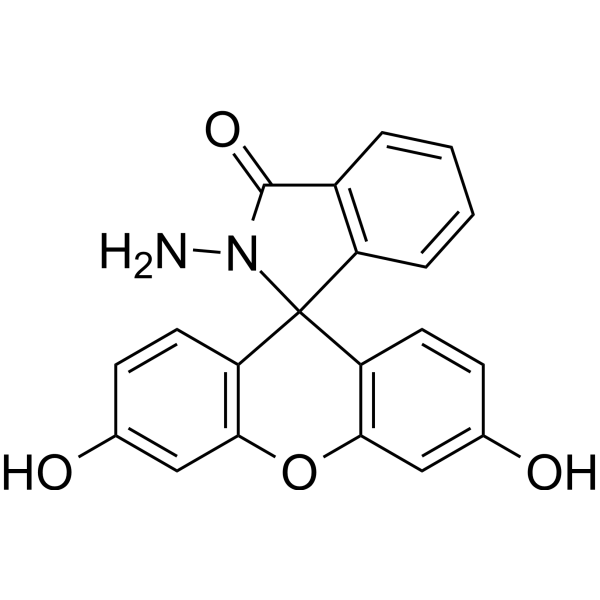
N-Aminofluorescein is a fluorescein hydrazide with spiro form. It is a highly selective and sensitive fluorescence probe for Cu2+. N-Aminofluorescein has no selective fluorescence response to other common metal ions, can be used for direct detection of Cu2+ in biological systems with λex/em=495/516 nm
Physicochemical Properties
| Molecular Formula | C20H14N2O4 |
| Molecular Weight | 346.3362 |
| Exact Mass | 346.095 |
| CAS # | 98907-26-7 |
| PubChem CID | 15883728 |
| Appearance | Off-white to light yellow solid powder |
| LogP | 3.463 |
| Hydrogen Bond Donor Count | 3 |
| Hydrogen Bond Acceptor Count | 5 |
| Rotatable Bond Count | 0 |
| Heavy Atom Count | 26 |
| Complexity | 558 |
| Defined Atom Stereocenter Count | 0 |
| InChi Key | CHYVTSCIBXXQJT-UHFFFAOYSA-N |
| InChi Code | InChI=1S/C20H14N2O4/c21-22-19(25)13-3-1-2-4-14(13)20(22)15-7-5-11(23)9-17(15)26-18-10-12(24)6-8-16(18)20/h1-10,23-24H,21H2 |
| Chemical Name | 2-amino-3',6'-dihydroxyspiro[isoindole-3,9'-xanthene]-1-one |
| HS Tariff Code | 2934.99.9001 |
| Storage |
Powder-20°C 3 years 4°C 2 years In solvent -80°C 6 months -20°C 1 month Note: This product requires protection from light (avoid light exposure) during transportation and storage. |
| Shipping Condition | Room temperature (This product is stable at ambient temperature for a few days during ordinary shipping and time spent in Customs) |
Biological Activity
| ln Vitro | Advice (This is our suggested protocol, which should be adjusted to suit your particular circumstances as it simply offers guidance). N-aminofluorescein is made up of a hydrazide group and a fluorescein moiety that together can bind and identify Cu2+ to facilitate the hydrolysis of amide [1]. In a 70% HEPES buffer solution (pH 7.4) containing Cu2+, N-Aminofluorescein (FG) exhibits selectivity for Cu2+ and exhibits absorption and emission bands at 632 nm and 515 nm [2]. Advice (This is our suggested protocol, which should be adjusted to suit your particular circumstances as it simply offers guidance). Steps to determine Cu2+ in general [1]: 1. Make a 1.0 mM spiral fluorescein hydrazide ethanol stock solution; 2. Use 10 μM N-aminofluorescein and 0.01 M Tris-HCl buffer (pH 7.2) to perform fluorescence. Get the response going; 3. A suitable quantity of sample solution should be added to ensure that the final Cu2+ concentration does not surpass 10 μM. The final volume should be adjusted to 10 mL using 0.01 M Tris-HCl buffer (pH 7.2); 4. After two hours, transfer three milliliters of the solution to a one-centimeter quartz cell. Measure the fluorescence spectra and intensity at room temperature (λex/em = 495/516 nm), with excitation and emission slit widths of five nm each. Simultaneously prepare a blank solution devoid of Cu2+ and measure it under identical conditions for comparative analysis. |
| References |
[1]. A selective fluorescence-on reaction of spiro form fluorescein hydrazide with Cu(II). Anal Chim Acta. 2006 Aug 11;575(2):217-22. [2]. A water compatible turn ‘on’ optical probe for Cu2+ based on a fluorescein-sugar conjugate. Sensors and Actuators B: Chemical. 2014;196:345-351. |
Solubility Data
| Solubility (In Vitro) | DMSO : ~125 mg/mL (~360.92 mM) |
| Solubility (In Vivo) |
Note: Listed below are some common formulations that may be used to formulate products with low water solubility (e.g. < 1 mg/mL), you may test these formulations using a minute amount of products to avoid loss of samples. Injection Formulations (e.g. IP/IV/IM/SC) Injection Formulation 1: DMSO : Tween 80: Saline = 10 : 5 : 85 (i.e. 100 μL DMSO stock solution → 50 μL Tween 80 → 850 μL Saline) *Preparation of saline: Dissolve 0.9 g of sodium chloride in 100 mL ddH ₂ O to obtain a clear solution. Injection Formulation 2: DMSO : PEG300 :Tween 80 : Saline = 10 : 40 : 5 : 45 (i.e. 100 μL DMSO → 400 μLPEG300 → 50 μL Tween 80 → 450 μL Saline) Injection Formulation 3: DMSO : Corn oil = 10 : 90 (i.e. 100 μL DMSO → 900 μL Corn oil) Example: Take the Injection Formulation 3 (DMSO : Corn oil = 10 : 90) as an example, if 1 mL of 2.5 mg/mL working solution is to be prepared, you can take 100 μL 25 mg/mL DMSO stock solution and add to 900 μL corn oil, mix well to obtain a clear or suspension solution (2.5 mg/mL, ready for use in animals). Injection Formulation 4: DMSO : 20% SBE-β-CD in saline = 10 : 90 [i.e. 100 μL DMSO → 900 μL (20% SBE-β-CD in saline)] *Preparation of 20% SBE-β-CD in Saline (4°C,1 week): Dissolve 2 g SBE-β-CD in 10 mL saline to obtain a clear solution. Injection Formulation 5: 2-Hydroxypropyl-β-cyclodextrin : Saline = 50 : 50 (i.e. 500 μL 2-Hydroxypropyl-β-cyclodextrin → 500 μL Saline) Injection Formulation 6: DMSO : PEG300 : castor oil : Saline = 5 : 10 : 20 : 65 (i.e. 50 μL DMSO → 100 μLPEG300 → 200 μL castor oil → 650 μL Saline) Injection Formulation 7: Ethanol : Cremophor : Saline = 10: 10 : 80 (i.e. 100 μL Ethanol → 100 μL Cremophor → 800 μL Saline) Injection Formulation 8: Dissolve in Cremophor/Ethanol (50 : 50), then diluted by Saline Injection Formulation 9: EtOH : Corn oil = 10 : 90 (i.e. 100 μL EtOH → 900 μL Corn oil) Injection Formulation 10: EtOH : PEG300:Tween 80 : Saline = 10 : 40 : 5 : 45 (i.e. 100 μL EtOH → 400 μLPEG300 → 50 μL Tween 80 → 450 μL Saline) Oral Formulations Oral Formulation 1: Suspend in 0.5% CMC Na (carboxymethylcellulose sodium) Oral Formulation 2: Suspend in 0.5% Carboxymethyl cellulose Example: Take the Oral Formulation 1 (Suspend in 0.5% CMC Na) as an example, if 100 mL of 2.5 mg/mL working solution is to be prepared, you can first prepare 0.5% CMC Na solution by measuring 0.5 g CMC Na and dissolve it in 100 mL ddH2O to obtain a clear solution; then add 250 mg of the product to 100 mL 0.5% CMC Na solution, to make the suspension solution (2.5 mg/mL, ready for use in animals). Oral Formulation 3: Dissolved in PEG400 Oral Formulation 4: Suspend in 0.2% Carboxymethyl cellulose Oral Formulation 5: Dissolve in 0.25% Tween 80 and 0.5% Carboxymethyl cellulose Oral Formulation 6: Mixing with food powders Note: Please be aware that the above formulations are for reference only. InvivoChem strongly recommends customers to read literature methods/protocols carefully before determining which formulation you should use for in vivo studies, as different compounds have different solubility properties and have to be formulated differently. (Please use freshly prepared in vivo formulations for optimal results.) |
| Preparing Stock Solutions | 1 mg | 5 mg | 10 mg | |
| 1 mM | 2.8873 mL | 14.4367 mL | 28.8734 mL | |
| 5 mM | 0.5775 mL | 2.8873 mL | 5.7747 mL | |
| 10 mM | 0.2887 mL | 1.4437 mL | 2.8873 mL |