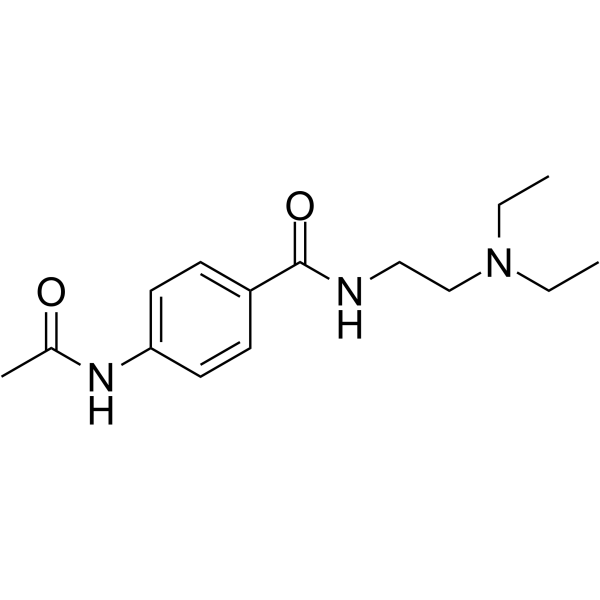
Physicochemical Properties
| Molecular Formula | C15H23N3O2 |
| Molecular Weight | 277.36202 |
| Exact Mass | 277.179 |
| CAS # | 32795-44-1 |
| Related CAS # | N-Acetylprocainamide hydrochloride;34118-92-8 |
| PubChem CID | 4342 |
| Appearance | White to off-white solid powder |
| Density | 1.097g/cm3 |
| Boiling Point | 500ºC at 760mmHg |
| Melting Point | 138-140ºC(lit.) |
| Flash Point | 256.2ºC |
| LogP | 2.18 |
| Hydrogen Bond Donor Count | 2 |
| Hydrogen Bond Acceptor Count | 3 |
| Rotatable Bond Count | 7 |
| Heavy Atom Count | 20 |
| Complexity | 308 |
| Defined Atom Stereocenter Count | 0 |
| InChi Key | KEECCEWTUVWFCV-UHFFFAOYSA-N |
| InChi Code | InChI=1S/C15H23N3O2/c1-4-18(5-2)11-10-16-15(20)13-6-8-14(9-7-13)17-12(3)19/h6-9H,4-5,10-11H2,1-3H3,(H,16,20)(H,17,19) |
| Chemical Name | 4-acetamido-N-[2-(diethylamino)ethyl]benzamide |
| HS Tariff Code | 2934.99.9001 |
| Storage |
Powder-20°C 3 years 4°C 2 years In solvent -80°C 6 months -20°C 1 month |
| Shipping Condition | Room temperature (This product is stable at ambient temperature for a few days during ordinary shipping and time spent in Customs) |
Biological Activity
| Targets |
N-Acetylprocainamide targets K⁺ channels (specifically voltage-dependent K⁺ channels in tracheal smooth muscle) [1] N-Acetylprocainamide targets epithelial Na⁺ channels and Cl⁻ channels in colonic epithelium [2] |
| ln Vitro |
K+ blocker N-acetyl procainamide. K+ and methacholine-induced tension are both decreased by N-acetyl procainamide. The pIC50 values of N-acetyl procainamide were 2.80 ± 0.03 and 2.65 ± 0.02, respectively, against contraction induced by 0.3 and 1 μM methacholine. K+ channel blockers prevent N-acetyl procainamide from having this calming effect [1]. Neither Cl-secretion nor Na+ absorption are impacted by N-acetyl procainamide [2]. - Tracheal smooth muscle relaxation: In isolated bovine tracheal smooth muscle strips precontracted with carbachol (1 μM), N-Acetylprocainamide induced dose-dependent relaxation, with a maximum relaxation rate of 82% at 100 μM and an EC₅₀ value of 32 μM; the relaxation effect was partially blocked by tetraethylammonium (a non-selective K⁺ channel blocker), indicating involvement of K⁺ channel activation [1] - Inhibition of epithelial ion transport: In rabbit descending colon epithelium mounted in Ussing chambers, N-Acetylprocainamide (10-100 μM) dose-dependently inhibited basal and forskolin-stimulated Na⁺ absorption, reducing Na⁺ flux by 45-70% at 100 μM [2] - N-Acetylprocainamide (10-100 μM) also suppressed basal and forskolin-induced Cl⁻ secretion in rabbit colonic epithelium, decreasing Cl⁻ flux by 38-65% at 100 μM; the inhibitory effect on ion transport was reversible after washing out the compound [2] - The relaxation of tracheal smooth muscle by N-Acetylprocainamide was not affected by atropine (muscarinic receptor antagonist) or propranolol (β-adrenergic receptor antagonist), ruling out involvement of cholinergic or adrenergic pathways [1] |
| Animal Protocol |
- Bovine tracheal smooth muscle preparation: Bovine tracheae were collected, and smooth muscle strips (2×10 mm) were dissected and mounted in organ baths containing Krebs-Henseleit buffer (37°C, 95% O₂ + 5% CO₂); the strips were precontracted with carbachol (1 μM) until a stable tension was achieved before adding serial concentrations of N-Acetylprocainamide (1-100 μM); vascular tension was recorded using a force transducer [1] - Rabbit colonic epithelium preparation: Male rabbits were euthanized, and the descending colon was excised and rinsed with ice-cold physiological saline; the mucosa was stripped from the muscular layer, cut into 0.5×0.5 cm pieces, and mounted in Ussing chambers with Krebs-Ringer bicarbonate buffer (37°C, 95% O₂ + 5% CO₂); transepithelial potential difference and short-circuit current (Isc) were measured to assess Na⁺ and Cl⁻ transport after adding N-Acetylprocainamide (10-100 μM) [2] |
| ADME/Pharmacokinetics |
Metabolism / Metabolites Acecainide is a known human metabolite of Procainamide. |
| References |
[1]. Role of K+ channels in N-acetylprocainamide-induced relaxation of bovine tracheal smooth muscle. Eur J Pharmacol. 2001 Mar 9;415(1):73-8. [2]. Class I antiarrhythmics inhibit Na+ absorption and Cl- secretion in rabbit descending colon epithelium. Naunyn Schmiedebergs Arch Pharmacol. 2005 Jun;371(6):492-9. |
| Additional Infomation |
N-acetylprocainamide is a benzamide obtained via formal condensation of 4-acetamidobenzoic acid and 2-(diethylamino)ethylamine. It has a role as an anti-arrhythmia drug. It is a member of benzamides and a member of acetamides. Acecainide is an investigational anti-arrhythmia drug. A major metabolite of PROCAINAMIDE. Its anti-arrhythmic action may cause cardiac toxicity in kidney failure. - N-Acetylprocainamide is an active metabolite of procainamide, belonging to class Ia antiarrhythmic drugs [2] - Its tracheal smooth muscle relaxant effect is mediated primarily through activation of voltage-dependent K⁺ channels, leading to membrane hyperpolarization and reduced smooth muscle contraction [1] - The inhibitory effect on colonic epithelial Na⁺ and Cl⁻ transport suggests potential impacts on intestinal fluid and electrolyte balance [2] - Unlike procainamide, N-Acetylprocainamide has a longer half-life and lower incidence of lupus-like syndrome, but retains similar ion channel-modulating properties [2] - The compound’s action on K⁺, Na⁺, and Cl⁻ channels contributes to both its antiarrhythmic activity and non-cardiac effects (e.g., smooth muscle relaxation, intestinal ion transport modulation) [1][2] |
Solubility Data
| Solubility (In Vitro) | DMSO : ≥ 100 mg/mL (~360.54 mM) |
| Solubility (In Vivo) |
Solubility in Formulation 1: ≥ 2.5 mg/mL (9.01 mM) (saturation unknown) in 10% DMSO + 40% PEG300 + 5% Tween80 + 45% Saline (add these co-solvents sequentially from left to right, and one by one), clear solution. For example, if 1 mL of working solution is to be prepared, you can add 100 μL of 25.0 mg/mL clear DMSO stock solution to 400 μL PEG300 and mix evenly; then add 50 μL Tween-80 to the above solution and mix evenly; then add 450 μL normal saline to adjust the volume to 1 mL. Preparation of saline: Dissolve 0.9 g of sodium chloride in 100 mL ddH₂ O to obtain a clear solution. Solubility in Formulation 2: ≥ 2.5 mg/mL (9.01 mM) (saturation unknown) in 10% DMSO + 90% (20% SBE-β-CD in Saline) (add these co-solvents sequentially from left to right, and one by one), clear solution. For example, if 1 mL of working solution is to be prepared, you can add 100 μL of 25.0 mg/mL clear DMSO stock solution to 900 μL of 20% SBE-β-CD physiological saline solution and mix evenly. Preparation of 20% SBE-β-CD in Saline (4°C,1 week): Dissolve 2 g SBE-β-CD in 10 mL saline to obtain a clear solution. Solubility in Formulation 3: ≥ 2.5 mg/mL (9.01 mM) (saturation unknown) in 10% DMSO + 90% Corn Oil (add these co-solvents sequentially from left to right, and one by one), clear solution. For example, if 1 mL of working solution is to be prepared, you can add 100 μL of 25.0 mg/mL clear DMSO stock solution to 900 μL of corn oil and mix evenly. (Please use freshly prepared in vivo formulations for optimal results.) |
| Preparing Stock Solutions | 1 mg | 5 mg | 10 mg | |
| 1 mM | 3.6054 mL | 18.0271 mL | 36.0542 mL | |
| 5 mM | 0.7211 mL | 3.6054 mL | 7.2108 mL | |
| 10 mM | 0.3605 mL | 1.8027 mL | 3.6054 mL |