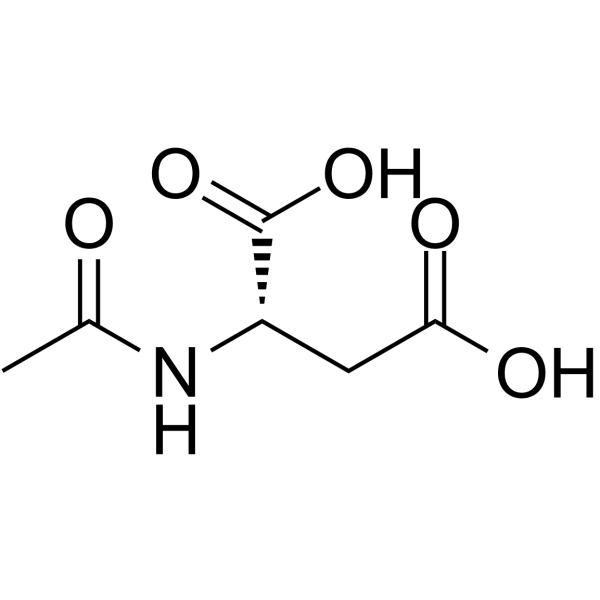
Physicochemical Properties
| Molecular Formula | C6H9NO5 |
| Molecular Weight | 175.1394 |
| Exact Mass | 175.048 |
| CAS # | 997-55-7 |
| PubChem CID | 65065 |
| Appearance | White to off-white solid powder |
| Density | 1.5±0.1 g/cm3 |
| Boiling Point | 329.1±52.0 °C at 760 mmHg |
| Melting Point | 137-140 °C(lit.) |
| Flash Point | 152.8±30.7 °C |
| Vapour Pressure | 0.0±1.6 mmHg at 25°C |
| Index of Refraction | 1.538 |
| LogP | -0.09 |
| Hydrogen Bond Donor Count | 3 |
| Hydrogen Bond Acceptor Count | 5 |
| Rotatable Bond Count | 4 |
| Heavy Atom Count | 12 |
| Complexity | 212 |
| Defined Atom Stereocenter Count | 1 |
| SMILES | CC(=O)N[C@@H](CC(=O)O)C(=O)O |
| InChi Key | OTCCIMWXFLJLIA-BYPYZUCNSA-N |
| InChi Code | InChI=1S/C6H9NO5/c1-3(8)7-4(6(11)12)2-5(9)10/h4H,2H2,1H3,(H,7,8)(H,9,10)(H,11,12)/t4-/m0/s1 |
| Chemical Name | (2S)-2-acetamidobutanedioic acid |
| HS Tariff Code | 2934.99.9001 |
| Storage |
Powder-20°C 3 years 4°C 2 years In solvent -80°C 6 months -20°C 1 month |
| Shipping Condition | Room temperature (This product is stable at ambient temperature for a few days during ordinary shipping and time spent in Customs) |
Biological Activity
| References |
[1]. N-acetyl-L-aspartic acid: a literature review of a compound prominent in 1H-NMR spectroscopic studies of brain. Neurosci Biobehav Rev. 1989 Spring;13(1):23-31. |
| Additional Infomation |
N-acetyl-L-aspartic acid is an N-acyl-L-aspartic acid in which the acyl group is specified as acetyl. It has a role as a nutraceutical, an antioxidant, a human metabolite, a mouse metabolite and a rat metabolite. It is a N-acetyl-L-amino acid and a N-acyl-L-aspartic acid. It is a conjugate acid of a N-acetyl-L-aspartate(2-). N-Acetyl-L-aspartic acid is a metabolite found in or produced by Escherichia coli (strain K12, MG1655). N-Acetyl-L-aspartic acid has been reported in Homo sapiens and Caenorhabditis elegans with data available. N-Acetylaspartate is the acetylated form of aspartic acid synthesized in the mitochondria of neurons from aspartic acid and acetyl-coenzyme A. Although highly concentrated in neurons, the exact biological role of N-acetylaspartate has yet to be identified. N-acetylaspartate can act as a neuronal marker and brain levels are decreased in many neuropathological conditions. N-Acetylaspartic acid is a derivative of aspartic acid. It is the second most concentrated molecule in the brain after the amino acid glutamate. It is synthesized in neurons from the amino acid aspartate and acetyl coenzyme A. The various functions served by N-acetylaspartic acid are still under investigation, but the primary proposed functions include:. 1) A neuronal osmolyte that is involved in fluid balance in the brain 2) A source of acetate for lipid and myelin synthesis in oligodendrocytes, the glial cells that myelinate neuronal axons 3) A precursor for the synthesis of the important neuronal dipeptide N-acetylaspartylglutamate 4)N-Acetylaspartic acid may also be involved in energy production from the amino acid glutamate in neuronal mitochondria. |
Solubility Data
| Solubility (In Vitro) |
H2O : ~62.5 mg/mL (~356.86 mM) DMSO : ~5 mg/mL (~28.55 mM) |
| Solubility (In Vivo) |
Solubility in Formulation 1: 12.5 mg/mL (71.37 mM) in PBS (add these co-solvents sequentially from left to right, and one by one), clear solution; with sonication. (Please use freshly prepared in vivo formulations for optimal results.) |
| Preparing Stock Solutions | 1 mg | 5 mg | 10 mg | |
| 1 mM | 5.7097 mL | 28.5486 mL | 57.0972 mL | |
| 5 mM | 1.1419 mL | 5.7097 mL | 11.4194 mL | |
| 10 mM | 0.5710 mL | 2.8549 mL | 5.7097 mL |