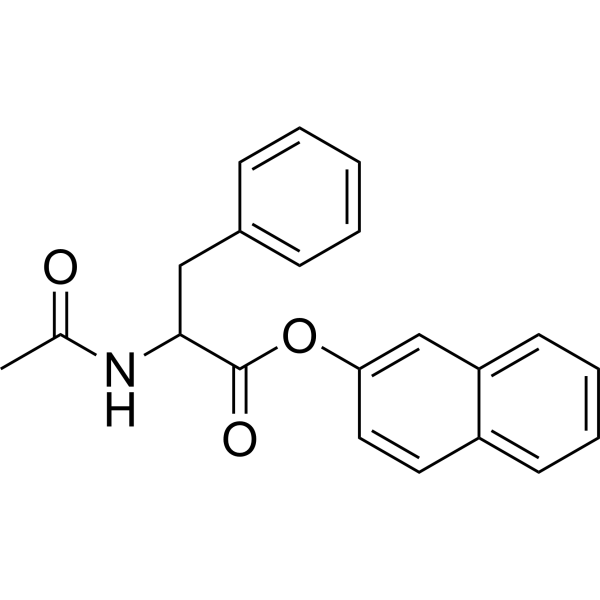
Physicochemical Properties
| Molecular Formula | C21H19NO3 |
| Molecular Weight | 333.38046 |
| Exact Mass | 333.136 |
| CAS # | 20874-31-1 |
| PubChem CID | 98192 |
| Appearance | Typically exists as solid at room temperature |
| Density | 1.2g/cm3 |
| Boiling Point | 589.8ºC at 760mmHg |
| Flash Point | 310.5ºC |
| Vapour Pressure | 6.93E-14mmHg at 25°C |
| Index of Refraction | 1.618 |
| LogP | 3.883 |
| Hydrogen Bond Donor Count | 1 |
| Hydrogen Bond Acceptor Count | 3 |
| Rotatable Bond Count | 6 |
| Heavy Atom Count | 25 |
| Complexity | 458 |
| Defined Atom Stereocenter Count | 0 |
| SMILES | CC(NC(C(OC1=CC2=CC=CC=C2C=C1)=O)CC3=CC=CC=C3)=O |
| InChi Key | BBXRRTJNJCPGBU-UHFFFAOYSA-N |
| InChi Code | InChI=1S/C21H19NO3/c1-15(23)22-20(13-16-7-3-2-4-8-16)21(24)25-19-12-11-17-9-5-6-10-18(17)14-19/h2-12,14,20H,13H2,1H3,(H,22,23) |
| Chemical Name | naphthalen-2-yl 2-acetamido-3-phenylpropanoate |
| HS Tariff Code | 2934.99.9001 |
| Storage |
Powder-20°C 3 years 4°C 2 years In solvent -80°C 6 months -20°C 1 month |
| Shipping Condition | Room temperature (This product is stable at ambient temperature for a few days during ordinary shipping and time spent in Customs) |
Biological Activity
| ln Vitro | N-acetyl-DL-phenylalanine β-naphthyl ester is hydrolyzed in vivo at neutral pH under the catalysis of esterase (APNEase). There is evidence that APNEase may play a role in the turnover and pathological degradation of muscle proteins since it is linked to multiple types of muscular atrophy [1]. The yeast Pichia pastoris Base can be used to directly express N-acetyl-DL-phenylalanine β-naphthyl ester (0.75 mM, DMF; 3 min) as a substrate and o-dianisidine tetrazide (oD) as a dye to assess the protease inhibitory performance [2]. Diazo coupling of β-naphthyl ester of N-acetyl-DL-phenylalanine (0.75 mM, DMF; 3 min) (2.4 g/L) by N-enzyme hydrolysis of β-naphthol-stained agar gel Acetyl-DL-phenylalanine beta-naphthyl ester (APNE) visual results are provided. The region with just the protease shows vivid pink-purple, while the circular region with the inhibitor-protease complex stays colorless [3]. N-acetyl-DL-phenylalanine beta-naphthyl ester (5 mg/40 mL) application: Sorting mouse plasma according to peptidase class. Immunoprecipitation using antisera in radial immunodiffusion allowed for the visualization of the enzyme. Subsequently, each immunoprecipitated ring was incubated in a protease inhibitor solution, cleaned with sufficient physiological saline to eliminate unprecipitated serum and other components, and stained with chromogenic substrates (NAPBNE and Fast Blue B). Straightforward photography in well-lit environments can provide photographs [4]. |
| References |
[1]. Acetyl-DL-phenylalanine beta-naphthyl esterase activity in human muscle disease. Biochem Med. 1978 Aug. 20(1):63-9. [2]. A simple method to determine trypsin and chymotrypsin inhibitory activity. J Biochem Biophys Methods. 2004 Jun 30. 59(3):241-51. [3]. Assay for enzyme inhibition: detection of natural inhibitors of trypsin and chymotrypsin. Anal Biochem. 1987 May 1. 162(2):345-9. [4]. An association between Schistosoma mansoni worms and an enzymatically-active protease/peptidase in mouse blood. Parasitology. 2008 Apr. 135(4):467-72. [5]. Isolation of an N-acetyl-DL-phenylalanine beta-naphthyl esterase from rabbit peritoneal polymorphonuclear leukocytes. Biochim Biophys Acta. 1975 Sep 22;403(1):98-105. |
| Additional Infomation | Beta-naphthyl N-acetylphenylalaninate is an alpha-amino acid ester obtained by the fromal condensation of N-acetylphenylalanine with 2-naphthol. It is an alpha-amino acid ester and a phenylalanine derivative. It is functionally related to a 2-naphthol. |
Solubility Data
| Solubility (In Vitro) | May dissolve in DMSO (in most cases), if not, try other solvents such as H2O, Ethanol, or DMF with a minute amount of products to avoid loss of samples |
| Solubility (In Vivo) |
Note: Listed below are some common formulations that may be used to formulate products with low water solubility (e.g. < 1 mg/mL), you may test these formulations using a minute amount of products to avoid loss of samples. Injection Formulations (e.g. IP/IV/IM/SC) Injection Formulation 1: DMSO : Tween 80: Saline = 10 : 5 : 85 (i.e. 100 μL DMSO stock solution → 50 μL Tween 80 → 850 μL Saline) *Preparation of saline: Dissolve 0.9 g of sodium chloride in 100 mL ddH ₂ O to obtain a clear solution. Injection Formulation 2: DMSO : PEG300 :Tween 80 : Saline = 10 : 40 : 5 : 45 (i.e. 100 μL DMSO → 400 μLPEG300 → 50 μL Tween 80 → 450 μL Saline) Injection Formulation 3: DMSO : Corn oil = 10 : 90 (i.e. 100 μL DMSO → 900 μL Corn oil) Example: Take the Injection Formulation 3 (DMSO : Corn oil = 10 : 90) as an example, if 1 mL of 2.5 mg/mL working solution is to be prepared, you can take 100 μL 25 mg/mL DMSO stock solution and add to 900 μL corn oil, mix well to obtain a clear or suspension solution (2.5 mg/mL, ready for use in animals). Injection Formulation 4: DMSO : 20% SBE-β-CD in saline = 10 : 90 [i.e. 100 μL DMSO → 900 μL (20% SBE-β-CD in saline)] *Preparation of 20% SBE-β-CD in Saline (4°C,1 week): Dissolve 2 g SBE-β-CD in 10 mL saline to obtain a clear solution. Injection Formulation 5: 2-Hydroxypropyl-β-cyclodextrin : Saline = 50 : 50 (i.e. 500 μL 2-Hydroxypropyl-β-cyclodextrin → 500 μL Saline) Injection Formulation 6: DMSO : PEG300 : castor oil : Saline = 5 : 10 : 20 : 65 (i.e. 50 μL DMSO → 100 μLPEG300 → 200 μL castor oil → 650 μL Saline) Injection Formulation 7: Ethanol : Cremophor : Saline = 10: 10 : 80 (i.e. 100 μL Ethanol → 100 μL Cremophor → 800 μL Saline) Injection Formulation 8: Dissolve in Cremophor/Ethanol (50 : 50), then diluted by Saline Injection Formulation 9: EtOH : Corn oil = 10 : 90 (i.e. 100 μL EtOH → 900 μL Corn oil) Injection Formulation 10: EtOH : PEG300:Tween 80 : Saline = 10 : 40 : 5 : 45 (i.e. 100 μL EtOH → 400 μLPEG300 → 50 μL Tween 80 → 450 μL Saline) Oral Formulations Oral Formulation 1: Suspend in 0.5% CMC Na (carboxymethylcellulose sodium) Oral Formulation 2: Suspend in 0.5% Carboxymethyl cellulose Example: Take the Oral Formulation 1 (Suspend in 0.5% CMC Na) as an example, if 100 mL of 2.5 mg/mL working solution is to be prepared, you can first prepare 0.5% CMC Na solution by measuring 0.5 g CMC Na and dissolve it in 100 mL ddH2O to obtain a clear solution; then add 250 mg of the product to 100 mL 0.5% CMC Na solution, to make the suspension solution (2.5 mg/mL, ready for use in animals). Oral Formulation 3: Dissolved in PEG400 Oral Formulation 4: Suspend in 0.2% Carboxymethyl cellulose Oral Formulation 5: Dissolve in 0.25% Tween 80 and 0.5% Carboxymethyl cellulose Oral Formulation 6: Mixing with food powders Note: Please be aware that the above formulations are for reference only. InvivoChem strongly recommends customers to read literature methods/protocols carefully before determining which formulation you should use for in vivo studies, as different compounds have different solubility properties and have to be formulated differently. (Please use freshly prepared in vivo formulations for optimal results.) |
| Preparing Stock Solutions | 1 mg | 5 mg | 10 mg | |
| 1 mM | 2.9996 mL | 14.9979 mL | 29.9958 mL | |
| 5 mM | 0.5999 mL | 2.9996 mL | 5.9992 mL | |
| 10 mM | 0.3000 mL | 1.4998 mL | 2.9996 mL |